
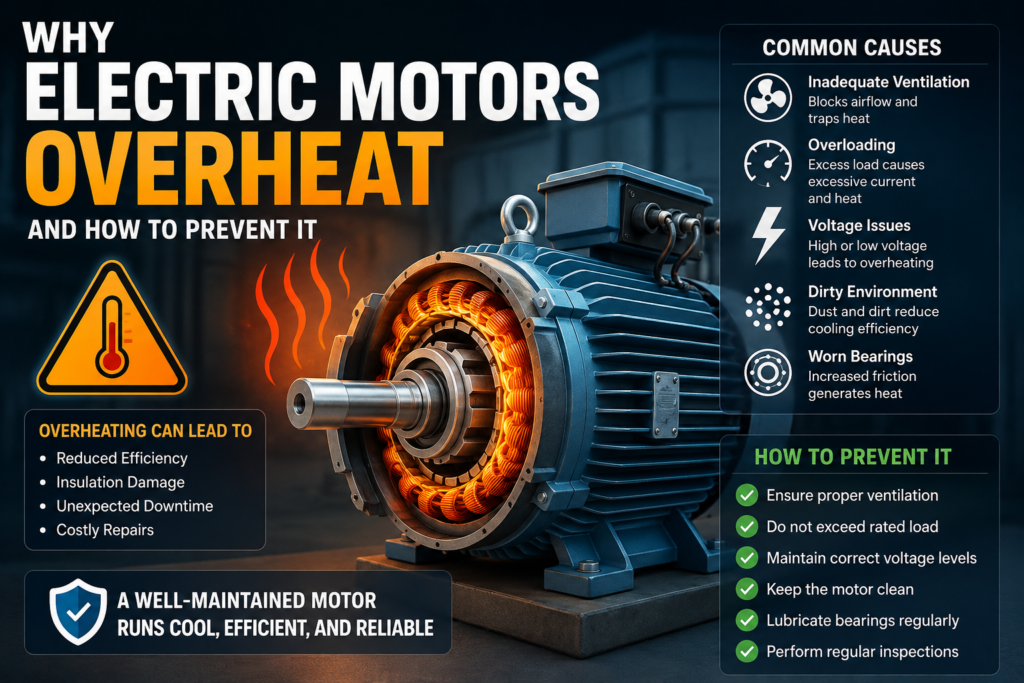
Motor overheating represents one of the most common and genuinely damaging problems affecting electric motors across industrial and household applications, often leading to premature failure if not properly understood and addressed. This article covers the main causes of motor overheating and practical prevention approaches.
Why Overheating Is So Damaging to Motors
Excessive heat degrades motor winding insulation progressively, and this degradation is cumulative and largely irreversible; even relatively brief periods of significant overheating can meaningfully shorten a motor’s operational lifespan, making overheating prevention a genuinely important consideration rather than a problem to address only after damage becomes apparent.
Sustained Overload: The Most Common Cause
Running a motor beyond its rated load capacity for extended periods, whether from an oversized mechanical load, a process demanding more than the motor was designed to handle, or gradual load increase over time, causes sustained excess current draw and corresponding heat generation beyond what the motor’s cooling design can adequately dissipate.
Phase Loss and Voltage Imbalance
As discussed in our dedicated motor protection article, losing one supply phase while a three-phase motor continues attempting to operate causes severely increased current in the remaining phases, and even smaller voltage imbalances across phases can cause meaningfully increased heating, both representing genuinely common and serious overheating causes worth actively monitoring for.
Poor or Blocked Ventilation
Most motors rely on airflow, either from external fans or the motor’s own rotation-driven cooling fan, to dissipate heat generated during operation; dust accumulation, blocked ventilation openings, or installation in poorly ventilated enclosures can significantly reduce cooling effectiveness even when the motor itself isn’t electrically overloaded.
Frequent Starting and Stopping
Motor starting draws significantly higher current than normal running operation, discussed in our star-delta starting article, generating substantial heat during each start; applications with very frequent starting and stopping cycles can accumulate heat faster than the motor can dissipate it between cycles, even if steady-state running conditions are otherwise normal.
Common Causes at a Glance
| Cause | Why It Generates Excess Heat |
|---|---|
| Sustained overload | Excess current draw beyond rated capacity |
| Phase loss/imbalance | Severely increased current in remaining phases |
| Blocked ventilation | Reduced heat dissipation despite normal operation |
| Frequent starting | Repeated high-current starting surges |
| Poor power quality | Harmonics and voltage issues increasing losses |
How Motor Protection Devices Help Prevent Overheating Damage
Thermal overload relays and other motor protection devices, discussed in depth in our dedicated motor protection article, are specifically designed to detect sustained overcurrent conditions indicating developing overheating and disconnect the motor before winding insulation damage occurs, providing an essential safeguard beyond simply hoping overheating doesn’t happen.
Practical Prevention Steps Worth Taking
- Ensure motors are properly sized for their actual application load, avoiding chronic overload conditions.
- Maintain clean, unobstructed ventilation through regular inspection and cleaning of cooling airflow paths.
- Install and properly calibrate motor protection devices, discussed in our dedicated protection article, to catch developing problems early.
- Monitor for phase loss or voltage imbalance through appropriate protection relays or periodic electrical checks.
- Consider VFDs or soft starters, discussed in our dedicated comparison articles, for applications with frequent starting to reduce starting-related heat accumulation.
Power Quality Issues as an Overlooked Overheating Contributor
Beyond the more commonly recognized causes discussed above, poor power quality, harmonic distortion, voltage fluctuations, or supply issues common in some grid environments, can meaningfully increase motor losses and heating even under otherwise normal loading conditions; this less obvious contributor is genuinely worth considering, particularly in settings with known power quality challenges, alongside the more commonly checked mechanical and electrical causes.
Common Misconceptions
- “A motor that’s still running is necessarily operating within safe temperature limits.” Motors can continue running for a period even while sustaining genuine cumulative insulation damage from excess heat.
- “Overheating is always caused by electrical problems rather than mechanical or environmental factors.” Blocked ventilation and mechanical load issues are equally common, genuinely significant overheating causes.
- “Motor protection devices alone are sufficient without addressing underlying causes.” Protection devices prevent catastrophic damage from detected conditions but don’t address root causes like chronic overload or poor ventilation.
Frequently Asked Questions
How can I tell if a motor is running hotter than normal without specialized equipment?
While specialized temperature measurement provides genuine precision, unusually hot-to-touch motor housings (used cautiously and briefly), unusual odors suggesting insulation stress, or noticeably increased noise can all suggest developing problems worth further investigation.
Does ambient temperature significantly affect motor overheating risk?
Yes, motors operating in already-hot environments have reduced cooling capacity margin, making them more vulnerable to overheating from causes that might not be as serious in cooler ambient conditions.
Can a motor recover fully after experiencing significant overheating, or is damage always permanent?
Insulation degradation from significant overheating is generally cumulative and not reversible, though a motor may continue functioning with reduced remaining lifespan rather than failing immediately after a single overheating event.
Final Thoughts
Motor overheating stems from several distinct, genuinely common causes, sustained overload, phase problems, blocked ventilation, and frequent starting cycles, each contributing to cumulative, largely irreversible insulation damage that shortens motor lifespan. Understanding these causes and implementing proper protection, sizing, and maintenance practices provides genuinely important protection for motor reliability and operational longevity.