
Artificial intelligence is no longer a distant, theoretical topic for electrical engineers; it is actively reshaping how power systems are monitored, how faults are predicted, and how engineers design and troubleshoot complex systems.
For Nigerian electrical engineering students and professionals, understanding where AI genuinely intersects with the field, rather than treating it as unrelated hype, is becoming an important part of staying competitive.
This article explains the concrete ways AI is changing electrical engineering practice and what it means for engineers building careers in Nigeria today.
AI in Power Systems Monitoring and Grid Management
Modern power grids generate enormous amounts of data from sensors, smart meters, and monitoring equipment, and AI-based systems are increasingly used to analyse this data for patterns that human operators would struggle to detect manually.
In more advanced grid systems globally, machine learning models help predict demand fluctuations, detect abnormal patterns that signal developing faults, and optimise load distribution across networks.
As Nigeria’s grid infrastructure gradually modernises, engineers working with GenCos, TCN, and DisCos are likely to encounter more AI-assisted monitoring tools integrated into their existing supervisory control and data acquisition systems.
Predictive Maintenance and Fault Detection
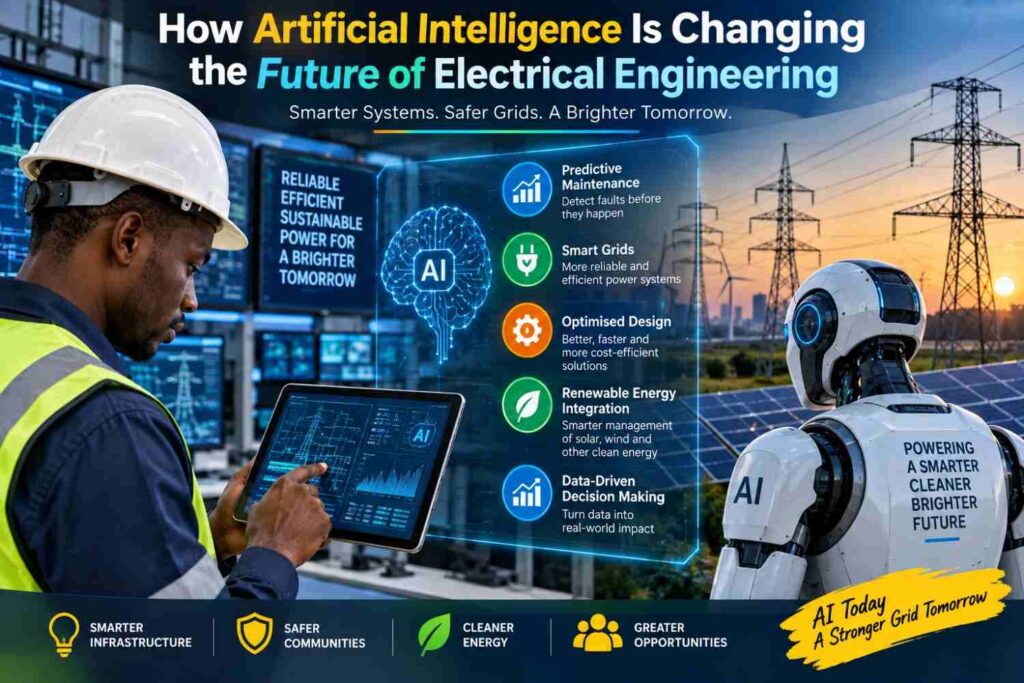
One of the most practically valuable applications of AI in electrical engineering is predictive maintenance, where sensor data from equipment such as transformers, motors, and generators is analysed to predict failures before they happen, rather than relying purely on scheduled maintenance intervals.
This shift from reactive or purely scheduled maintenance to predictive approaches can significantly reduce downtime and repair costs in industrial and power sector settings, an area particularly relevant to engineers working in manufacturing and oil and gas facilities where unplanned equipment failure is costly.
AI in Control Systems and Automation
Control and automation engineering, already a field built around systems that respond to real-time data, is a natural area for AI integration, with machine learning increasingly used to optimise control loops, improve process efficiency, and enable more adaptive automated systems than traditional fixed-logic controllers.
Engineers with strong PLC and control systems foundations, discussed further in our engineering software skills article, are well positioned to work with these more advanced systems as they become more common in Nigerian manufacturing and process industries.
Comparing Traditional and AI-Assisted Approaches
| Task | Traditional Approach | AI-Assisted Approach |
|---|---|---|
| Equipment maintenance | Fixed scheduled servicing intervals | Predictive maintenance based on real-time sensor data patterns |
| Fault detection | Manual inspection and reactive response | Automated anomaly detection flagging issues before failure |
| Load forecasting | Historical averages and manual estimation | Machine learning models incorporating multiple variables for more accurate forecasts |
| System design | Manual calculation and simulation | AI-assisted design tools that explore optimisation options faster |
AI’s Role in Solar and Renewable Energy Systems
Solar and battery storage systems increasingly incorporate AI-driven energy management, optimising when to draw from batteries versus solar generation versus the grid, based on usage patterns and weather forecasting.
For engineers involved in solar installation and system design, understanding these smarter energy management approaches, alongside the fundamental sizing and installation skills covered in our solar installation business article, adds valuable depth to their technical offering as clients increasingly ask about smarter, more efficient systems.
Skills Nigerian Engineers Should Build Now
- Basic data literacy, including comfort working with spreadsheets, sensor data, and simple statistical concepts.
- Familiarity with tools like MATLAB, which increasingly incorporate AI and machine learning toolboxes relevant to engineering applications.
- An understanding of how automation and control systems are evolving, even without becoming a dedicated AI specialist.
- Willingness to learn basic programming concepts, since many AI-assisted engineering tools require at least a working understanding of scripting or configuration.
- Staying current with how power and industrial sectors globally are adopting these tools, since Nigerian adoption often follows global trends with some delay.
What AI Is Not Likely to Replace
Despite genuine advances, AI is not close to replacing the core hands-on and judgment-based work electrical engineers perform, particularly in Nigeria’s infrastructure context where physical installation, site-specific troubleshooting, and practical decision-making under real-world constraints remain firmly human-driven tasks.
AI tools are best understood as assistants that enhance an engineer’s ability to monitor, predict, and optimise, not as replacements for the practical competence built through training, SIWES experience, and years of hands-on work.
Preparing for a Gradually Changing Field
Nigerian electrical engineering students and early-career professionals do not need to become AI specialists overnight, but building a general awareness of these trends, alongside strong fundamentals in power systems, control systems, or whichever specialisation they choose, positions them well as these tools become more common in local industry.
Engineering programs and professional development increasingly touch on these topics, and engineers who stay curious about how AI is applied within their specific specialisation will find themselves better prepared as adoption grows.
Common Misconceptions
- “AI will replace the need for electrical engineers.” AI tools assist with data analysis and prediction, but hands-on technical work, judgment, and site-specific problem-solving remain firmly within human expertise.
- “AI in electrical engineering is only relevant to advanced economies, not Nigeria.” As Nigerian power and industrial infrastructure modernises, AI-assisted monitoring and maintenance tools are gradually becoming more relevant locally.
- “You need to become a programmer to benefit from AI in this field.” Basic data literacy and an understanding of how these tools apply to your specialisation is often sufficient without becoming a dedicated software developer.
Frequently Asked Questions
Is AI already being used in Nigeria’s power sector?
Adoption is still developing compared to more advanced grids globally, but interest in smarter monitoring, forecasting, and maintenance tools is growing among Nigerian power sector operators.
Should electrical engineering students in Nigeria learn programming because of AI?
Basic programming and data literacy skills are increasingly useful, even for engineers who do not plan to specialise directly in AI or software development.
Which electrical engineering specialisations are most affected by AI right now?
Control and automation, power systems monitoring, and predictive maintenance in industrial and oil and gas settings are among the areas seeing the most practical AI integration currently.
Final Thoughts
Artificial intelligence is steadily changing how electrical engineers monitor systems, predict failures, and optimise performance, and Nigerian engineers who stay aware of these shifts within their chosen specialisation will be better positioned as adoption grows locally.
Rather than viewing AI as a threat to the profession, it is more accurate to see it as an evolving set of tools that enhances the analytical side of engineering work while leaving hands-on technical competence as valuable as ever. Building strong fundamentals alongside a working awareness of these trends is the most practical way to prepare for where the field is heading.