Ten years ago, almost every inverter battery in a Nigerian home was a tubular or flat-plate lead-acid unit, heavy, bulky, and needing regular water top-ups.
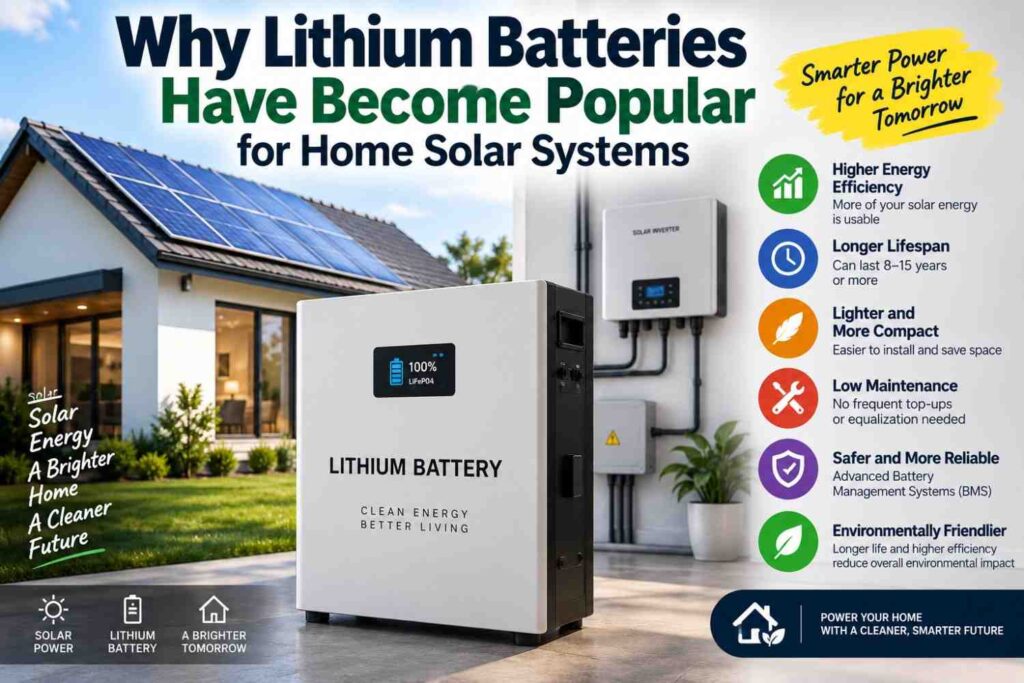
Today, lithium batteries have moved from being a premium curiosity to a mainstream choice for home solar and inverter systems, even though they cost more upfront.
This article looks at the specific reasons homeowners, installers, and solar companies have shifted toward lithium, beyond the general chemistry comparison already covered in our tubular vs lithium and lithium vs lead-acid articles.
Space and Weight Savings
A lithium battery storing the same usable energy as a tubular lead-acid battery is dramatically lighter and smaller, often less than half the weight and volume.
For homeowners retrofitting solar into an existing building, this matters enormously, since it means batteries can be mounted on walls, tucked into small utility spaces, or stacked in a cabinet rather than requiring a dedicated floor area strong enough to bear heavy lead-acid banks. Installers moving equipment up staircases in multi-storey homes or estates also find lithium far easier to work with.
Deeper Usable Capacity
Lithium batteries can typically be discharged much deeper than lead-acid batteries without shortening their lifespan, a concept explained fully in our dedicated depth of discharge article. In practical terms, this means a lithium battery rated at a certain Ah figure delivers significantly more usable energy day to day than a lead-acid battery of the same rating, because you are not forced to leave 50 percent or more of its capacity untouched to protect its lifespan.
For solar households trying to maximize backup time from a limited number of batteries, this difference alone can justify the higher purchase price.
Faster Charging From Solar Panels
Lithium batteries generally accept charge faster and more efficiently than lead-acid batteries, which matters a great deal in a solar setup where you are racing to top up the battery bank during limited daylight hours, especially during Nigeria’s rainy season when sunlight can be inconsistent for days at a time.
A lithium bank can often go from a low state of charge to nearly full within a shorter window of good sunlight, meaning less reliance on generator backup or the grid to finish charging.
Longer Cycle Life
Lithium batteries typically endure many more charge-discharge cycles before their capacity noticeably declines, a subject explored in detail in our dedicated cycle life article. While a decent tubular battery might be rated for a few hundred deep cycles, a good lithium battery can often be rated for two thousand cycles or more.
For a solar system that cycles the battery daily, this translates into a service life stretching well beyond what lead-acid can offer, which changes the long-term cost calculation even though the sticker price is higher.
Comparing the Practical Differences
| Factor | Typical Lead-Acid (Tubular) | Typical Lithium |
|---|---|---|
| Weight (for similar Wh) | Heavy | Roughly half or less |
| Usable depth of discharge | ~50 percent | 80 to 100 percent |
| Typical cycle life | 300 to 500 cycles | 1,500 to 3,000+ cycles |
| Charging speed | Slower, more current-sensitive | Faster, more efficient |
| Maintenance | Periodic water top-up (flooded types) | Sealed, no water top-up |
Lower Long-Term Cost Despite Higher Upfront Price
The naira cost of a lithium battery bank remains significantly higher than an equivalent lead-acid setup at the point of purchase, and this upfront gap is still the biggest reason many households stick with tubular batteries.
But when you divide the total cost by the number of usable cycles and factor in that lead-acid banks may need replacing two or three times over the same period a single lithium bank lasts, the cost per year of service often favors lithium, especially for households running daily inverter cycles rather than occasional backup.
Reduced Maintenance Burden
Sealed lithium batteries do not require the periodic distilled water top-ups that flooded tubular batteries need, and they are far less prone to the sulfation problems that come from irregular charging patterns common with unstable grid power.
For households where nobody remembers to check water levels every few months, or where the battery sits in a poorly ventilated store that is inconvenient to access, this reduced maintenance is a genuine practical advantage, not just a marketing point.
Built-In Safety Through the BMS
The rise of affordable, well-built Battery Management Systems, covered in our dedicated BMS article, has made lithium batteries far safer and more consumer-friendly than they were when the chemistry first became available.
A quality BMS protects against overcharge, over-discharge, and short circuits automatically, giving homeowners confidence that the battery will not be damaged by the kind of inconsistent charging patterns that unstable Nigerian grid power can produce.
Common Misconceptions
- “Lithium batteries are always the better choice regardless of budget.” Lead-acid remains a reasonable choice for lighter, occasional backup needs where the higher lithium upfront cost is not justified.
- “Lithium batteries never need any protective wiring or equipment.” A quality BMS and correctly matched inverter or charge controller are still necessary for safe lithium operation.
- “All lithium batteries on the market offer the same performance.” Build quality, BMS quality, and cell grade vary widely between brands, so price and reputation still matter when choosing a lithium battery.
Frequently Asked Questions
Is lithium always worth the extra cost for a Nigerian home solar system?
It depends on usage pattern; households that cycle their batteries daily tend to see the best return, while occasional backup users may not recoup the price difference as quickly.
Can lithium batteries work with an existing lead-acid inverter setup?
Many inverters can work with either, but you should confirm the inverter’s charging profile is compatible with lithium, since the two chemistries charge differently.
Do lithium batteries handle Nigeria’s heat better than lead-acid batteries?
A quality lithium battery with a good BMS generally tolerates heat reasonably well, though extreme, prolonged heat still accelerates aging in both chemistries.
Final Thoughts
Lithium batteries have become popular for home solar in Nigeria because they solve several practical problems at once, lighter weight, deeper usable capacity, faster charging, longer cycle life, and lower maintenance, even though the upfront naira cost remains higher than lead-acid.
For households that run their inverter systems daily and want to maximize backup time from a compact battery bank, the total cost of ownership increasingly favors lithium over the life of the system. The decision still depends on budget, usage pattern, and the quality of the specific battery and BMS chosen, so it is worth comparing real specifications rather than assuming lithium is automatically the right answer for every household.