
You switch off the light and walk away, but a few minutes later you notice the bulb still has a faint, ghostly glow. This is a common complaint with LED bulbs, and it often makes people worry that something is wrong with their wiring or that the bulb is faulty.
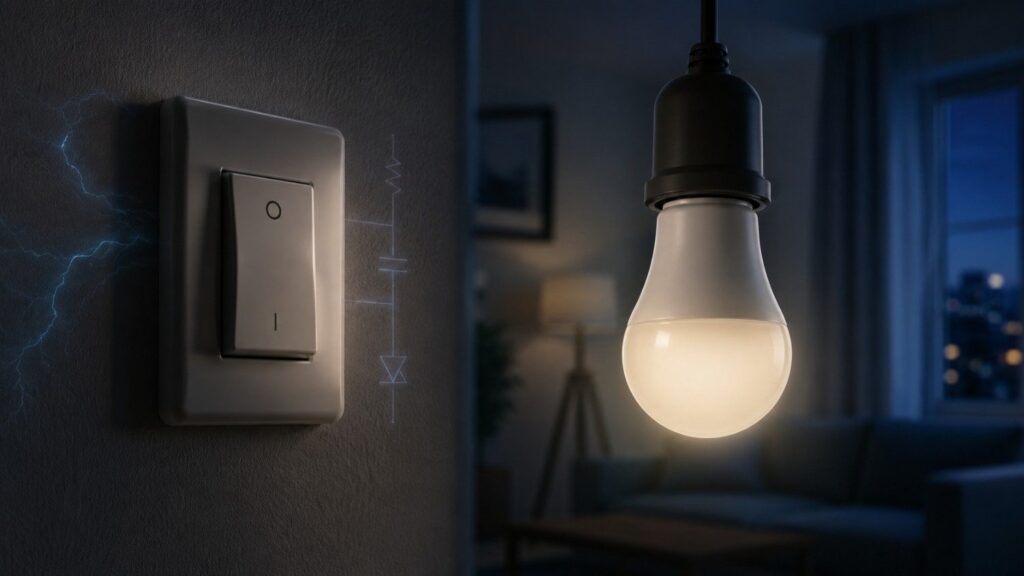
In most cases the cause is simple and harmless, related to how your switch and wiring interact with the sensitive electronics inside an LED. This article explains why it happens and how to stop it.
The Main Cause: Residual Current Leakage
LED bulbs are extremely sensitive to tiny amounts of electricity because their internal driver circuit only needs a very small current to produce a visible glow. When a switch is wired to interrupt only the live wire in a way that still allows a small leakage current to pass through the neutral or through capacitive coupling in the cable, that trace of current is enough to make the LED chip glow dimly, even though the switch is technically off. This is different from a genuine fault; it is simply a side effect of how low-power LED circuits respond to minute current levels that older incandescent bulbs would never have reacted to.
Common Wiring Situations That Cause This
- A switch wired with a neon or illuminated indicator that draws a small standby current through the bulb circuit.
- Long cable runs where capacitive coupling between the live and neutral conductors induces a tiny voltage even after the switch opens.
- A two-way switching arrangement (staircase wiring) where current can leak through the second switch position.
- Shared neutral wiring in older installations, common in many older Nigerian buildings, where the neutral is not fully isolated from other circuits.
- A dimmer switch that is not fully compatible with LED bulbs, leaving a trickle of current flowing even in the off position.
Is It Dangerous or Does It Damage the Bulb?
In the overwhelming majority of cases, the faint afterglow is not dangerous and does not meaningfully shorten the bulb’s lifespan. It simply means a very small leakage current, often measured in milliamps, is passing through the driver circuit. It does not indicate a short circuit or a fire risk on its own. However, if you notice unusually warm switches, a burning smell, or the glow becoming brighter over time rather than staying faint, that could point to a genuine wiring fault, and you should have a qualified electrician inspect the circuit rather than assume it is the harmless version of this issue.
How to Fix It: Practical Solutions
| Cause | Recommended Fix |
|---|---|
| Illuminated switch indicator | Replace with a standard non-illuminated switch |
| Long cable runs with capacitive leakage | Add a small bypass capacitor or resistor kit designed for LED bulbs |
| Two-way switching leakage | Ask an electrician to check the switch loop wiring for proper isolation |
| Incompatible dimmer switch | Replace with an LED-rated dimmer or a standard switch |
| Persistent glow despite fixes | Try a different LED bulb brand, since some drivers are more sensitive than others |
Step-by-Step: Diagnosing the Problem Yourself
- Turn off the circuit breaker for that room and confirm the glow disappears completely, which confirms it is a leakage issue rather than a fault elsewhere.
- Check whether the switch has a small indicator light or glow-in-the-dark strip, since these are the most common culprits.
- Try the same LED bulb in a different socket in the house to see if the glow persists, which helps isolate whether it is the bulb or the wiring.
- Try a different bulb brand or model in the original socket to rule out a particularly sensitive driver.
- If the glow only appears with two-way switching, note this and mention it specifically to your electrician, since it usually needs rewiring of the switch loop.
Why Older Bulb Types Never Showed This Problem
Incandescent bulbs needed a substantial current to heat the filament enough to glow visibly, so the tiny leakage currents that trigger LED afterglow were never enough to make an old-style bulb light up at all. Fluorescent bulbs also required a certain threshold of current to strike the gas inside the tube. LED chips, by contrast, can be driven to a faint but visible glow with currents thousands of times smaller, which is exactly why this issue became noticeable only after LED bulbs became widespread in Nigerian homes over the past decade.
When This Points to a Bigger Electrical Issue
While faint afterglow is usually harmless, it is worth taking seriously in older buildings where the wiring has never been inspected, since it can sometimes indicate poor earthing or a neutral that is not properly isolated. This is particularly relevant given Nigeria’s variable mains voltage of around 230V to 240V, which can stress old insulation and increase the chance of unwanted leakage paths. If you also notice flickering elsewhere in the house, warm switch plates, or breakers tripping occasionally, it is worth having a full inspection done, a topic covered in more depth in our electrical safety and protection devices article.
Common Misconceptions
- “A glowing bulb after switch-off means the bulb is faulty.” The bulb is usually fine; the glow is caused by tiny leakage current in the wiring or switch, not a defect in the LED itself.
- “This only happens with cheap LED bulbs.” Even reputable, well-made LED bulbs can glow faintly because they are simply more sensitive to small currents than older bulb technologies.
- “It means the house is at risk of fire.” The leakage currents involved are tiny, far below what is needed to generate heat or ignite anything, so on their own they are not a fire hazard.
Frequently Asked Questions
Will this residual glow increase my electricity bill?
No, the leakage current is extremely small, typically a fraction of a milliamp, and its contribution to your electricity consumption is negligible.
Can I fix this without calling an electrician?
Simple cases caused by an illuminated switch or a sensitive bulb can often be fixed by swapping the switch or bulb yourself, but wiring-related causes like two-way switch loops are safer left to a qualified electrician.
Does using a stabilizer or inverter make this worse?
Not typically, since the glow is caused by wiring leakage rather than voltage level, though some inverter output waveforms can occasionally interact differently with sensitive LED drivers.
Final Thoughts
A faintly glowing LED bulb after you switch it off looks alarming but is usually nothing more than a harmless side effect of small leakage currents finding their way through the wiring or switch. The fix is often as simple as replacing an illuminated switch or trying a different bulb brand.
Pay closer attention only if the glow grows brighter over time, coincides with warm switches, or appears alongside other electrical symptoms in the house. In most Nigerian homes, a quick swap of the switch or bulb resolves the issue completely, restoring true darkness when the light is off.