
LED bulbs are marketed for their long lifespan, often rated for tens of thousands of hours, so it can be frustrating when a bulb that seemed perfectly bright a few months ago now looks noticeably dimmer.
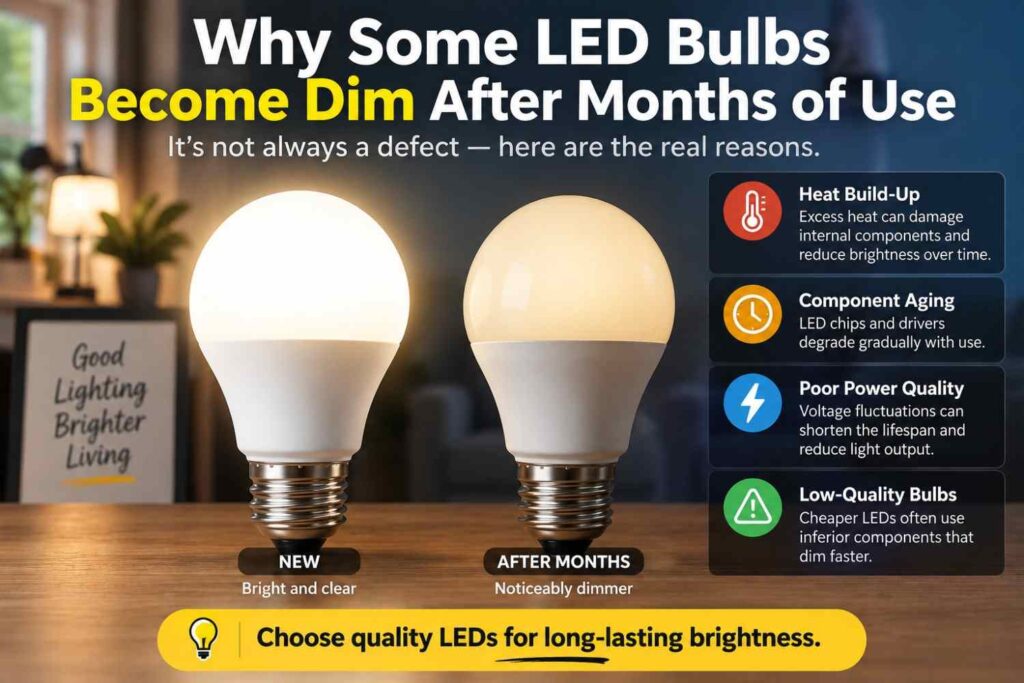
This gradual dimming, known in the industry as lumen depreciation, is a real phenomenon with identifiable causes, some of which are normal aging and others of which point to poor quality components or unstable power supply. This article explains why it happens and what you can do about it.
What Lumen Depreciation Actually Means
Unlike incandescent bulbs, which tend to work at full brightness until the filament suddenly snaps and the bulb fails completely, LED bulbs typically fade gradually over their lifespan rather than failing abruptly. Manufacturers rate LED lifespan based on the point at which output has dropped to 70 percent of its original brightness, a threshold known as L70 in the industry. This means some dimming over time is expected and normal, but the rate at which it happens depends heavily on build quality, heat management, and the power supply conditions the bulb operates under.
Main Causes of Premature Dimming
- Poor heat dissipation, since excessive heat is the single biggest factor that accelerates LED chip degradation over time.
- Low quality LED chips that degrade faster than premium chips even under identical operating conditions.
- Frequent exposure to voltage above the rated tolerance, which stresses the driver circuit and the LED chip together.
- Poor driver circuit design that fails to regulate current steadily, causing uneven stress on the LED over time.
- Enclosed fittings with inadequate ventilation, which trap heat around the bulb and speed up degradation.
- Continuous long-duration use without any rest, particularly relevant for security lights left on many hours nightly.
Why Heat Is the Biggest Enemy of LED Longevity
LED chips are far more efficient than incandescent filaments, but they are also more sensitive to heat buildup at the chip level, which is somewhat counterintuitive given how much cooler LED bulbs feel to the touch compared to incandescent bulbs. The heat generated at the LED junction, if not properly conducted away through the bulb’s heat sink, gradually degrades the phosphor coating and semiconductor material, reducing light output faster than the manufacturer’s rated lifespan would suggest. This is why cheap bulbs with minimal heat sink material tend to dim noticeably faster than well-built bulbs with proper aluminum heat sinks.
Comparing Causes and Fixes
| Cause | Typical Sign | Fix |
|---|---|---|
| Poor heat dissipation | Bulb feels very hot, dims within weeks | Use bulbs with proper heat sinks, avoid fully enclosed fittings |
| Low quality LED chip | Dims noticeably within a few months | Buy from reputable, certified brands |
| Voltage fluctuation stress | Multiple bulbs across the house dim together | Install a voltage stabilizer |
| Poor driver design | Uneven or flickering brightness before dimming | Replace with a bulb from a trusted manufacturer |
| Enclosed fitting | Bulb overheats even though it is a good brand | Switch to open or well-ventilated fittings |
The Role of Nigeria’s Voltage Fluctuations
In areas where mains voltage regularly swings outside the standard 230V to 240V range, LED drivers are placed under repeated stress that most consumer-grade bulbs are not fully designed to withstand over the long term. Even when a voltage spike is not severe enough to cause immediate failure, repeated exposure gradually degrades the driver’s components and can accelerate lumen depreciation across the bulb’s lifespan. This is one of the main reasons why identical LED bulbs can perform very differently depending on the DisCo supply quality in different parts of the country, and it strengthens the case for using a stabilizer, a topic explored further in our voltage fluctuation and surge protection article.
Step-by-Step: Diagnosing Premature Dimming
- Note when the bulb was installed and compare its current brightness to your memory or a photo from when it was new.
- Check whether the fitting is fully enclosed or has adequate airflow around the bulb.
- Feel the bulb’s base or heat sink after it has been on for a while; excessive heat suggests poor heat dissipation.
- Check if other bulbs across the house are also dimming, which would point toward a voltage supply issue rather than an isolated bulb problem.
- Consider the brand and price point of the bulb, since unbranded budget bulbs are more prone to premature dimming than reputable certified products.
How to Extend the Useful Life of Your LED Bulbs
Choosing bulbs from established brands with visible heat sink fins, avoiding fully sealed enclosed fittings for high-wattage bulbs, and installing a stabilizer where voltage fluctuation is a known issue are the most effective steps toward slowing lumen depreciation. It also helps to avoid running bulbs continuously for very long stretches where possible, particularly in fittings without good ventilation. For households relying on inverter power during outages, using good quality inverters with clean output waveforms also reduces additional stress on LED drivers, a subject covered in our inverters and batteries article.
Common Misconceptions
- “LED bulbs should stay at full brightness until they suddenly fail.” Gradual dimming over time, known as lumen depreciation, is a normal and expected characteristic of LED technology, unlike the sudden failure typical of incandescent bulbs.
- “All LED bulbs dim at the same rate regardless of brand.” Build quality, chip quality, and heat sink design vary significantly between brands, causing real differences in how fast bulbs lose brightness over time.
- “A dim LED bulb is always close to complete failure.” A bulb can remain functional and usable for a long time even after noticeable dimming, since dimming and complete failure are separate stages in an LED’s life.
Frequently Asked Questions
How much dimming is considered normal for an LED bulb over its lifetime?
Manufacturers generally consider a drop to about 70 percent of original brightness as the end-of-useful-life point, so gradual, slow dimming toward that level over years is expected.
Can a dim LED bulb be restored to full brightness?
No, lumen depreciation from LED chip and phosphor aging is not reversible, so a bulb that has dimmed significantly needs to be replaced rather than repaired.
Does using a bulb in an enclosed fitting really make that much difference?
Yes, enclosed fittings trap heat around the bulb, and since heat is the primary driver of premature LED degradation, bulbs in poorly ventilated enclosures often dim noticeably faster than identical bulbs in open fittings.
Final Thoughts
Some gradual dimming in LED bulbs is a normal part of how the technology ages, but noticeably fast dimming within months usually points to a specific and often fixable cause, whether that is poor heat dissipation, low build quality, or unstable mains voltage.
Paying attention to fitting ventilation, buying from reputable brands, and protecting your circuits with a stabilizer where needed will help your LED bulbs hold their brightness for years rather than months. Recognizing the early signs of premature dimming also helps you catch a wider power supply issue before it affects other appliances in the home.