
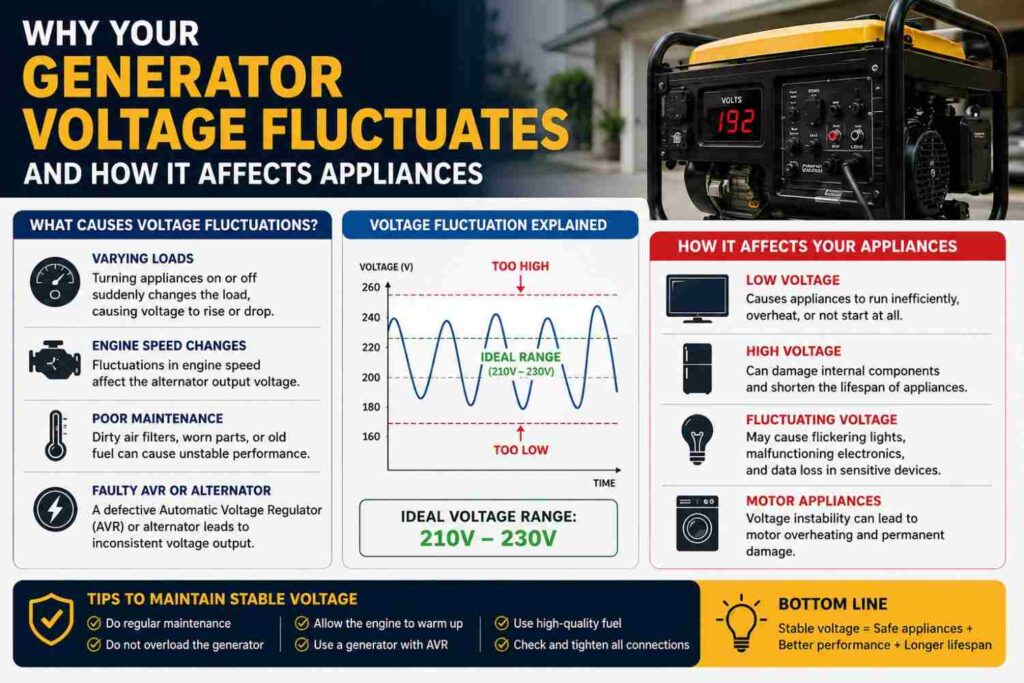
Generator voltage fluctuation, where the electricity your generator delivers rises and falls noticeably rather than remaining steady, is a genuinely common issue affecting many households and businesses, and understanding its causes helps you both address it and appreciate why it’s not something to simply tolerate as normal generator behavior. This article explains what’s really happening and how it affects your connected appliances.
Why Voltage Should Actually Stay Relatively Stable
A properly functioning generator should deliver voltage within a fairly narrow, stable range around its rated output (typically close to 230V for standard Nigerian residential single-phase supply), similar to grid power’s expected stability; noticeable, ongoing fluctuation beyond this normal range indicates something isn’t functioning as it should, whether in the generator itself or in how it’s being used.
1. A Failing or Poorly Functioning AVR
The Automatic Voltage Regulator, covered in depth in our dedicated AVR article, is specifically responsible for maintaining stable output voltage as load conditions change; a failing, aging, or poorly maintained AVR is one of the most common causes of voltage fluctuation, since this is literally the component’s core job, and its failure directly manifests as unstable output.
2. Load Changes Without Adequate Compensation
Every time a significant appliance switches on or off, particularly motor-driven devices with substantial starting surge, a healthy generator’s AVR should compensate quickly to maintain stable voltage; a generator running near its capacity limit, or with a struggling AVR, may show noticeable voltage dips or spikes specifically correlating with these load changes rather than maintaining consistent output.
3. Engine Speed Instability
Generator output voltage is directly tied to engine rotational speed remaining consistent; an engine with governor issues, worn components, or fuel delivery problems causing speed fluctuation will produce corresponding voltage fluctuation, since these two factors are mechanically and electrically linked in how a generator produces its output.
4. Generator Running Near or Beyond Rated Capacity
As discussed in our dedicated overloading article, a generator consistently run near or beyond its rated capacity struggles to maintain stable voltage under these strained conditions, since it’s being asked to deliver more than it was designed to comfortably provide, a common cause traced directly back to improper sizing discussed in our generator sizing article.
5. Poor Fuel Quality or Fuel System Issues
Contaminated or poor-quality fuel, or fuel system issues like a clogged filter or failing fuel pump, can cause inconsistent engine performance and, consequently, voltage instability, an often overlooked cause worth investigating particularly if fluctuation coincides with fuel source changes.
Why Voltage Fluctuation Genuinely Damages Connected Appliances
Sustained overvoltage stresses appliance components and can shorten their lifespan, discussed in our dedicated bulb lifespan article, while undervoltage can cause motors to run inefficiently, overheat, and in some cases fail prematurely from insufficient starting torque; genuinely unstable, fluctuating voltage is often more damaging than consistently high or low voltage, since components experience repeated stress cycles rather than a single, at least predictable, condition.
A Diagnostic Table
| Symptom Pattern | Likely Cause |
|---|---|
| Fluctuation correlates with specific appliances switching on/off | AVR struggling to compensate, or generator near capacity |
| Fluctuation is constant, unrelated to load changes | Engine speed instability or AVR failure |
| Fluctuation worsens over time or with generator age | Aging/failing AVR or general wear |
| Fluctuation coincides with fuel refills or fuel source changes | Fuel quality or fuel system issue |
Protecting Your Appliances While Addressing the Root Cause
While diagnosing and fixing the underlying voltage instability, using a quality voltage stabilizer or surge protector, discussed in our dedicated surge protector article, for particularly sensitive electronics provides a meaningful protective buffer, though this should be treated as a temporary mitigation rather than a substitute for actually addressing the generator’s underlying fluctuation issue.
When to Call a Qualified Generator Technician
Persistent voltage fluctuation not resolved by basic checks, ensuring the generator isn’t overloaded and fuel quality is adequate, warrants professional inspection, particularly to assess AVR function and engine performance using proper diagnostic equipment rather than continuing to operate a generator with an unresolved, potentially appliance-damaging fault.
Why Regular Servicing Catches Most of These Issues Early
A consistent generator servicing schedule, checking AVR function, engine performance, and fuel system condition at regular intervals rather than only after problems become noticeable, catches most of the underlying causes of voltage fluctuation discussed throughout this article while they’re still minor and inexpensive to address, rather than allowing them to develop into more serious, costly faults.
Common Misconceptions
- “Some voltage fluctuation is just normal for generators.” A properly functioning generator with a healthy AVR should maintain reasonably stable voltage; persistent fluctuation indicates a genuine issue worth addressing.
- “Voltage fluctuation only matters for sensitive electronics.” Motor-driven appliances and even simple resistive devices can be affected by significant, sustained voltage instability over time.
- “If the generator still runs and provides power, fluctuation isn’t a real problem.” Fluctuation can cause gradual, cumulative appliance damage even while the generator continues technically functioning.
Frequently Asked Questions
Can I test my generator’s voltage stability myself?
A basic multimeter can give you readings at different times and load conditions to get a general sense of stability, though proper diagnostic testing of the AVR and engine specifically requires a qualified technician’s equipment and expertise.
Does generator brand or price point affect voltage stability?
Generally yes; higher-quality generators with better-engineered AVR systems and more robust engines tend to maintain more stable voltage than budget units, though proper maintenance matters for any generator regardless of initial quality.
Is it worth replacing just the AVR rather than the whole generator?
Often yes, if the AVR is specifically identified as the fault and the rest of the generator remains in good condition; a qualified technician can assess whether AVR replacement alone resolves the issue cost-effectively.
Final Thoughts
Generator voltage fluctuation is a genuine, diagnosable issue with specific underlying causes, not something to accept as an unavoidable quirk of generator power. Understanding these causes, from AVR health to proper sizing and fuel quality, helps you both protect your connected appliances and address the root problem rather than simply working around persistently unstable power.