
A small amount of warmth in electrical wiring during normal operation is often nothing to worry about, but knowing exactly where the line sits between “normal” and “dangerous” is a piece of knowledge every homeowner should have.
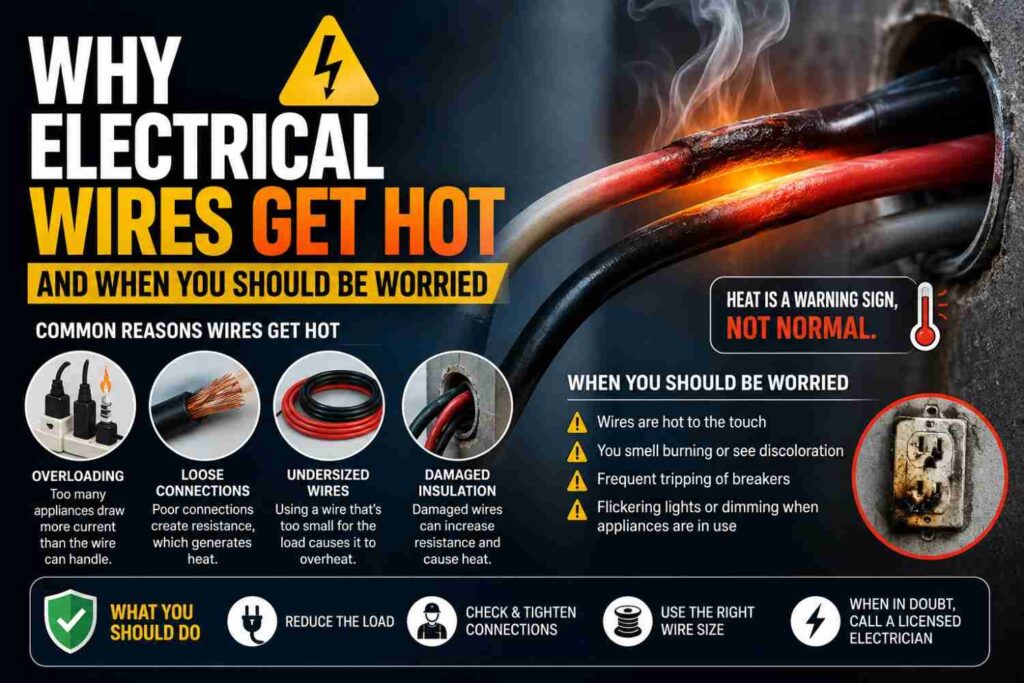
This article explains, in practical terms, why electrical wires heat up at all, what level of warmth is expected, what level signals a genuine problem, and what steps to take if you discover a hot wire, socket or cable in your home.
Why Wires Get Warm at All: The Basic Physics
Every conductor, no matter how good, has some electrical resistance, and whenever current flows through a resistance, some energy converts to heat, following the formula P = I²R, explained in depth in our voltage, current, resistance and power article. This means that some heating is a completely normal, unavoidable consequence of current flow, and properly sized cables are specifically designed and rated to dissipate this normal heat safely into the surrounding air without their temperature climbing to dangerous levels.
What “Normal” Warmth Feels Like
A cable or connection carrying its rated current, properly installed, might feel slightly warm to a brief touch, particularly a cable feeding a high-power appliance like a water heater or air conditioner running continuously. This mild warmth, if consistent and not increasing over time, is generally not a cause for concern. The important distinction is between mild, stable warmth and noticeable heat that continues rising, feels distinctly hot rather than warm, or is accompanied by other warning signs described below.
Warning Signs That Indicate a Genuine Problem
- Distinctly hot to the touch, not merely warm, especially if you need to pull your hand away quickly
- A burning or plastic smell near the wire, socket or connection point, covered in more depth in our dedicated article on that specific warning sign
- Visible discoloration of the socket faceplate, plug, or cable insulation, often yellowing, browning or scorching
- Buzzing, crackling or sizzling sounds from a socket, switch or connection
- Sparking when plugging or unplugging a device
- A cable or connection that has become noticeably hotter over time under the same load, rather than staying stable
Any of these signs warrants immediate attention: switch off and unplug the affected circuit if it is safe to do so, and contact a qualified electrician rather than continuing to use the circuit.
Common Causes of Genuinely Hot Wires
1. Undersized Cable for the Connected Load
As covered in our dedicated cable sizing article, a cable too small for the current it is carrying will run hotter than its design allows, since I²R heating scales with current relative to the conductor’s cross-sectional area. This is one of the most common root causes of genuinely problematic wire heating.
2. Loose Connections
A loose connection at a socket, switch, junction box or terminal concentrates resistance at that single point rather than distributing it evenly along the cable, causing localized overheating that can be dramatically worse than the surrounding cable, even though the cable itself might be perfectly adequately sized. Loose connections often develop gradually over time due to vibration, thermal expansion and contraction cycles, or simply an initially imperfect installation.
3. Overloaded Circuits
Drawing more current than a circuit was designed for, discussed extensively in our dedicated circuit overload article, directly increases heating throughout the affected wiring, connections and protective devices.
4. Poor Quality or Counterfeit Cable
Substandard cable, sometimes sold with cross-sectional area or insulation quality misrepresented relative to genuine, standards-compliant product, may run hotter than expected for a given current even when apparently correctly sized on paper, a genuine and unfortunately not uncommon problem in some markets.
5. Aging and Degraded Insulation
Insulation naturally degrades over time, particularly under repeated thermal cycling, UV exposure for outdoor cabling, or general age, gradually reducing its ability to safely contain heat and maintain proper electrical isolation, making older wiring more susceptible to heating problems even under loads it previously handled without issue.
How to Safely Check for Hot Wiring
- Visual inspection first: Look for discoloration, melted plastic, or visible damage before touching anything.
- Brief touch test on accessible, exposed surfaces only: A quick touch (never prolonged contact) on an accessible socket faceplate or cable jacket can indicate a problem, but should never be relied upon as a substitute for proper testing on anything you suspect may be seriously faulty.
- Infrared thermometer or thermal camera: Increasingly affordable and accessible, these tools allow non-contact temperature measurement, which is both safer and more precise than touch alone, and are commonly used by professional electricians during inspections.
- Professional inspection: For any suspected serious issue, or before continuing to use a circuit showing warning signs, a qualified electrician can perform proper testing, including checking connection tightness and measuring actual current draw under load.
Why Connection Points Are the Most Common Failure Location
It is worth emphasizing that the cable itself, if correctly sized and installed, is often not where heating problems originate; connection points, sockets, switches, junction boxes and terminals are disproportionately common failure locations, because these are the points where resistance can most easily increase due to loosening, corrosion, or poor initial installation quality. This is why a hot socket, even with apparently adequate cable feeding it, should never be dismissed as a wiring gauge issue alone without checking the connection itself, and why periodic tightening and inspection of connections is a standard part of professional electrical maintenance, particularly in older installations.
Nigeria-Specific Considerations
In the Nigerian context, several factors can compound wire heating risks beyond the general causes described above. Higher ambient temperatures, particularly during hot seasons, reduce the safety margin cables have before reaching unsafe operating temperatures, meaning a cable that ran acceptably during cooler months may show heating problems during peak heat. Voltage fluctuations common on some parts of the grid can also indirectly stress connections and appliances, sometimes contributing to accelerated wear at vulnerable connection points. Additionally, informal or unlicensed electrical work, unfortunately not uncommon in some residential and commercial buildings, increases the likelihood of undersized cable, poor connections, or non-compliant materials being used in the first place, making a professional inspection particularly valuable for properties with an uncertain electrical work history.
What to Do If You Find a Hot Wire or Socket
| Situation | Recommended Action |
|---|---|
| Mildly warm, stable, no other symptoms | Monitor; mention to an electrician at next routine check |
| Noticeably hot but no smell, sound or damage | Reduce load on that circuit; schedule electrician visit soon |
| Hot with burning smell, discoloration, or sound | Switch off circuit immediately; call electrician urgently |
| Sparking or visible flame | Cut power at the main breaker if safe; evacuate if necessary; call for help |
Preventing Wire Heating Problems Before They Start
Prevention is considerably easier and cheaper than dealing with a developed heating problem or, worse, its consequences. Practical preventive steps include having a qualified electrician verify that circuits are appropriately sized for their connected loads whenever significant new appliances are added, periodically checking (or having checked) that socket and switch connections remain tight, particularly in older properties, avoiding daisy-chained extension cords and overloaded multi-plug adapters, and choosing cable and accessories from reputable suppliers to reduce the risk of substandard materials. For properties with electrical installations more than a decade or two old, or with an uncertain installation history, a periodic professional electrical inspection, sometimes called an electrical installation condition report in other markets, can identify developing problems, including early-stage heating issues at connections, well before they become dangerous or cause visible damage.
How This Connects to Circuit Protection Devices
While hot wires and loose connections are not always directly detected by standard circuit breakers, proper protection devices remain an essential layer of defense against the more severe consequences of heating problems. A correctly rated breaker will still trip in response to the elevated current associated with a developing short circuit, which can sometimes result from severely degraded insulation at a chronically overheated point. Residual current devices (RCDs), discussed in our dedicated RCD versus RCBO versus MCB article, add further protection against earth leakage faults that can develop as insulation deteriorates, making a combination of correctly sized cable, tight connections, and appropriate protective devices the complete, layered approach to minimizing wire heating risk in any installation.
Common Misconceptions
- “If a wire feels hot but the breaker hasn’t tripped, it must be fine.” Breakers protect against overload and short-circuit current levels; they do not necessarily detect localized heating at a loose connection carrying otherwise normal current.
- “Only old wiring gets dangerously hot.” New installations can develop hot spots too, particularly from poor workmanship, substandard materials, or connections that were never properly tightened.
- “A little heat is always fine as long as nothing has caught fire yet.” Sustained, worsening heat degrades insulation over time even without an immediate dramatic failure, meaning “nothing has happened yet” is not the same as “nothing is wrong.”
When to Call an Electrician Immediately vs Schedule a Visit
Not every warm wire requires an emergency call-out, but knowing the difference matters. Immediate action, including switching off the affected circuit and calling for urgent help, is warranted for any sparking, visible flame, burning smell, or wiring that is hot enough to be uncomfortable to touch even briefly. A scheduled, non-emergency visit is generally appropriate for mild, stable warmth noticed during routine use, or a single instance of a breaker tripping without other symptoms. When in doubt, erring on the side of caution and switching off the affected circuit while awaiting professional assessment is always the safer choice, since the inconvenience of temporarily losing power to one circuit is minor compared to the potential consequences of continuing to use genuinely faulty wiring.
Frequently Asked Questions
Is it normal for an extension cord to feel warm when running a heavy appliance?
Mild warmth under heavy, rated load can be normal for a properly sized extension cord, but distinctly hot cord, especially at the plug or socket ends, suggests the cord may be undersized for the load or developing a connection fault, and should be addressed promptly.
Can a hot wire be a sign of a problem even if my lights and appliances are working fine?
Yes. Heating problems, particularly at connection points, can develop and worsen gradually while connected equipment continues to function apparently normally, right up until a more serious fault or failure eventually develops.
How quickly can a hot wire actually start a fire?
This varies enormously depending on severity, surrounding materials and conditions, ranging from a slow, gradual insulation degradation over months or years, to a rapid escalation within minutes under severe fault conditions; the unpredictability itself is part of why prompt attention to warning signs matters.
Should I be more concerned about hot wires in the wall versus hot extension cords?
Both deserve attention, but wiring concealed within walls is arguably more concerning since problems can develop unseen for longer, and any fire risk is closer to combustible building materials; concealed wiring issues should always be assessed by a qualified electrician rather than guessed at.
Does using LED bulbs instead of incandescent reduce wire heating risk?
LED bulbs draw significantly less current than equivalent incandescent bulbs for the same light output, which modestly reduces heating in lighting circuits specifically, though this has little bearing on heating risks in circuits feeding higher-power appliances like air conditioners or water heaters.
Can weather or humidity make wire heating problems worse?
Yes, in some cases. High humidity can accelerate corrosion at connection points, which increases resistance and therefore heating at that specific point over time, while very high ambient temperatures reduce the overall margin a cable has before reaching unsafe operating temperatures, making both extremes worth factoring into an honest assessment of an installation’s condition, particularly for outdoor or semi-exposed wiring.
Final Thoughts
Learning to distinguish normal, expected warmth from genuinely dangerous heating is one of the most practically valuable pieces of electrical safety knowledge any homeowner can develop. While mild, stable warmth under load is often unremarkable, escalating heat, discoloration, smells or sounds are signals worth taking seriously and acting on promptly, ideally with the help of a qualified electrician, since the cost of an inspection is almost always far smaller than the potential cost of an unaddressed electrical fire risk.