
A battery that once comfortably ran your fridge, fans, and lights through a three-hour outage might, two or three years later, struggle to last even one hour, even though nothing about your appliances has changed.
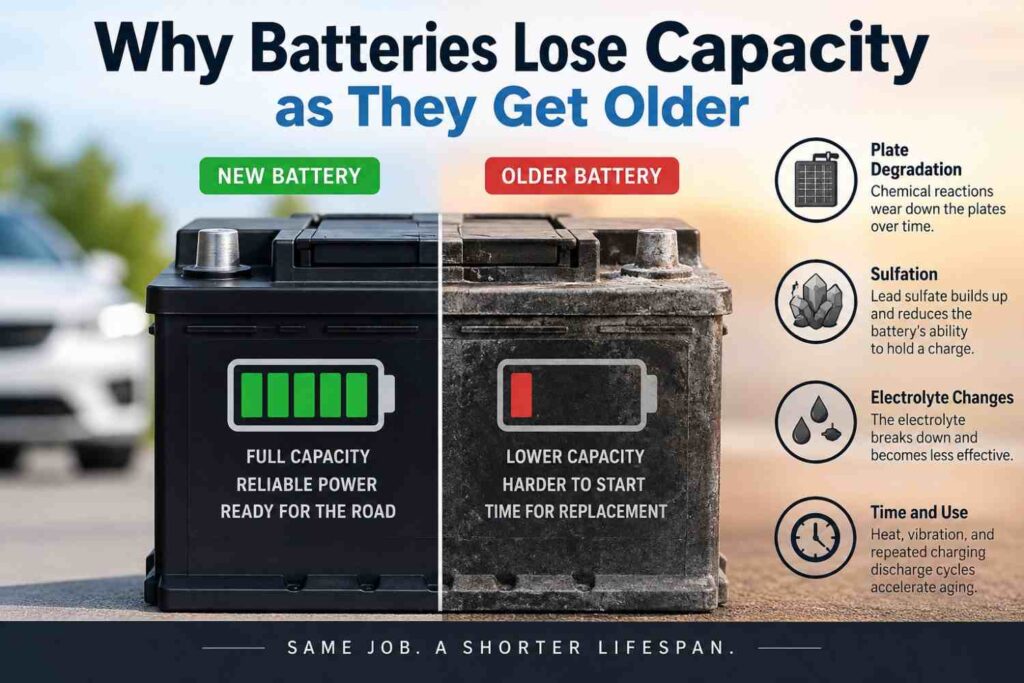
This gradual decline is called capacity fade, and it happens to every battery chemistry, lead-acid and lithium alike, just for somewhat different underlying reasons.
Understanding what is actually happening inside an aging battery helps you recognize normal wear from a genuine fault, and helps you know when a battery has reached the point discussed in our dedicated article on knowing when to replace a battery.
What Capacity Fade Actually Means
Capacity fade is the gradual, permanent reduction in the maximum amount of energy a battery can store compared to when it was new. A battery rated at 200Ah when purchased might only be able to deliver the equivalent of 160Ah after a few years of use, even though it still charges and discharges normally.
This is a normal, expected process for every rechargeable battery; the question is never whether a battery will lose capacity over time, only how fast and how much.
Why Lead-Acid Batteries Lose Capacity
In lead-acid batteries, the main culprit is a process called sulfation, where lead sulfate crystals form on the battery plates during discharge.
Under normal operation, these crystals dissolve back into the electrolyte during charging, but if a battery sits partially discharged for extended periods, or is repeatedly undercharged, the crystals harden and become difficult to reverse.
Over time, hardened sulfation permanently reduces the plate area available for the chemical reaction that stores energy, directly reducing usable capacity.
Plate corrosion and gradual loss of active material from repeated charge-discharge cycling also contribute, especially in flooded batteries that experience temperature swings common across Nigeria.
Why Lithium Batteries Lose Capacity
Lithium batteries age differently, through a combination of chemical side reactions inside the cell that gradually consume the lithium ions responsible for storing charge, and physical changes to the electrode materials that reduce their ability to hold those ions.
Every charge and discharge cycle causes a small amount of this wear, which is why cycle count matters so much for lithium batteries, a relationship explained in our dedicated cycle life article.
Heat significantly accelerates these lithium aging reactions, which is one reason a good Battery Management System, covered in its own dedicated article, actively monitors temperature to slow this process down.
Two Types of Aging: Cycle Aging and Calendar Aging
| Aging Type | What Drives It | Occurs Even If Unused? |
|---|---|---|
| Cycle aging | Number and depth of charge-discharge cycles | No, requires active use |
| Calendar aging | Time, temperature, and storage state of charge | Yes, happens even in storage |
This distinction matters because a battery can lose meaningful capacity even if it is barely used, simply from sitting in storage, especially in a hot environment or left at a very high or very low state of charge for long stretches.
Factors That Accelerate Capacity Loss in Nigerian Conditions
- High ambient heat, especially in poorly ventilated battery rooms or direct sun exposure, which speeds up both lead-acid corrosion and lithium chemical aging.
- Frequent deep discharges beyond the recommended depth of discharge for the battery’s chemistry.
- Irregular or incomplete charging caused by unstable grid power or undersized solar arrays that never fully top up the battery.
- Long periods left in a low state of charge during extended outages or when a household is away.
- Poor ventilation trapping heat generated by the battery itself during charging and discharging.
Can Capacity Loss Be Slowed Down?
While capacity fade cannot be stopped entirely, it can be slowed with reasonable care. Keeping batteries in a cool, well-ventilated location rather than a sealed hot store, avoiding letting a battery sit fully discharged for extended periods, charging fully and promptly after each significant discharge, and using a quality charge controller or inverter that charges correctly for the battery’s chemistry all help extend the years before capacity fade becomes noticeable.
For lithium batteries specifically, a good BMS handles much of this protection automatically, which is part of why lithium has grown popular for home solar systems, as covered in our dedicated article on that trend.
How to Notice Capacity Fade Before It Becomes a Problem
The clearest sign of capacity fade is a battery that reaches full charge in less time than it used to but also runs down faster than it used to under the same load.
Households that pay attention to roughly how long their inverter used to last during outages, and notice that runtime shrinking over months, are picking up on capacity fade in real time.
This gradual decline is different from sudden failure or swelling, covered in our dedicated battery swelling article, which usually signals a more acute problem rather than normal aging.
Common Misconceptions
- “A battery that loses capacity is faulty and should be returned under warranty.” Gradual capacity fade is normal aging, not a defect, though a sudden sharp drop early in a battery’s life may indicate a genuine fault.
- “Batteries only age when they are being used.” Calendar aging happens even in storage, driven mainly by time, heat, and the state of charge the battery is left at.
- “Once a battery starts losing capacity, nothing can be done to slow it further.” Better charging habits, cooler storage, and avoiding deep discharges can meaningfully slow the remaining rate of capacity loss.
Frequently Asked Questions
How much capacity loss per year is considered normal?
It varies by chemistry and conditions, but many lead-acid batteries lose noticeable capacity within two to three years, while quality lithium batteries with good management often retain strong capacity for five years or more.
Does leaving a battery on float charge constantly cause faster aging?
Prolonged time at a very high state of charge can contribute to calendar aging in some chemistries, though modern chargers and BMS units are designed to minimize this effect.
Can a battery with reduced capacity still be useful?
Yes, a battery that has lost some capacity can still provide backup power, just for a shorter duration than when new, and many households continue using such batteries for lighter loads before full replacement.
Final Thoughts
Capacity fade is an unavoidable part of every battery’s life, driven by sulfation and corrosion in lead-acid cells and by chemical and physical wear in lithium cells, with heat and poor charging habits accelerating both.
Understanding cycle aging versus calendar aging helps explain why even a lightly used battery can weaken over time simply from sitting in storage under harsh conditions.
While you cannot stop capacity loss entirely, cooler storage, prompt recharging, and avoiding excessive deep discharge all help stretch out the years before a battery’s shrinking runtime becomes a real inconvenience.
Paying attention to gradually shortening backup time is the best early warning sign that a battery is aging, well before it fails outright.