
Flip over any solar panel and you will find a small metal label packed with abbreviations like Voc, Vmp, Isc, and Imp, followed by numbers that mean very little to most first-time buyers.
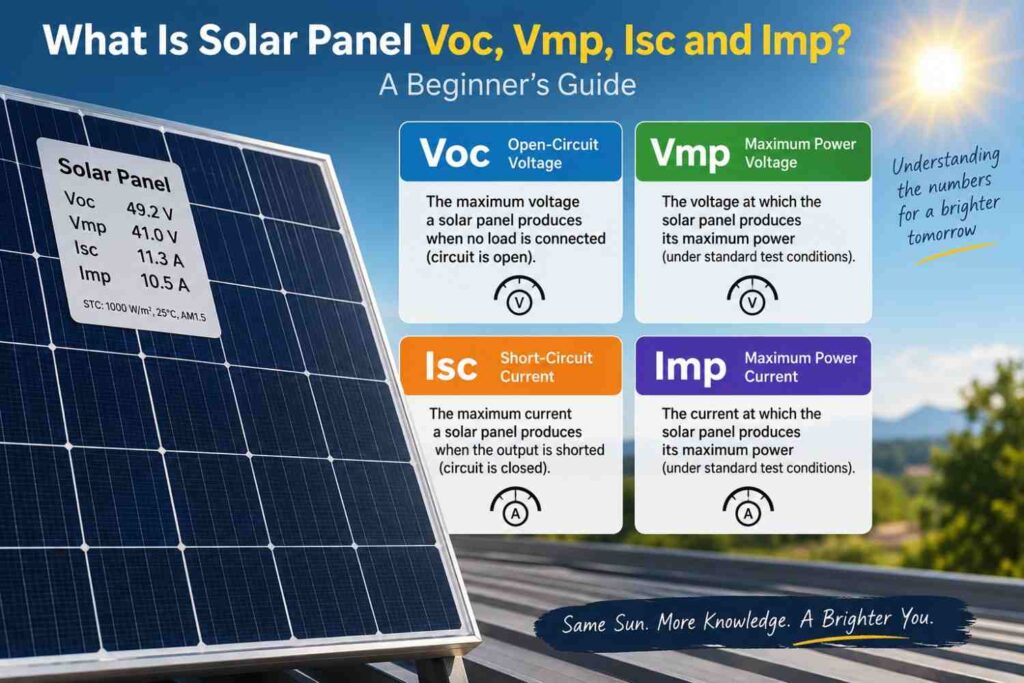
These four specifications are actually the key to correctly wiring a solar array, matching panels to a charge controller, and avoiding equipment damage from an oversized or mismatched string.
This article breaks down what each term means in plain language and how to actually use them.
Voc: Open Circuit Voltage
Voc stands for open circuit voltage, and it is the voltage a panel produces when it is not connected to any load at all, just the panel sitting in sunlight with its terminals open. This is the highest voltage the panel will ever produce, typically measured on a cool, bright morning.
Voc matters most when wiring panels in series, since the individual Voc values of each panel add together, and the total must stay safely below the maximum input voltage your charge controller or inverter can handle. Exceeding that limit can permanently damage the equipment.
Vmp: Voltage at Maximum Power
Vmp, or voltage at maximum power, is the voltage the panel actually produces once it is connected to a load and operating at its most efficient point, generating the most power it can. It is always somewhat lower than Voc, because the moment current starts flowing, voltage naturally drops.
Vmp is the number that matters for real-world performance, since it reflects what the panel delivers during actual operation rather than an idealized no-load condition.
Isc: Short Circuit Current
Isc stands for short circuit current, the maximum current a panel produces when its positive and negative terminals are connected directly to each other with no resistance in between. Like Voc, this is a theoretical maximum rather than the panel’s normal operating condition.
Isc is critical for sizing fuses and for wiring panels in parallel, since parallel-connected panels add their currents together, and the combined Isc must stay within what your charge controller, combiner box fusing, and cabling can safely handle.
Imp: Current at Maximum Power
Imp, current at maximum power, is the actual current the panel delivers while operating at its most efficient point under load, working alongside Vmp.
Multiplying Vmp by Imp gives you the panel’s rated wattage, which is why these two figures together tell you far more about real performance than Voc and Isc alone. When installers calculate expected system output, Vmp and Imp are the numbers doing the real work.
| Term | Full Name | What It Represents | Used For |
|---|---|---|---|
| Voc | Open Circuit Voltage | Maximum possible voltage, no load | Series wiring limits |
| Vmp | Voltage at Maximum Power | Actual operating voltage under load | Real performance estimates |
| Isc | Short Circuit Current | Maximum possible current, no resistance | Parallel wiring and fuse sizing |
| Imp | Current at Maximum Power | Actual operating current under load | Real performance estimates |
How These Figures Affect Series and Parallel Wiring
These four specifications are the practical foundation behind the series versus parallel wiring decisions covered in our dedicated article. In a series string, individual panel voltages add up while current stays the same, so you must track total Voc against your charge controller’s maximum input voltage rating.
In a parallel configuration, individual panel currents add up while voltage stays the same, so total Isc becomes the number to watch against your controller’s maximum current rating and your cable and fuse sizing. Getting these sums wrong is one of the most common causes of a charge controller tripping, underperforming, or failing outright.
Why These Numbers Change with Temperature
All four values shift with temperature, and Voc in particular drops as panel temperature rises. This is why installers calculate series string sizing using the panel’s rated Voc at cold temperatures, since a cool early morning can actually push voltage higher than the standard test condition rating, and stacking too many panels in series without accounting for this can push total voltage above the safe limit on a cold morning even if it looked fine on paper at room temperature.
How to Use This Information When Buying or Wiring a System
- Check your charge controller or inverter’s datasheet for its maximum input voltage and maximum input current.
- Add up the Voc of all panels in a series string and confirm the total stays comfortably below the controller’s maximum voltage, including a safety margin for cold mornings.
- Add up the Isc of all panels in a parallel group and confirm the total stays within the controller’s maximum current rating.
- Use Vmp and Imp, not Voc and Isc, to estimate the actual wattage your array will deliver day to day.
- Keep panels in the same series string matched in Voc and Vmp specifications to avoid mismatched performance.
Common Misconceptions
- “Voc is the voltage the panel produces normally while powering my system.” Voc is a no-load figure that only applies when the panel is disconnected from any load; actual operating voltage is Vmp, which is lower.
- “Isc tells me how much current my appliances will actually receive.” Isc is a theoretical maximum under short circuit conditions; the real operating current under load is Imp.
- “These specifications only matter for large commercial installations.” Even a small two or three panel home system depends on these numbers to wire safely and match the charge controller correctly.
Frequently Asked Questions
Where can I find these specifications for my panel?
They are printed on the specification label on the back of the panel and also listed in the manufacturer’s datasheet, usually available from the seller or online.
What happens if total series voltage exceeds my charge controller’s rating?
It can permanently damage the charge controller, so this limit should never be exceeded, particularly accounting for higher Voc on cold mornings.
Do Voc and Isc change as the panel ages?
Yes, slightly, as panels degrade over their lifespan, output including these values gradually declines, a topic covered further in our panel lifespan article.
Final Thoughts
Voc, Vmp, Isc, and Imp might look like intimidating abbreviations on a panel label, but they answer four very practical questions: how much voltage and current your panel can produce at its absolute limits, and how much it actually delivers during normal operation.
Understanding the difference between the no-load and under-load figures is what allows a system to be wired safely, whether by a professional installer or a hands-on homeowner double-checking the work.
Before wiring any array in series or parallel, take a few minutes to check these four numbers against your charge controller’s rated limits rather than assuming any combination of panels will simply work.