
Walk into any solar shop in Nigeria and you will hear salesmen throw around efficiency numbers like 18 percent, 21 percent, or even 23 percent, often implying that a higher number is automatically the better buy. Efficiency is a real and useful specification, but it is also one of the most misunderstood numbers on a solar panel datasheet.
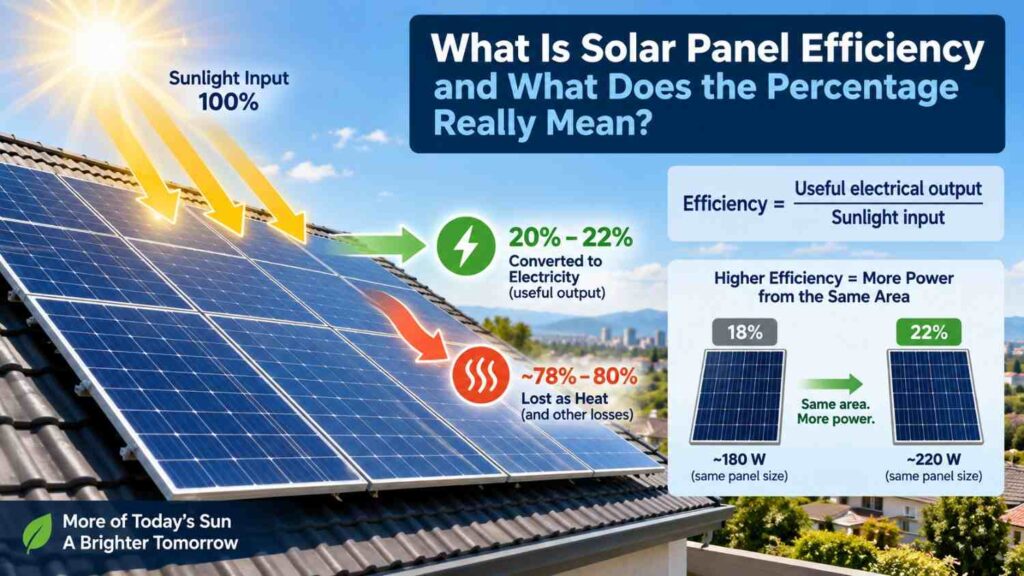
This article explains exactly what the efficiency percentage measures, why it matters less than most buyers assume, and when it genuinely should influence your purchase decision.
What Solar Panel Efficiency Actually Measures
Solar panel efficiency is the percentage of sunlight energy hitting the panel’s surface that gets converted into usable electricity. If a panel is rated 20 percent efficient, it means that out of every 1,000 watts of sunlight falling on one square metre of that panel under standard test conditions, 200 watts comes out as electrical power.
The rest is lost to reflection, heat, and the natural limitations of the silicon cells themselves. This figure is measured in a laboratory under fixed conditions of sunlight intensity, cell temperature, and light spectrum, so it is a standardized comparison tool rather than a guarantee of real-world output.
Why Efficiency Numbers Differ Between Panels
Efficiency is largely determined by the type of solar cell used, a topic covered in depth in our dedicated panel types article. Monocrystalline panels generally sit at the higher end of the efficiency range because their single-crystal silicon structure allows electrons to move with less resistance.
Polycrystalline panels, made from multiple silicon fragments melted together, are usually a few percentage points lower. Newer cell technologies such as PERC or bifacial designs can push efficiency even higher by capturing light that would otherwise be lost or by harvesting reflected light from the back of the panel as well.
Efficiency vs Physical Size vs Total Output
The most common mistake buyers make is treating efficiency as a stand-in for total power output. It is not. A 400-watt panel and a 450-watt panel of the same physical dimensions will have different efficiency ratings, but if you have unlimited roof space, a slightly less efficient panel that costs less per watt can be a smarter financial decision than paying a premium for a higher efficiency rating you do not actually need. Efficiency only becomes a decisive factor when roof space is genuinely limited and you need to squeeze maximum output from a fixed area.
| Efficiency Range | Typical Panel Type | Best Suited For |
|---|---|---|
| 15 to 17 percent | Older or budget polycrystalline | Large open roofs, ground mounts |
| 18 to 20 percent | Standard monocrystalline | Most residential installations |
| 21 to 23 percent | Premium mono or PERC/bifacial | Small roofs, high-value space |
What Affects Real-World Efficiency in Nigeria
The lab-tested efficiency number assumes ideal conditions, but Nigerian rooftops rarely deliver ideal conditions all year round. Panel temperature is the biggest factor: silicon cells actually lose efficiency as they get hotter, and Nigeria’s climate regularly pushes panel surface temperatures well above the 25 degrees Celsius used in standard testing.
Dust accumulation, especially during the Harmattan season, and shading from nearby buildings or trees also reduce the effective efficiency a panel delivers day to day, issues covered more fully in our articles on shading and panel cleaning. Good ventilation behind the panel and regular cleaning help preserve as much of that rated efficiency as possible.
Does Higher Efficiency Justify a Higher Price?
Not automatically. A one or two percentage point efficiency gain often comes with a noticeably higher price tag, and the extra cost only pays for itself if space constraints genuinely require fewer, more powerful panels.
For a typical Nigerian home or small business with a decent-sized roof, mid-range efficiency panels from a reputable brand usually offer better value than chasing the highest efficiency number on the shelf.
Where roof space is tight, such as on a small bungalow trying to power a substantial load, paying more for higher efficiency can be the difference between fitting the required capacity or not.
How to Compare Panels Properly
- Check the wattage rating alongside efficiency, not efficiency alone.
- Compare price per watt across brands rather than price per panel.
- Confirm the panel dimensions against your available roof or ground space.
- Look at the temperature coefficient, since a panel that loses less output as it heats up performs better in Nigeria’s climate regardless of its base efficiency figure.
- Verify the warranty terms, since a cheap high-efficiency panel with a short warranty may cost more in the long run.
Common Misconceptions
- “A higher efficiency percentage always means a better panel.” Efficiency is only one factor; total wattage, price per watt, temperature performance, and warranty matter just as much for most buyers.
- “Efficiency tells you how much electricity a panel will produce in a day.” Efficiency is a percentage of sunlight converted under lab conditions, not a direct measure of daily energy yield, which depends on wattage, sun hours, and system losses too.
- “Low efficiency panels are simply defective or fake.” Lower efficiency is usually just a characteristic of the cell technology used, such as standard polycrystalline cells, and does not mean the panel is faulty.
Frequently Asked Questions
What is considered a good efficiency rating for panels sold in Nigeria today?
Anything from 18 to 21 percent is considered solidly good for residential use, with premium panels reaching into the low 20s.
Does panel efficiency drop over time?
Yes, all panels degrade gradually with age, typically by less than one percent per year, a topic covered in more detail in our panel lifespan article.
Should I choose panels purely based on the highest efficiency available?
No, match the efficiency to your actual space constraints and budget rather than defaulting to the highest number on offer.
Final Thoughts
Solar panel efficiency is a genuinely useful specification, but it answers a narrower question than most buyers assume: how much power can this panel squeeze out of a given surface area, not how good or reliable the panel is overall.
For most homes and businesses in Nigeria with reasonable roof space, prioritizing total wattage, price per watt, and build quality will deliver better value than chasing the highest efficiency percentage on the market.
Reserve the premium high-efficiency panels for situations where space really is the limiting factor, and let your installer walk you through the trade-offs before you commit to a specific brand.