
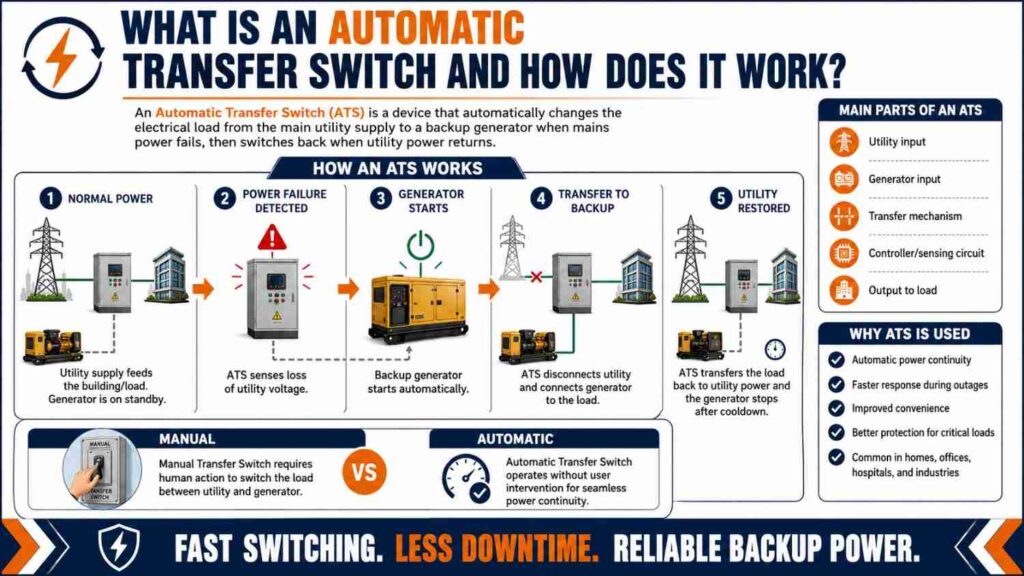
An automatic transfer switch, commonly abbreviated ATS, is the piece of equipment that makes seamless, hands-free switching between power sources possible, and understanding exactly how it works helps you appreciate both its convenience and the genuine safety function it serves. This article explains what an ATS actually does and how it accomplishes it.
The Core Problem an ATS Solves
Without an ATS, switching between grid power, generator power, and battery/inverter power requires manual intervention, physically operating a changeover switch, discussed in our dedicated manual vs automatic comparison, at the exact right moments, a process that’s inconvenient, easy to forget or delay, and during unexpected outages, means your home genuinely loses power until someone manually intervenes, potentially at an inconvenient time like the middle of the night.
How an ATS Actually Detects a Power Loss
An ATS continuously monitors your primary power source (typically grid power) for voltage and frequency within acceptable parameters; when it detects the primary source has failed or dropped outside these acceptable parameters, it initiates the switching process automatically, without requiring any human observation or action.
The Actual Switching Sequence
- Detection: The ATS detects primary power has failed or become unacceptable.
- Disconnection: It disconnects your home’s circuits from the failed primary source, a critical safety step preventing backfeeding, discussed in our generator-and-inverter article.
- Generator start signal (if applicable): For generator-integrated ATS systems, it sends a signal to automatically start the generator if it isn’t already running.
- Stabilization wait: The system waits briefly for the backup source (generator or battery inverter) to stabilize to acceptable voltage and frequency.
- Connection to backup source: Your home’s circuits are connected to the now-stable backup power source.
- Reverse process on restoration: When primary power returns and stabilizes, the ATS reverses this process, switching back to primary power and, if applicable, signaling the generator to shut down after a brief cooldown period.
Why the Disconnection Step Is the Genuinely Critical Safety Function
The moment of disconnecting from the failed source before connecting to the backup source is what prevents backfeeding, ensuring your backup power never has a path back into grid lines (a genuine hazard to utility workers during outages) and that two unsynchronized AC sources are never simultaneously connected to your home’s circuits, the same safety concern discussed in our generator-and-inverter compatibility article.
ATS for Generators vs ATS for Inverter/Battery Systems
While the core switching principle is similar, ATS systems designed for generator integration include the generator start/stop signaling described above, while ATS functionality for battery inverter systems is often built directly into the inverter itself, automatically switching to battery power the moment grid power fails, without a separate physical ATS unit necessarily being required, an important distinction when comparing quotes or understanding your specific system’s actual configuration.
A Comparison of ATS Benefits vs Manual Switching
| Factor | Automatic Transfer Switch | Manual Changeover Switch |
|---|---|---|
| Speed of switching | Seconds, immediate | Depends on how quickly someone responds |
| Requires someone present | No | Yes |
| Cost | Higher | Lower |
| Risk of human error | Minimal | Present (forgetting to switch back, incomplete switching) |
| Complexity | More complex installation | Simpler installation |
Why Proper Installation and Sizing Matter
An ATS must be properly sized for your home’s total electrical load and correctly installed by a qualified electrician to function safely and reliably; improper installation can compromise the very safety function the ATS is meant to provide, making this an area where professional installation, rather than DIY attempts, is genuinely important given the safety stakes involved.
What Regular ATS Testing Actually Involves
Periodic testing, often through a simulated outage triggered deliberately rather than waiting for a genuine grid failure, confirms your ATS correctly detects the loss, executes the full switching sequence, and properly reverses the process once primary power is simulated as restored, catching any developing mechanical or electrical issues with the switch itself before you’re depending on it during an actual, unplanned outage.
Common Misconceptions
- “An ATS eliminates the need for a generator to have its own separate controls.” An ATS integrates with and signals your generator but doesn’t replace the generator’s own operational systems; both work together.
- “Any electrician can properly install an ATS without specific experience.” Given the safety-critical nature of proper backfeeding prevention, experience specifically with transfer switch installation is genuinely valuable, not just general electrical qualification.
- “ATS systems never require any maintenance once installed.” Like any electromechanical system, periodic testing and maintenance helps ensure an ATS continues functioning correctly when actually needed during a genuine outage.
Frequently Asked Questions
How quickly does an ATS typically switch power sources?
Generally within a few seconds for grid-to-battery switching (often fast enough that sensitive electronics don’t even notice), while grid-to-generator switching takes somewhat longer, typically 10-30 seconds, to allow time for the generator to start and stabilize.
Can an ATS fail, leaving me without automatic switching during an outage?
Like any equipment, an ATS can potentially fail, which is why periodic testing (many are tested through a simulated outage) and choosing quality, properly installed equipment reduces this risk, though no system is entirely immune to potential failure.
Is an ATS worth the additional cost compared to a manual switch for a typical household?
This depends on how much you value the convenience and reliability of automatic switching versus cost savings; households experiencing frequent outages, or those wanting power restored automatically even when no one is home to operate a manual switch, often find the additional cost worthwhile.
Final Thoughts
An automatic transfer switch performs a genuinely valuable dual function: convenient, seamless power source switching without requiring manual intervention, and critically, the safety-essential disconnection step that prevents dangerous backfeeding between power sources. Understanding this dual role helps explain why quality ATS equipment and proper professional installation are worth the investment for households wanting both convenience and safety in their backup power setup.