
“Overload” is a word thrown around casually in everyday conversation about electricity, usually right before a breaker trips or a fuse blows. But what is actually happening, physically, inside a wire or a circuit breaker at the moment of an overload?
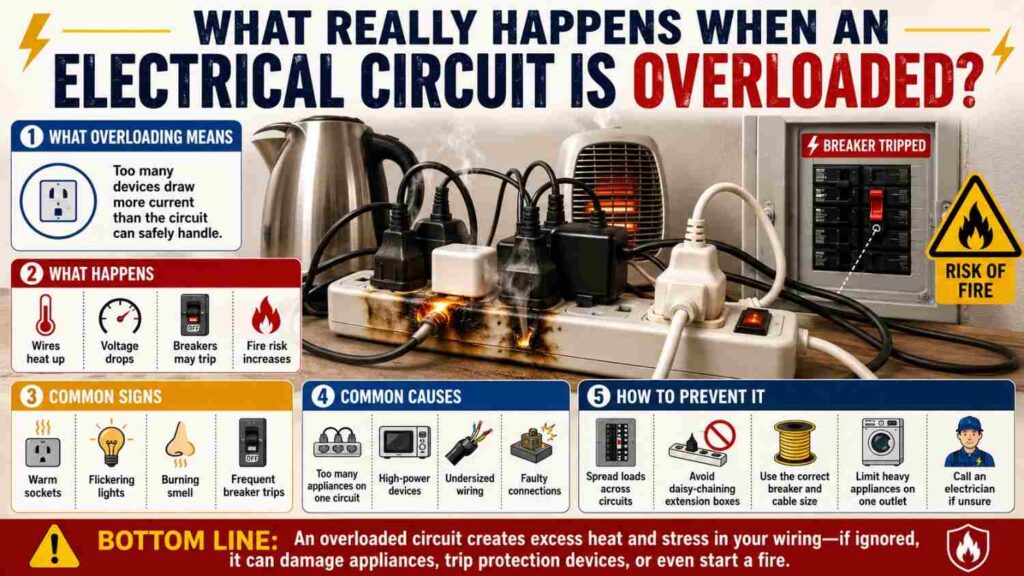
Understanding this process in detail explains not just why breakers trip, but why overloaded circuits are genuinely dangerous, why they are one of the leading causes of electrical fires, and what you can do to avoid creating one in your own home.
What Does “Overload” Actually Mean?
An electrical overload occurs when the current flowing through a circuit exceeds the safe rated capacity of the wiring, breaker, or connected equipment. Every circuit, cable and protective device is designed to carry a specific maximum current safely and continuously; when the total current demanded by connected appliances exceeds that rating, the circuit is overloaded.
This is different from a short circuit, which is a sudden, near-instantaneous fault caused by an unintended low-resistance connection (such as bare live and neutral wires touching), producing an extremely high current spike almost immediately. An overload, by contrast, is typically a more gradual condition caused by simply drawing more current than the circuit was designed for, often by connecting too many appliances to the same circuit.
What Physically Happens Inside an Overloaded Wire
Every conductor has some electrical resistance, and whenever current flows through it, some energy is converted to heat according to the formula P = I²R, discussed in more depth in our article on voltage, current, resistance and power. Cables are designed and rated with a maximum continuous current (ampacity) specifically because, beyond that point, the heat generated exceeds what the cable’s insulation and surrounding environment can safely dissipate.
When a circuit is overloaded, several things happen in sequence:
- Current exceeds the cable’s rated ampacity, causing heat generation to increase beyond the cable’s safe dissipation capacity.
- The cable’s temperature begins rising steadily, since heat is being generated faster than it can escape into the surrounding air or building material.
- As temperature rises, the cable’s resistance typically increases slightly too (most conductors’ resistance rises with temperature), which in turn increases heat generation further — a mild but real compounding effect.
- If the condition persists, the insulation surrounding the conductor can begin to soften, degrade, or in severe and prolonged cases, melt or ignite, particularly if the cable is bundled tightly with others, run through insulation material, or otherwise unable to dissipate heat effectively.
- Properly functioning protective devices, primarily circuit breakers or fuses, are designed to detect this excess current and interrupt the circuit before insulation damage or fire occurs — but only if they are correctly rated and functioning, and only if the person has not bypassed them by using an oversized fuse or breaker.
How Circuit Breakers and Fuses Respond to Overload
Modern circuit breakers typically use a thermal or thermal-magnetic tripping mechanism specifically designed to respond differently depending on the severity of excess current:
- Thermal response (for moderate overloads): A bimetallic strip inside the breaker heats up and bends as excess current flows through it over time, eventually triggering the trip mechanism. This response is deliberately time-delayed — a small, brief overload might not trip the breaker at all, while a larger or more sustained overload trips it more quickly, mimicking how cables themselves heat up gradually.
- Magnetic response (for severe overloads/short circuits): A very large, sudden current surge, typical of a short circuit rather than a gradual overload, triggers an electromagnetic mechanism that trips the breaker almost instantly, well before significant heat has time to build up.
Fuses work on a related but simpler principle: a thin metal element inside the fuse is designed to melt and break the circuit once current exceeds its rated value for a sufficient duration, permanently sacrificing itself in the process, which is why blown fuses must be physically replaced rather than simply reset like a breaker.
Common Causes of Circuit Overload in Homes
- Too many high-power appliances on one circuit: Running an air conditioner, kettle, iron and microwave simultaneously on the same circuit can easily exceed its rated capacity, even if each appliance individually seems modest.
- Overuse of extension cords and adapter blocks: “Octopus” style multi-plug adapters make it easy to connect far more total load to a single socket and circuit than it was ever designed to carry.
- Undersized wiring for the intended load: Older installations, or wiring not updated as appliance loads have grown over time, may simply be undersized relative to modern electricity demand, discussed further in our dedicated cable sizing guide.
- Bypassed or incorrectly rated protection devices: Installing a breaker or fuse rated higher than the wiring it protects defeats the safety margin the system was designed with, allowing dangerous overload conditions to persist without tripping.
Warning Signs of an Overloaded Circuit
Several warning signs can indicate a circuit is chronically overloaded, even before a breaker trips or a fault fully develops:
- Circuit breakers that trip repeatedly, particularly when certain combinations of appliances are used together
- Warm or discolored wall sockets, switches or extension boxes
- A persistent burning smell near sockets, switchboards or extension cords, covered in more depth in our dedicated article on that specific warning sign
- Lights that dim noticeably when a large appliance switches on
- Buzzing or crackling sounds from sockets or the distribution board
Any of these signs warrants prompt attention, ideally from a qualified electrician, since continuing to use a circuit showing these symptoms significantly increases fire risk over time.
A Worked Example: How Overload Happens in Practice
Consider a typical 15A circuit, rated for a maximum continuous load of approximately 15A × 230V = 3,450W. If a household connects a 1,500W air conditioner, an 800W microwave, and a 1,200W kettle to that same circuit and runs them simultaneously, the total load reaches 3,500W — slightly exceeding the circuit’s rating, drawing roughly 15.2A. While this specific example is only marginally over the limit and might not trip a breaker instantly, sustained or repeated overloads like this cause cumulative thermal stress on the wiring and connections over time, gradually degrading insulation and connection integrity even without an immediate dramatic failure, which is precisely why chronic mild overloading is often more insidious than a single obvious dramatic event.
Why Overloaded Circuits Are a Leading Cause of Electrical Fires
Electrical fires caused by overloaded circuits typically develop through a combination of the mechanisms described above: sustained excess heat gradually degrades insulation, increasing the risk of a short circuit or arcing fault at a weakened point, particularly at connections, joints, or wherever a cable is bent, pinched or physically stressed. Loose connections at sockets, switches or terminals are especially vulnerable, since a loose connection concentrates resistance (and therefore heat) at that single point rather than distributing it along the cable, often leading to localized overheating and charring well before the rest of the circuit shows any obvious signs of stress, which is why electrical fires often start at a specific socket, junction box or connection point rather than along the length of an otherwise healthy cable.
How to Prevent Circuit Overload
- Distribute high-power appliances across multiple circuits rather than concentrating them on one, particularly kitchen appliances, air conditioners and water heaters.
- Avoid daisy-chaining multiple extension cords and adapter blocks, especially for high-power appliances.
- Have a qualified electrician assess your home’s wiring capacity if you have added significant new appliance load (such as air conditioning) since the original wiring was installed.
- Ensure breakers and fuses are correctly rated for the wiring they protect, and never replace a tripped breaker or blown fuse with a higher-rated one simply to “stop it tripping” without addressing the underlying cause.
- Have periodic electrical inspections for older properties, particularly if warning signs described above have been noticed.
Overload vs Short Circuit: Key Differences
| Feature | Overload | Short Circuit |
|---|---|---|
| Cause | Excess connected load | Unintended low-resistance fault path |
| Current rise | Gradual, moderate | Sudden, extreme |
| Breaker response | Thermal (time-delayed) | Magnetic (near-instant) |
| Typical warning signs | Warmth, dimming, repeated tripping | Sudden trip, possible sparking/bang |
How Generators and Inverters Respond to Overload Differently From Grid Circuits
Overload protection works somewhat differently for backup power sources like generators and inverters compared to standard grid-connected household circuits. Generators typically include their own overload protection, often a dedicated breaker separate from the household distribution board, and may also exhibit a noticeable drop in output voltage and frequency, or audibly labor and change engine sound, as they approach or exceed their rated capacity, providing an additional practical warning sign beyond the breaker itself. Inverters generally respond to overload electronically, and many modern units will display a specific overload warning or error code and automatically shut down or limit output to protect their internal power electronics from damage, since these components are often more sensitive to sustained overcurrent than simple wiring and breakers are. Understanding these differences matters because a generator or inverter overload, while inconvenient, is often a self-limiting event by design; the same is not necessarily true of a fixed household wiring overload if protection devices are missing, bypassed or incorrectly rated, which is why backup power overload protection should never be relied upon as a substitute for correctly rated household circuit protection.
The Role of Earth Leakage Protection Alongside Overload Protection
While standard circuit breakers and fuses are specifically designed to respond to overload and short-circuit conditions, they are not designed to detect earth leakage faults, where current escapes to earth through an unintended path, such as through a person accidentally contacting a faulty appliance. This is why residual current devices (RCDs), and combined RCBOs that provide both overload and earth leakage protection in a single device, are increasingly recommended or required alongside standard overload protection, particularly for socket circuits, bathrooms, kitchens and outdoor circuits where the risk of earth leakage faults is higher. Our dedicated article comparing RCDs, RCBOs and MCBs explains these distinctions and their appropriate applications in much greater detail.
Common Misconceptions
- “If the breaker hasn’t tripped, the circuit must be fine.” A circuit can be chronically mildly overloaded without tripping the breaker every time, especially with borderline loads, while still causing cumulative wear and heat stress over time.
- “Using a bigger breaker solves the tripping problem.” This removes the protective safety margin the wiring was designed with, potentially allowing dangerous overheating to continue undetected rather than solving the underlying overload.
- “Overload only matters for very old wiring.” Any circuit, regardless of age, can be overloaded if enough load is connected to it; the risk is about the relationship between connected load and circuit rating, not simply the age of the installation.
What to Do Immediately If You Suspect an Overload
If you notice warning signs such as warm sockets, a burning smell, or a breaker that trips repeatedly under a predictable combination of appliances, the safest immediate response is to reduce the connected load on that circuit right away, unplugging non-essential appliances, and avoid resetting a tripped breaker repeatedly without investigating further. Continuing to force-reset a breaker that keeps tripping, or worse, replacing it with a higher-rated one without addressing the underlying cause, removes the very safety margin that protection device was designed to provide. For any circuit showing persistent symptoms, engaging a qualified electrician to inspect the wiring, connections and load distribution is the appropriate next step, since diagnosing the exact cause, whether it is genuine overload, a developing loose connection, or degraded insulation, typically requires proper testing equipment and training beyond what most homeowners have available.
Frequently Asked Questions
Is it dangerous to reset a tripped breaker without investigating why it tripped?
It can be. If the breaker tripped due to a genuine overload or fault, simply resetting it without addressing the underlying cause risks a repeat trip, or in the case of an undetected developing fault, continued deterioration and increased fire risk.
How do I know if my circuit is close to being overloaded?
Add up the wattage of everything typically running simultaneously on that circuit, divide by your supply voltage (approximately 230V) to estimate current, and compare against your breaker’s rated current; a qualified electrician can also perform a proper load assessment.
Can an overload happen even if I’m not using any unusual appliances?
Yes, particularly in older homes where wiring was designed for the lower appliance loads typical decades ago, before air conditioners, larger refrigerators and multiple electronic devices became standard in most households.
Does an overloaded circuit always show obvious symptoms?
Not necessarily immediately; some overload conditions develop gradually and may only become obvious once insulation has already been significantly degraded, which is why periodic professional inspection is valuable even without dramatic warning signs.
Is a power strip with its own circuit breaker enough protection against overload?
A power strip’s built-in protection helps guard against overloading that specific strip, but it does not protect the upstream household circuit and wiring from being overloaded if multiple strips or high-power appliances are connected to the same underlying household circuit.
Why does my breaker sometimes trip only when the weather is hot?
Higher ambient temperatures reduce a cable and breaker’s margin for additional heat before reaching unsafe levels, meaning a circuit that operates acceptably in cooler conditions may trip more readily during hot weather, especially when combined with the extra load of air conditioning or refrigeration equipment working harder in the heat.
Can overload damage appliances themselves, not just the wiring?
Generally, a properly functioning circuit breaker protects the wiring rather than the appliance directly; however, voltage sag caused by a heavily loaded or struggling circuit, generator or inverter can itself stress sensitive appliance electronics over time, which is a related but distinct concern from the wiring overload discussed throughout this article.
Final Thoughts
An electrical overload is not an abstract technical term but a real, physical process of heat building up faster than a cable or connection can safely dissipate it, with real consequences ranging from nuisance tripping to serious fire risk. Understanding what is actually happening inside an overloaded circuit, and recognizing the warning signs before they escalate, is one of the most practical pieces of electrical knowledge any homeowner or business operator can have, and a solid foundation for making sensible decisions about how appliances are distributed across circuits in any building. A few minutes spent thinking through which appliances share which circuit can be the difference between a minor tripped breaker and a far more serious, costly incident down the line.