On a bright afternoon with light household load and a fully charged battery bank, a solar array can easily be producing far more power than the home is using or storing at that moment, which raises a fair question: where does all that extra energy actually go?
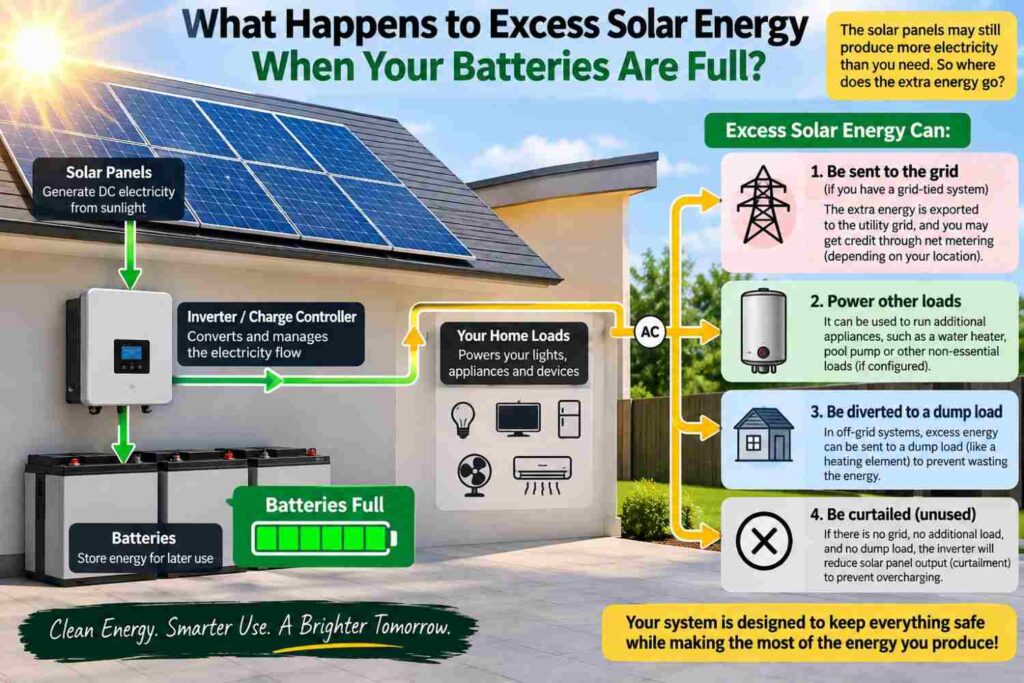
The answer depends heavily on the type of system installed, and understanding it can help you decide whether your setup is wasting potential or handling surplus power sensibly.
This article covers what really happens to excess solar energy once your batteries are full.
The Charge Controller Steps In First
In any battery-based system, whether off-grid or hybrid, the charge controller is the component actively managing how much power flows from the panels into the batteries.
Once the batteries reach full charge, a properly functioning charge controller, whether MPPT or PWM as explained in our dedicated comparison article, automatically reduces or stops the charging current to prevent overcharging, which would otherwise damage the batteries and shorten their lifespan.
This protective behaviour is standard on virtually every quality charge controller sold in Nigeria today.
Where the Extra Power Actually Goes
Once the charge controller throttles back charging, the panels are still capable of generating that extra power, but with nowhere designated to send it, the surplus is simply not harvested, similar in effect to the clipping discussed in our dedicated clipping article.
In a hybrid system with an active household load, however, that surplus does not have to go to waste, since it can instead be redirected to power appliances directly.
| System Setup | What Happens to Excess Energy |
|---|---|
| Off-grid, batteries full, no active load | Panel output is throttled; surplus is simply not harvested |
| Hybrid, batteries full, active household load | Surplus powers appliances directly, reducing grid draw |
| Grid-tied with net metering | Surplus exported to the grid for credit, where available |
| Hybrid with no export permission | Any surplus beyond load and full batteries goes unused |
Hybrid Systems: Powering Loads Directly
This is where hybrid systems show one of their real advantages. Once the battery bank is full, a hybrid inverter can prioritize sending solar power directly to whatever appliances are running in the home at that moment, rather than continuing to push current into batteries that no longer need it.
This means that even after the batteries are topped up, your solar array keeps offsetting your grid or generator usage throughout the rest of the sunny day, which is one of the reasons hybrid systems tend to deliver strong overall value in Nigeria’s grid-unreliable environment.
Grid Export and Net Metering
In markets with formal net metering arrangements, any solar power beyond what your batteries and household loads need can be exported back to the utility grid, earning a credit or reduced bill in return.
Net metering is still limited and inconsistent across Nigeria, with availability depending on the local distribution company, so most Nigerian hybrid systems are not currently designed around exporting surplus for credit, though where it is available, it is a genuinely useful way to avoid wasting excess generation.
Diversion Loads: An Underused Option
Some more advanced hybrid setups use what is called a diversion or dump load, a secondary circuit, often a water heater element or a similar resistive load, that automatically absorbs surplus solar power once batteries are full and there is no export option available. Instead of letting that extra generation go unused, the system diverts it into heating water or running another useful but flexible task.
This approach is still relatively uncommon in typical Nigerian residential installations but is worth asking your installer about if you want to squeeze maximum value out of your array.
Ways to Make Better Use of Surplus Solar Power
- Schedule flexible, high-consumption tasks like laundry, water pumping, or ironing for the middle of the day when surplus solar is most likely available.
- Ask your installer whether your inverter supports load prioritization once the battery bank reaches full charge.
- Consider a diversion load setup, such as a solar-compatible water heater element, if you consistently generate more than you can store or use.
- Investigate whether your local distribution company offers any form of net metering or grid export credit.
- If surplus is frequent and significant, evaluate whether your battery bank is undersized relative to your panel array’s actual output.
Is Wasted Surplus a Sign of a Poorly Designed System?
Not necessarily. Some amount of unused surplus around midday is a normal, expected trade-off in most battery-based systems, similar to the modest clipping accepted in inverter sizing.
It only signals a design problem when it happens consistently and in large amounts, which usually points to a panel array that is significantly oversized relative to both the household’s typical load and the battery bank’s capacity.
In that case, it may be worth revisiting your system sizing with your installer, since correcting a persistent mismatch can meaningfully improve how much of your generated power actually gets used.
Common Misconceptions
- “Excess solar energy is automatically stored somewhere for later use.” Without a bigger battery bank, a diversion load, or grid export, surplus power beyond what is needed in the moment is simply not harvested at all.
- “A full battery bank means the panels stop producing electricity entirely.” The panels can still generate power; it is the charge controller that throttles how much current it draws from them once the battery no longer needs charging.
- “Every solar system in Nigeria can sell excess power back to the grid.” Net metering availability varies significantly by location and distribution company, and most residential hybrid systems are not currently set up for grid export.
Frequently Asked Questions
Is it bad for my system if excess solar energy goes unused sometimes?
Occasional unused surplus around midday is normal and not harmful to the equipment; it is only a concern if it happens consistently in large amounts.
Can I add a bigger battery bank to capture more of the surplus?
Yes, expanding your battery capacity is one direct way to store more of what would otherwise go unused, alongside the panel expansion options covered in our related article.
Does a diversion load require special equipment to install?
Yes, it typically needs a compatible controller or relay designed to detect full battery status and redirect power, so it should be planned with your installer rather than added informally.
Final Thoughts
Excess solar energy is not lost through some dramatic waste, it simply is not harvested when there is nowhere useful for it to go, whether that is a full battery bank, no active load, or no export arrangement with the grid.
Hybrid systems handle this more gracefully than off-grid setups because they can redirect surplus straight into household appliances once batteries are topped up, keeping more of your generated power actually useful.
If you consistently notice large amounts of unused capacity, it is worth discussing battery sizing, load scheduling, or a diversion load option with your installer rather than accepting the waste as unavoidable.