
A flickering LED bulb is more than just annoying; it can strain your eyes, disturb anyone sensitive to light patterns, and sometimes signals an underlying electrical problem worth fixing.
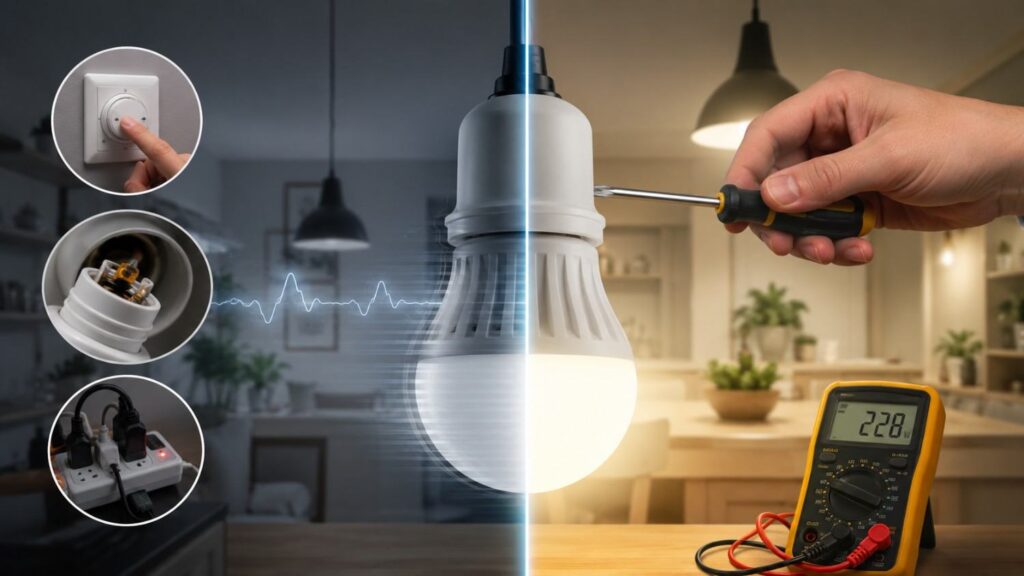
Unlike old incandescent bulbs, which rarely flickered unless the filament was about to fail, LED bulbs flicker for a range of reasons tied to their sensitive electronic drivers. This article walks through the common causes of LED flicker and practical steps to fix each one.
Understanding How LED Drivers Work
Every LED bulb contains a small driver circuit that converts the incoming AC mains supply into a steady low-voltage DC current suitable for the LED chip. A well-designed driver smooths out the AC ripple so the light output stays constant. When the driver is poorly designed, mismatched with the dimmer, or receiving unstable input power, it cannot maintain that steady current, and the result is visible flicker, which can range from a barely noticeable strobe to an obvious blinking pattern.
Common Causes of LED Flicker
- Voltage fluctuations from the mains supply, which are common in many parts of Nigeria due to inconsistent DisCo supply quality.
- Incompatible dimmer switches designed for incandescent bulbs rather than LED-specific dimming circuits.
- A loose bulb connection or worn-out lamp holder that interrupts contact intermittently.
- A failing or low-quality driver circuit inside the bulb itself, especially common in cheaper imported bulbs.
- Overloaded circuits sharing the same line as heavy appliances that cause voltage dips when they switch on.
- Poor or loose neutral connections at the distribution board, which can cause flicker across multiple bulbs at once.
Diagnosing the Source of the Flicker
| Symptom | Likely Cause |
|---|---|
| Only one bulb flickers, others are fine | Faulty bulb, loose holder, or bad connection at that fitting |
| All bulbs on one circuit flicker together | Loose wiring or connection issue on that circuit |
| Flicker worsens when large appliances switch on | Voltage dip caused by overloaded supply line |
| Flicker only occurs with a dimmer switch | Dimmer incompatibility with LED driver |
| Flicker happens randomly throughout the day | Unstable mains voltage from the grid |
Step-by-Step: How to Fix LED Flicker
- Turn off power at the breaker and tighten the bulb in its holder, checking for corrosion or a worn contact spring.
- Test the same bulb in another socket to see if the flicker follows the bulb or stays with the fitting.
- If using a dimmer, confirm it is rated for LED loads; many older dimmers are only rated for incandescent or resistive loads.
- Check whether flicker coincides with other appliances switching on, which points to an overloaded circuit or voltage sag.
- Install a voltage stabilizer if mains fluctuation is confirmed as the cause, particularly in areas with known unstable DisCo supply.
- Replace the bulb with one from a reputable brand if the driver itself appears to be the fault, especially after ruling out wiring issues.
The Role of Voltage Fluctuation in Nigeria
Nigeria’s mains supply is nominally 230V to 240V single-phase at 50Hz, but in practice many areas experience swings well outside that range, especially during periods of heavy load or when supply is restored after an outage. LED drivers are generally built to tolerate a certain voltage range, but sustained fluctuation outside that window can cause visible flicker or, in worse cases, permanent damage to the driver components. This is one of the reasons voltage stabilizers remain popular in Nigerian homes, a topic explored further in our dedicated voltage fluctuation and surge protection article.
Dimmer Compatibility Issues
Many homes still have dimmer switches originally installed for incandescent bulbs. These dimmers work by chopping the AC waveform to reduce average power, a method that incandescent filaments handle gracefully but LED drivers often cannot. The result is flicker, buzzing, or the bulb failing to dim smoothly at all. If you want dimmable lighting, the safest approach is to buy LED bulbs explicitly labeled as dimmable and pair them with a dimmer switch rated for LED loads, rather than assuming any dimmer will work with any bulb.
When Flicker Signals a Bigger Wiring Problem
Occasional, brief flicker is usually a minor annoyance, but flicker that is frequent, affects multiple circuits, or is accompanied by warm switches, tripping breakers, or a burning smell needs urgent attention. These can indicate a loose neutral at the main distribution board, deteriorating wiring insulation, or an overloaded supply cable. In such cases, do not simply keep replacing bulbs; have a qualified electrician inspect the panel and wiring, since ignoring these signs can lead to more serious faults over time.
Preventing Flicker Before It Starts
Buying LED bulbs from reputable brands with proper certification markings goes a long way toward avoiding flicker caused by poor internal driver design. Pairing bulbs with a good quality stabilizer in areas with known voltage instability, ensuring lamp holders are not corroded, and avoiding cheap unbranded dimmer switches are all practical steps that reduce the likelihood of flicker developing in the first place. If your home runs on inverter backup during outages, it is also worth checking that the inverter’s output waveform is compatible with sensitive LED drivers, since poor quality inverters can introduce flicker of their own, a topic covered in our inverters and batteries article.
Common Misconceptions
- “Flickering always means the bulb is about to die.” While a failing bulb can flicker, the far more common causes are loose connections, dimmer incompatibility, or unstable mains voltage.
- “Any dimmer switch works with any LED bulb.” Many older dimmers are built for incandescent loads and will cause flicker or buzzing with LED bulbs unless both are explicitly rated for LED dimming.
- “Flicker is just a cosmetic issue with no real cause.” Flicker is always a symptom of something, whether it is a wiring fault, voltage instability, or a failing driver, and it is worth diagnosing rather than ignoring.
Frequently Asked Questions
Can a stabilizer completely eliminate LED flicker?
A good stabilizer resolves flicker caused by voltage fluctuation, but it will not fix flicker caused by a loose connection, a bad bulb driver, or dimmer incompatibility.
Is it safe to keep using a flickering LED bulb?
Occasional mild flicker is generally safe to live with temporarily, but persistent or worsening flicker should be investigated promptly since it can indicate a wiring issue that gets worse over time.
Why does only one bulb in a multi-bulb fitting flicker?
This usually points to a problem specific to that bulb or its holder, such as a loose contact or a failing driver, rather than a wider circuit issue.
Final Thoughts
LED flicker almost always has an identifiable cause, whether that is a loose connection, an incompatible dimmer, an unstable mains supply, or a failing driver inside the bulb itself. Working through the diagnostic steps methodically, starting with the simplest checks like tightening the bulb and testing it in another socket, will resolve most cases quickly.
Where voltage instability from the grid is the culprit, a stabilizer is a worthwhile investment that protects not just your lighting but other sensitive electronics in the home. Persistent or worsening flicker should never be ignored, since it can be an early warning sign of a wiring problem that deserves professional attention.