
It is instinct for most people to reach for water the moment they see a fire, but with an electrical fire, that instinct can turn a dangerous situation into a fatal one.
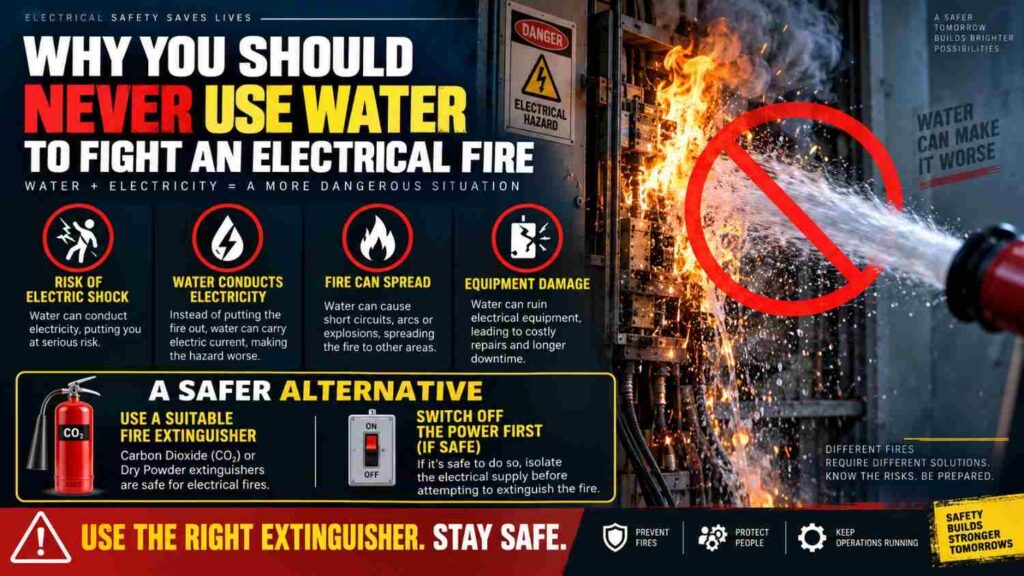
Water conducts electricity, and throwing it onto a fire that involves live wiring, an energised appliance, or a distribution board can send a lethal shock straight back through the water stream to the person holding it.
This article explains exactly why water and electrical fires do not mix, what actually happens when they meet, and what to do instead.
Why Water Makes an Electrical Fire More Dangerous
Pure, distilled water is actually a relatively poor conductor of electricity, but ordinary water, whether from a tap, a bucket, or rainwater, contains dissolved minerals and impurities that make it conduct current readily.
When water is thrown onto a fire involving live electrical equipment, that stream can create a continuous conductive path from the energised source back to the person throwing it. Instead of extinguishing the fire safely, the water can carry current through the jet itself, delivering a severe or fatal shock the instant contact is made, even from a distance away.
What Actually Happens When Water Meets a Live Electrical Fire
Beyond the shock risk to the person fighting the fire, water can also cause the fire itself to behave more dangerously. Water striking hot, energised equipment can cause sudden arcing and even small explosions as it rapidly vaporises, scattering burning or electrically live material further than the original fire covered.
If the fire involves a transformer or equipment containing oil, water can also cause the burning oil to splash and spread rather than being contained, worsening the situation rather than controlling it. None of these outcomes make the fire easier to fight; they typically make it more dangerous for everyone nearby.
Fire Classes and Why Electrical Fires Are Treated Differently
| Fire Class | Involves | Water Safe to Use? |
|---|---|---|
| Class A | Ordinary combustibles like wood, paper, fabric | Yes, generally safe once no electricity is involved |
| Class B | Flammable liquids, such as fuel | No, water can spread the burning liquid |
| Class C (Electrical) | Fires involving live electrical equipment | No, risk of shock through conductive water |
An electrical fire is classified separately precisely because the presence of live current changes the entire risk calculation. Once power to the involved equipment is confirmed off, the fire may effectively become an ordinary Class A fire depending on what is burning, but that determination should never be assumed by a bystander in the heat of the moment.
The Right Way to Respond to an Electrical Fire
- If it is safe and quick to do so, cut power to the affected circuit or the whole building at the main switch or distribution board, without touching the burning equipment itself.
- Use a fire extinguisher rated for electrical fires, typically marked Class C or carbon dioxide type, never a water-based extinguisher, on any fire suspected to involve live equipment.
- If no appropriate extinguisher is available and the fire is spreading, evacuate the area immediately rather than attempting to fight it with unsuitable means.
- Call the fire service and inform them specifically that electrical equipment is involved, so they arrive prepared with the right approach.
- Keep a safe distance from smoke, since burning insulation and plastics can release toxic fumes in addition to the fire and shock hazards.
Why This Risk Is Especially Relevant in Nigeria
Many Nigerian homes and small businesses do not keep a fire extinguisher on hand at all, let alone one rated for electrical fires, meaning water or improvised methods are often the first thing people reach for in a panic.
The widespread use of generators, extension boards, and multiple power sources including inverters increases the number of potential ignition points in a typical property, from overloaded circuits discussed in our dedicated overcurrent protection article to overheating panels covered in our dedicated panel overheating article.
Ensuring a suitable extinguisher is available, and that household members know where the main switch is and how to cut power quickly, matters as much as any other safety measure in the home.
What to Do Once the Fire Is Out
Even after an electrical fire appears extinguished, the area should not be treated as automatically safe. Damaged wiring, breakers, and connections may still be live or may have been weakened in ways that create a hazard later, and a qualified electrician should inspect the affected circuit before it is used again. Smoke and heat damage can also compromise insulation on cables that were not directly involved in the fire but were nearby, so a broader inspection is often warranted rather than assuming only the visibly burnt section needs attention.
Common Misconceptions
- “A small splash of water can’t hurt with an electrical fire.” Even a small amount of conductive water in contact with live equipment can deliver a dangerous shock, so no amount is considered safe.
- “Once the flames look out, the danger has passed.” Equipment may still be live or damaged in ways that are not visually obvious, so power should stay off until a qualified electrician confirms it is safe.
- “Any fire extinguisher will work on an electrical fire.” Water and foam extinguishers can conduct electricity and worsen the situation; only extinguishers rated for electrical fires, such as CO2 types, should be used.
Frequently Asked Questions
What should I use instead of water on an electrical fire?
A carbon dioxide or dry powder fire extinguisher rated for electrical fires is the correct choice, since these do not conduct electricity back toward the user.
Is it safe to use water once I’ve switched off the main power?
Only if you are absolutely certain the power is off and there is no risk of it being restored or of residual charge in the equipment, which is difficult to confirm without training, so it is safer to still use a proper extinguisher.
Should I try to unplug a burning appliance?
Only if it can be done without touching the burning parts or standing in water, and only briefly; if there is any doubt, cutting power at the distribution board is safer than approaching the appliance directly.
Final Thoughts
The instinct to grab water when something is on fire is natural, but with electrical fires it can turn a bystander into a casualty by creating a conductive path straight back to the source of danger. Cutting power where possible, using the correct class of fire extinguisher, and knowing when to simply evacuate and call for help are the responses that actually keep people safe.
Given how common overloaded circuits, ageing panels, and multiple power sources are in Nigerian homes, having the right extinguisher on hand is a small investment against a serious risk. After any electrical fire, no matter how small, a qualified electrician should inspect the affected wiring before it is used again.