
Three-phase motors are supposed to run smoothly and efficiently, but many technicians in Nigeria have encountered motors that vibrate, overheat, or trip out repeatedly despite appearing to receive power on all three phases.
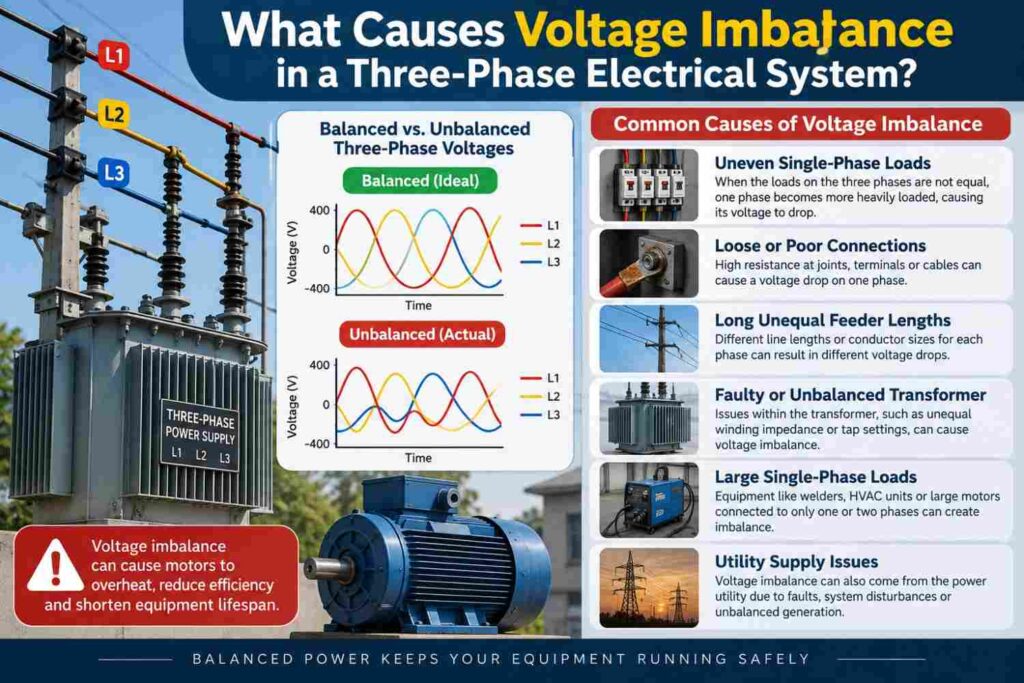
In a large number of these cases, the real culprit is voltage imbalance, a supply condition that is easy to overlook because it does not show up as an obvious outage or fault.
This article explains what causes voltage imbalance in a three-phase system and why it matters so much for equipment reliability.
What Voltage Imbalance Means
In a healthy three-phase electrical system, the voltage on each of the three phases, commonly labeled red, yellow, and blue or L1, L2, and L3, should be equal in magnitude and evenly spaced 120 degrees apart in phase angle. Voltage imbalance occurs when the voltage magnitude on one or more phases differs noticeably from the others, even though all three are technically still supplying power. This is usually expressed as a percentage, calculated by comparing the maximum deviation from the average voltage of the three phases to that average value.
What Causes Voltage Imbalance
- Uneven distribution of single-phase loads across the three phases, such as when far more lighting or sockets are connected to one phase than the others.
- Faulty or loose connections on one phase at the transformer, distribution board, or service connection.
- An open or high-resistance neutral connection at the transformer, causing voltage to shift unevenly between phases.
- Unequal transformer winding conditions or an aging transformer with degraded insulation on one phase, a subject covered further in our dedicated transformer article.
- Large single-phase loads, such as welding equipment or certain motors, drawing heavily from just one phase.
- Poor quality or unevenly loaded generator supply where three-phase loads are not properly balanced across phases.
Why Voltage Imbalance Is Common on Nigerian Feeders
Many Nigerian distribution networks, especially older ones, were not originally designed with perfectly even single-phase load distribution in mind, and as more homes and small businesses connect to a feeder over time, loads on one phase can grow disproportionately compared to the others. This is compounded by inconsistent maintenance, aging transformers, and the same kind of feeder-level supply quality differences discussed in our article on why power is available on one street but not the next. Imbalance often becomes more pronounced during peak evening hours when overall demand rises and any pre-existing unevenness between phases is magnified.
Measuring and Classifying Voltage Imbalance
| Imbalance Level | Effect on Equipment |
|---|---|
| Below 1% | Generally considered acceptable, minimal risk |
| 1% to 2% | Mild additional heating in motors, usually tolerable short term |
| 2% to 5% | Noticeable motor heating and reduced lifespan if sustained |
| Above 5% | Significant risk of overheating, vibration, and premature motor failure |
Voltage imbalance is calculated using the formula: Percentage Imbalance = (Maximum Voltage Deviation from Average / Average Voltage) x 100. For example, if the three phase voltages measure 230V, 225V, and 218V, the average is 224.3V, the maximum deviation is 6.3V, and the imbalance works out to roughly 2.8 percent, a level worth investigating rather than ignoring.
Why Voltage Imbalance Matters
Three-phase motors are particularly sensitive to voltage imbalance because even a small percentage of voltage imbalance translates into a much larger percentage of current imbalance, often six to ten times greater, due to the way motor windings respond to uneven voltage. This means a modest 3 percent voltage imbalance can produce current imbalance well above 20 percent on one winding, generating significant extra heat that is not evenly distributed across the motor. Left unaddressed, this uneven heating accelerates insulation breakdown, increases vibration and noise, and substantially shortens motor lifespan, a topic explored in more detail in our dedicated phase imbalance and motors article.
How to Address Voltage Imbalance
- Have a qualified electrician measure voltage on all three phases under normal load conditions.
- Redistribute single-phase loads, such as lighting circuits and sockets, more evenly across the three phases.
- Check and tighten all phase and neutral connections at the distribution board and meter.
- Request a supply-side inspection from the DisCo if imbalance persists despite correcting internal wiring.
- Consider phase failure and imbalance protection relays for critical three-phase motors.
- For generator supply, ensure loads are balanced evenly across all three phases during installation.
Common Misconceptions
- “If all three phases show power, the supply must be balanced.” Balance refers to equal voltage magnitude across phases, not simply whether each phase is energized; imbalance can exist even when all three phases appear to work fine individually.
- “Voltage imbalance only matters for large industrial motors.” Smaller three-phase motors used in boreholes, workshops, and small businesses are equally vulnerable to the effects of imbalance.
- “A slight imbalance is never worth worrying about.” Because current imbalance is amplified relative to voltage imbalance in motors, even a seemingly small voltage imbalance can cause meaningful motor heating over time.
Frequently Asked Questions
Can voltage imbalance damage single-phase appliances too?
Single-phase appliances connected to just one phase are affected mainly by that phase’s own voltage level rather than the imbalance between phases, though severe imbalance often coincides with poor voltage quality generally.
Who is responsible for fixing voltage imbalance, the customer or the DisCo?
It depends on where the imbalance originates; imbalance caused by internal load distribution is the customer’s responsibility to correct, while imbalance from the transformer or feeder itself falls under the distribution company’s responsibility.
Does a voltage stabilizer correct phase imbalance?
A standard single-phase stabilizer does not address three-phase imbalance directly; specialized three-phase voltage regulation equipment or load rebalancing is needed for that purpose.
Final Thoughts
Voltage imbalance is one of the more technical power quality issues, but it has an outsized effect on three-phase motor equipment precisely because a small voltage imbalance produces a much larger current imbalance inside the motor windings.
For homes, workshops, and businesses running boreholes, pumps, or industrial machinery in Nigeria, periodically checking phase voltages and addressing any imbalance early is a straightforward way to avoid premature motor failure.
Where the imbalance clearly originates from the supply rather than internal wiring, raising the issue with the local distribution company is a reasonable next step alongside protective measures on your own equipment.