
Variable Frequency Drives have become one of the most widely used devices in modern industrial motor control, offering genuine energy savings and precise control that older, simpler starting methods couldn’t provide. This article explains what a VFD actually is and how it works.
What a Variable Frequency Drive Actually Is
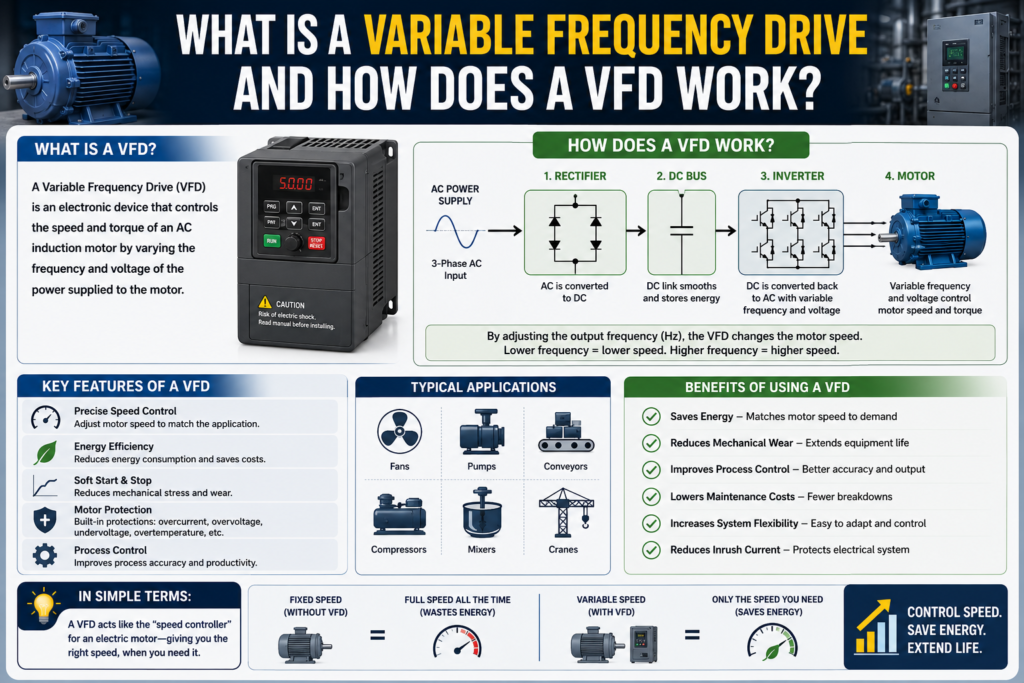
A Variable Frequency Drive (VFD), also called an inverter drive or adjustable frequency drive, is an electronic device that controls the speed and torque of an AC induction motor by varying the frequency and voltage of the electrical power supplied to it, allowing precise, adjustable motor speed control rather than the fixed-speed operation typical of motors connected directly to standard fixed-frequency power.
The Basic Working Principle: Why Frequency Controls Speed
An induction motor’s rotational speed is directly related to the frequency of the AC power supplying it, discussed further in our dedicated induction motor explanation article; by electronically converting incoming fixed-frequency AC power to DC and then back to AC at a controllable, adjustable frequency, a VFD can precisely control motor speed across a wide operating range rather than running only at the fixed speed determined by the standard grid frequency.
The Three Core Stages Inside a VFD
| Stage | Function |
|---|---|
| Rectifier | Converts incoming AC power to DC |
| DC bus/filter | Smooths the DC voltage |
| Inverter | Converts DC back to AC at controllable frequency |
Why VFDs Provide Genuine Energy Savings
Many industrial applications, pumps and fans particularly, don’t actually need to run at full speed continuously; VFDs allow motor speed to be matched to actual process demand rather than running at fixed full speed and using mechanical throttling (valves or dampers) to manage output, and because power consumption for these load types drops disproportionately faster than speed reduction, even modest speed reductions can produce substantial genuine energy savings.
Reduced Mechanical Stress and Extended Equipment Life
Beyond energy savings, VFDs provide gradual, controlled motor acceleration and deceleration rather than the abrupt, high-stress starting characteristic of direct-on-line motor starting, discussed in our star-delta starting article, reducing mechanical stress on motors, couplings, and driven equipment, and genuinely extending equipment operational lifespan in many applications.
Common Industrial Applications for VFDs
- Pumps: matching flow rate to actual demand rather than throttling valves
- Fans and blowers: adjusting airflow to actual ventilation or process needs
- Conveyor systems: precise speed control for process timing and coordination
- Compressors: matching output to actual demand rather than cycling on/off
- Mixers and agitators: precise speed control for process quality requirements
VFDs Compared to Soft Starters
While both VFDs and soft starters, discussed in depth in our dedicated comparison article, address the high inrush current problem of direct motor starting, VFDs provide genuine continuous, adjustable speed control throughout operation, not just during starting, making them the appropriate choice for applications genuinely requiring variable speed operation rather than just smoother starting.
Understanding VFD-Related Electrical Noise and Harmonics
A genuinely important practical consideration when installing VFDs is the electrical noise and harmonic distortion they can introduce into a power system, since the rapid switching involved in generating variable-frequency output isn’t a perfectly clean sine wave; proper installation practices, shielded cabling, appropriate filtering, and correct grounding, help manage these effects, making this an important design consideration rather than something to overlook when planning a VFD installation.
Common Misconceptions
- “VFDs and soft starters serve essentially the same purpose.” Soft starters only address starting characteristics, while VFDs provide continuous variable speed control throughout normal operation.
- “VFDs are only worth the investment for very large industrial motors.” Genuine energy savings and process control benefits often justify VFD use across a wide range of motor sizes, particularly for pump and fan applications with variable load requirements.
- “Any motor can have a VFD added without consideration.” Motor compatibility, cabling considerations, and proper VFD sizing all require genuine engineering attention for reliable operation.
Frequently Asked Questions
Can a VFD be added to an existing motor installation, or does it require a specifically designed motor?
Many standard induction motors are VFD-compatible, though genuinely verifying motor suitability, insulation rating, and proper installation practices matters for reliable long-term operation.
Do VFDs require special maintenance compared to standard motor starting equipment?
VFDs are electronic devices requiring some different maintenance considerations, including attention to cooling, electrical noise/interference management, and periodic inspection, compared to simpler electromechanical starting equipment.
How significant are the genuine energy savings from VFD installation in practice?
Savings vary considerably by application, but pump and fan applications with genuinely variable load requirements often see substantial, well-documented energy savings, sometimes recovering the VFD investment cost within a few years through reduced energy consumption alone.
Final Thoughts
Variable Frequency Drives provide genuine, adjustable motor speed control by electronically varying the frequency of power supplied to induction motors, delivering meaningful energy savings, reduced mechanical stress, and precise process control across a wide range of industrial applications. Understanding how VFDs work and where they provide genuine practical value helps engineers make informed decisions about motor control system design.