
Transmission and distribution lines are often mentioned together or confused with one another, yet they serve genuinely distinct functions within the electrical power delivery system.
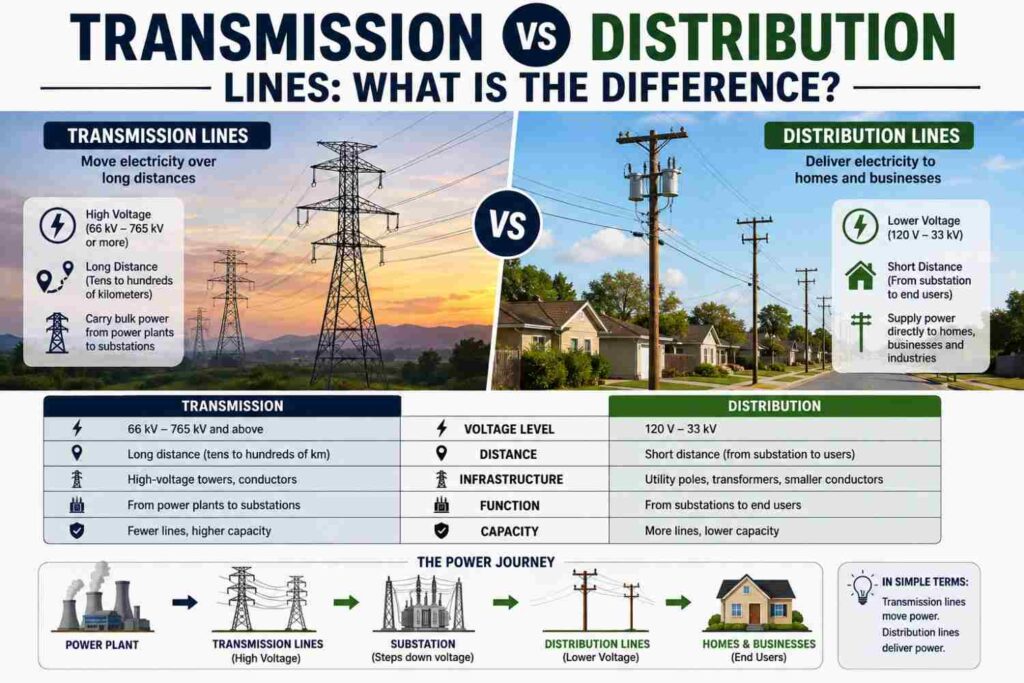
This article explains what actually separates them and why understanding the difference matters.
What Transmission Lines Actually Do
Transmission lines carry electricity over long distances at very high voltage, discussed in our dedicated article on why electricity travels at high voltage, from generation stations to major substations near population centers, using tall towers and specially designed conductors built to handle this high-voltage, long-distance bulk power transport efficiently.
What Distribution Lines Actually Do
Distribution lines take over after transmission-level voltage has been stepped down at substations, carrying electricity at lower voltage through local networks, the poles and lines running through neighborhoods and streets, ultimately delivering power to individual homes, businesses, and other end users through final step-down transformers.
A Direct Comparison Table
| Factor | Transmission | Distribution |
|---|---|---|
| Voltage level | Very high (typically 132kV+ in Nigeria) | Lower (typically 11kV or 415V/230V) |
| Typical distance covered | Long distance, often hundreds of km | Local, within cities/neighborhoods |
| Infrastructure | Tall steel towers | Wooden or concrete poles |
| Managing entity in Nigeria | Transmission Company of Nigeria (TCN) | Distribution companies (DisCos) |
Why This Two-Stage System Exists at All
Transmitting electricity at very high voltage over long distances significantly reduces transmission losses compared to lower voltage transport, but delivering power at such high voltage directly to homes would be extremely dangerous and impractical, making the two-stage system, efficient high-voltage transmission followed by voltage step-down and local distribution, a genuinely sensible engineering solution balancing efficiency and safety.
How Nigeria’s Power Sector Divides These Responsibilities
Following Nigeria’s power sector privatization, the Transmission Company of Nigeria (TCN) remains government-operated and specifically manages the transmission network connecting generation to distribution substations, while privatized Distribution Companies (DisCos) each manage distribution networks within their specific geographic franchise areas, delivering power to final end-users.
Why Distribution-Level Problems Are Often More Locally Visible
Because distribution infrastructure directly serves specific neighborhoods, problems at this level, aging transformers, overloaded feeders, damaged poles, tend to cause localized outages affecting specific streets or areas, discussed further in our article on why power can be available on one street but not the next, distinct from transmission-level problems that tend to cause more widespread, larger-scale outages when they occur.
How Sub-Transmission Sometimes Adds a Middle Layer
In some grid architectures, including parts of Nigeria’s system, an intermediate “sub-transmission” layer operates between full transmission and final distribution voltage, carrying power at a moderate voltage level to serve large industrial customers directly or to feed distribution substations across a wider area than a single primary distribution line would cover, adding a genuinely useful additional layer of flexibility to the overall two-stage transmission-distribution concept discussed above.
Common Misconceptions
- “Transmission and distribution lines look and function essentially the same way.” They differ substantially in voltage level, infrastructure design, and the specific entities responsible for managing them.
- “All power outages stem from the same type of infrastructure problem.” Transmission-level and distribution-level problems have genuinely different causes, scope, and typical resolution approaches.
- “TCN and DisCos are essentially the same organization with different names.” They’re distinct entities with separate infrastructure responsibilities within Nigeria’s unbundled power sector structure.
Frequently Asked Questions
Which infrastructure type, transmission or distribution, is more prone to failures in Nigeria?
Both face genuine challenges, but distribution infrastructure issues tend to be more frequently experienced by individual consumers given its direct, localized connection to end users.
Does understanding this distinction help when reporting power problems to the right authority?
Yes, localized street-level or neighborhood outages are typically distribution issues best reported to your specific DisCo, while widespread regional or national outages often relate to transmission or generation-level problems.
Are transmission and distribution networks planned and upgraded by the same processes?
No, given their separate managing entities in Nigeria’s structure, transmission and distribution infrastructure planning, investment, and upgrade processes are generally managed somewhat independently, though coordination between them remains genuinely important for overall system reliability.
Final Thoughts
Transmission and distribution represent genuinely distinct stages in delivering electrical power, transmission carrying bulk power at very high voltage over long distances, distribution delivering it at lower, safer voltage to individual end users locally. Understanding this distinction, along with how Nigeria’s specific TCN and DisCo structure divides these responsibilities, provides valuable context for anyone trying to understand power sector issues and outages.