
Switch on a large transformer and for a brief moment it can draw a current many times higher than its normal full-load rating, enough to trip protective relays, dim nearby lights, or make an unprepared technician think something has gone badly wrong.
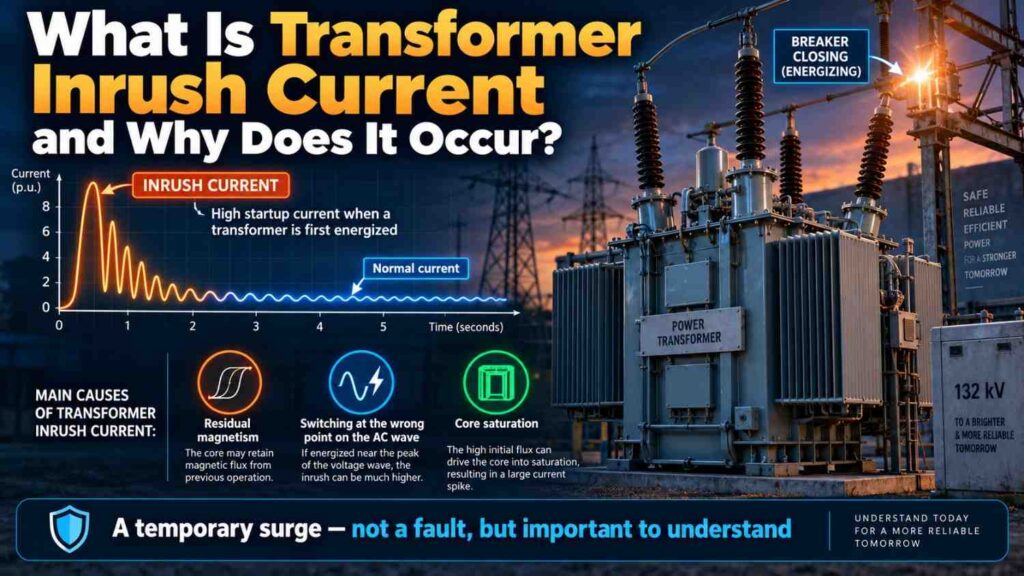
That surge is called inrush current, and it is a normal, predictable phenomenon rather than a fault. This article explains what causes it, why it can reach such extreme levels, and how engineers design around it so it does not cause nuisance trips or equipment stress.
What Inrush Current Is
Inrush current is the transient surge of current a transformer draws the instant it is energised, before settling down to its normal no-load magnetising current within a fraction of a second to a few seconds. Depending on the transformer’s size, core design, and the exact point on the voltage waveform at which it is switched on, inrush current can reach 8 to 12 times the transformer’s rated full-load current, and in some cases even higher for smaller units. It decays rapidly, often within a handful of cycles, but that brief spike is large enough to matter for protection and system design.
Why Inrush Current Happens
The root cause lies in how a transformer’s magnetic core behaves. Under steady-state operation, the magnetic flux in the core lags the applied voltage by 90 degrees, and the core operates within its normal, unsaturated range. When a transformer is switched on, however, the flux cannot instantly jump to its steady-state value, particularly if switching happens near a voltage zero crossing. This can force the flux to swing far higher than normal for the first cycle, driving the core into magnetic saturation. Once saturated, the core offers very little opposition to current flow, and the winding draws a large current to produce that same flux, which is why the current spike can be so extreme even though the applied voltage is completely normal.
Factors That Influence Inrush Magnitude
Several variables determine how severe inrush current will be for a given switching event.
- The point on the voltage waveform at which the switch closes, with switching near a voltage zero producing the worst case
- Residual magnetism left in the core from the last time the transformer was de-energised
- The transformer’s core material and design, since some cores saturate more readily than others
- The impedance of the source feeding the transformer, with a stiffer source allowing higher inrush
- The transformer’s size, with larger power transformers generally showing proportionally lower peak multiples than small distribution units
Why Inrush Current Matters for Protection
Overcurrent protection, whether fuses or protective relays, exists to detect abnormal current and disconnect the transformer before damage occurs. The trouble is that inrush current, a completely normal event, can look electrically similar in magnitude to an internal fault for a brief instant. If protection is set to react too aggressively to short-duration high current, the transformer will trip itself off every time it is switched on, an outcome known as nuisance tripping. Engineers solve this by designing protection schemes, discussed alongside broader protection topics in our dedicated article on motor and equipment protection, to distinguish inrush from genuine faults.
How Protection Schemes Tell Inrush Apart From a Fault
Modern differential protection relays use harmonic restraint, since inrush current is rich in second-harmonic content while a genuine internal fault current is not. When the relay detects a high proportion of second harmonic in the current waveform, it recognises the event as inrush and restrains itself from tripping, even though the current magnitude alone might otherwise look fault-like. Fuses and simpler overcurrent relays instead rely on time-current curves with enough delay at high current to ride through the brief inrush spike while still tripping promptly for a sustained fault.
Inrush Current vs Fault Current
Distinguishing the two matters enough that it is worth laying out clearly, since confusing them leads to either dangerous under-protection or constant nuisance tripping.
| Characteristic | Inrush Current | Fault Current |
|---|---|---|
| Duration | Milliseconds to a few seconds | Continues until cleared by protection |
| Harmonic content | High second-harmonic content | Mostly fundamental frequency |
| Cause | Core saturation at switch-on | Insulation breakdown or short circuit |
| Decay pattern | Rapid, predictable decay | Stays high or grows until interrupted |
| Action needed | None, allow to pass | Immediate disconnection |
Practical Steps to Reduce Inrush Problems
Where inrush current causes recurring nuisance tripping or stresses upstream equipment, several practical mitigations are used. Point-on-wave switching devices time the closing of the breaker to the optimal point on the voltage waveform, minimising the flux offset that drives saturation. Pre-insertion resistors temporarily add resistance during switching to limit the initial surge, then bypass once the transient settles. Soft-start or sequential energisation, common on larger installations with multiple transformers, staggers switching to avoid compounding inrush events across the network at once. Correctly rated and coordinated protection settings remain the most common and cost-effective solution for most distribution-level installations.
Why This Matters in Nigerian Power Systems
Frequent switching of distribution transformers, whether from load shedding schedules or repeated outages and restorations common on parts of the Nigerian grid, means inrush events happen far more often than in grids with steadier supply. Each energisation is a small mechanical and thermal stress on the windings, and poorly coordinated protection that trips on every restoration adds unnecessary downtime on top of the underlying supply instability.
Common Misconceptions
- “Inrush current means something is wrong with the transformer.” It is a normal consequence of core magnetisation at switch-on and occurs in healthy transformers every time they are energised.
- “Inrush current is dangerous to the transformer itself.” A well-designed transformer is built to withstand normal inrush events repeatedly over its service life without damage.
- “All protection relays trip on inrush current.” Relays with harmonic restraint and correctly graded time-current settings are specifically designed to ignore normal inrush while still catching real faults.
Frequently Asked Questions
How long does inrush current typically last?
Most of the surge decays within the first few cycles, though smaller residual effects can linger for a few seconds depending on the transformer’s design.
Can inrush current damage other equipment on the network?
Occasionally it can cause a brief voltage dip or nuisance tripping on sensitive nearby equipment, particularly on weaker sections of the grid, though it rarely causes direct damage.
Does switching a transformer off and back on quickly make inrush worse?
Yes, residual magnetism left in the core from a recent de-energisation can add to the next inrush event, sometimes producing a higher peak than the original energisation.
Final Thoughts
Inrush current looks alarming on a meter or an oscillograph, but it is one of the most well-understood and predictable behaviours in transformer engineering.
The real skill lies in designing protection that tolerates this normal transient while still reacting instantly to genuine faults, a balance that harmonic restraint relays and properly graded fuses handle every day across power systems.
For technicians working on Nigerian distribution networks, where switching events happen frequently, understanding inrush current helps separate a routine energisation surge from an actual developing problem.