
Three-phase motors power much of the industrial and commercial world, and while genuinely robust, they remain vulnerable to several failure modes that proper motor protection is specifically designed to prevent. This article explains why motor protection matters and the main types genuinely worth understanding.
Why Motors Need Dedicated Protection Beyond Basic Circuit Breakers
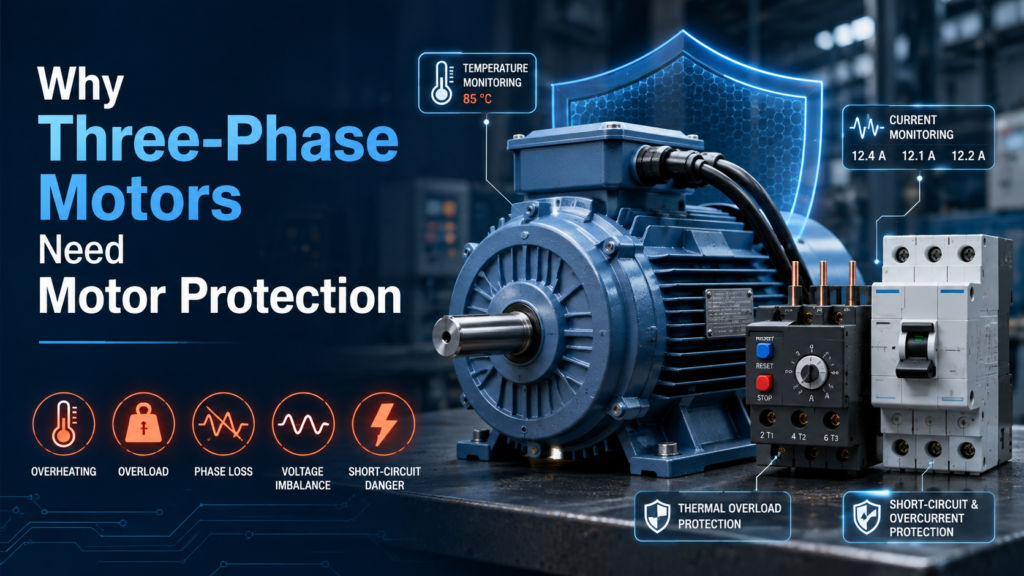
Standard circuit breakers and fuses primarily protect against short circuits and severe overcurrent conditions, but motors face additional failure risks, sustained overload, phase loss, voltage imbalance, and locked rotor conditions, that ordinary overcurrent protection doesn’t adequately address, making dedicated motor protection genuinely necessary beyond basic circuit protection alone.
Thermal Overload Protection: The Most Common Protection Type
Thermal overload relays monitor motor current continuously and disconnect the motor if sustained overcurrent conditions, indicating overload, persist beyond a time-based threshold calibrated to the motor’s thermal characteristics, protecting against the winding overheating discussed in depth in our dedicated motor overheating article, without nuisance-tripping during normal, brief starting current surges.
Phase Loss and Phase Imbalance Protection
Three-phase motors are particularly vulnerable to single-phasing, losing one of the three supply phases while continuing to attempt operation on the remaining two, which causes severely increased current in the remaining phases and rapid winding overheating; dedicated phase loss protection detects this condition and disconnects the motor before serious damage occurs.
Common Types of Motor Protection Devices
| Protection Type | What It Guards Against |
|---|---|
| Thermal overload relay | Sustained overcurrent/overload conditions |
| Phase failure relay | Loss of one or more supply phases |
| Voltage imbalance protection | Unequal voltage across the three phases |
| Locked rotor protection | Motor stalled while still energized |
| Ground fault protection | Current leakage to ground/earth |
Locked Rotor Protection: Guarding Against Stalled Conditions
If a motor’s rotor becomes mechanically stuck or stalled while still energized, whether from a mechanical jam or excessive load, current draw rises dramatically without the motor actually rotating and generating cooling airflow, creating rapid, severe overheating risk; locked rotor protection specifically detects this stalled condition and disconnects power before winding damage occurs.
How Motor Protection Integrates With Contactors
As discussed in our dedicated contactor versus relay article, contactors handle the actual switching of motor power but don’t inherently provide overload protection; motor protection devices work alongside contactors, monitoring conditions and signaling the contactor to disconnect when protective thresholds are exceeded, illustrating how these components form an integrated protection system rather than functioning independently.
Why Proper Protection Sizing and Calibration Matters
Motor protection devices must be properly sized and calibrated to the specific motor’s rated characteristics; protection set too sensitively causes nuisance tripping during normal operation, while protection set too loosely fails to genuinely protect the motor from damage, making correct sizing and calibration, rather than simply installing generic protection, a genuinely important engineering consideration.
Ground Fault Protection: An Often-Overlooked Safety Layer
Beyond the current and phase-related protection types discussed above, ground fault protection specifically monitors for current leaking to ground, often from degraded insulation, moisture ingress, or physical damage, conditions that other protection types might not detect promptly; this protection layer matters not only for equipment protection but genuinely for personnel safety, since ground faults create shock hazard risk that overload or phase protection alone doesn’t address.
Common Misconceptions
- “Standard circuit breakers provide sufficient motor protection on their own.” Circuit breakers address short circuits and severe overcurrent, but not the sustained overload, phase loss, and locked rotor conditions dedicated motor protection specifically addresses.
- “Motor protection devices are optional extras rather than genuinely necessary components.” Given motors’ vulnerability to several distinct failure modes, dedicated protection is a standard, genuinely necessary part of proper motor installation.
- “Any generic protection setting works adequately regardless of the specific motor.” Protection must be properly calibrated to each motor’s specific rated characteristics for genuinely effective protection.
Frequently Asked Questions
Can modern VFDs provide motor protection functions themselves?
Many VFDs, discussed in our dedicated VFD article, include built-in protective functions monitoring current and other parameters, though dedicated separate protection devices remain common in many installations depending on specific system design.
How often should motor protection settings be reviewed or recalibrated?
Protection settings should generally be reviewed whenever motor loading conditions change significantly, or as part of routine preventive maintenance schedules, discussed in our dedicated preventive maintenance article.
What’s typically the most common cause of motor protection tripping in practice?
Sustained overload conditions, often from mechanical issues in driven equipment or genuine process overload, represent among the most common practical triggers for thermal overload protection activation.
Final Thoughts
Three-phase motors face several distinct failure risks, sustained overload, phase loss, voltage imbalance, and locked rotor conditions, that dedicated motor protection devices are specifically designed to address beyond what standard circuit breakers provide. Understanding these protection types and ensuring proper sizing and calibration provides genuinely important safeguards for motor reliability and operational lifespan.