
Choosing an electrical engineering specialization is one of the more consequential decisions students face, shaping the specific coursework, skills, and career paths that follow, yet many students choose based on limited understanding of what each specialization actually involves day-to-day. This article explains the major specializations to help inform a genuinely well-considered choice.
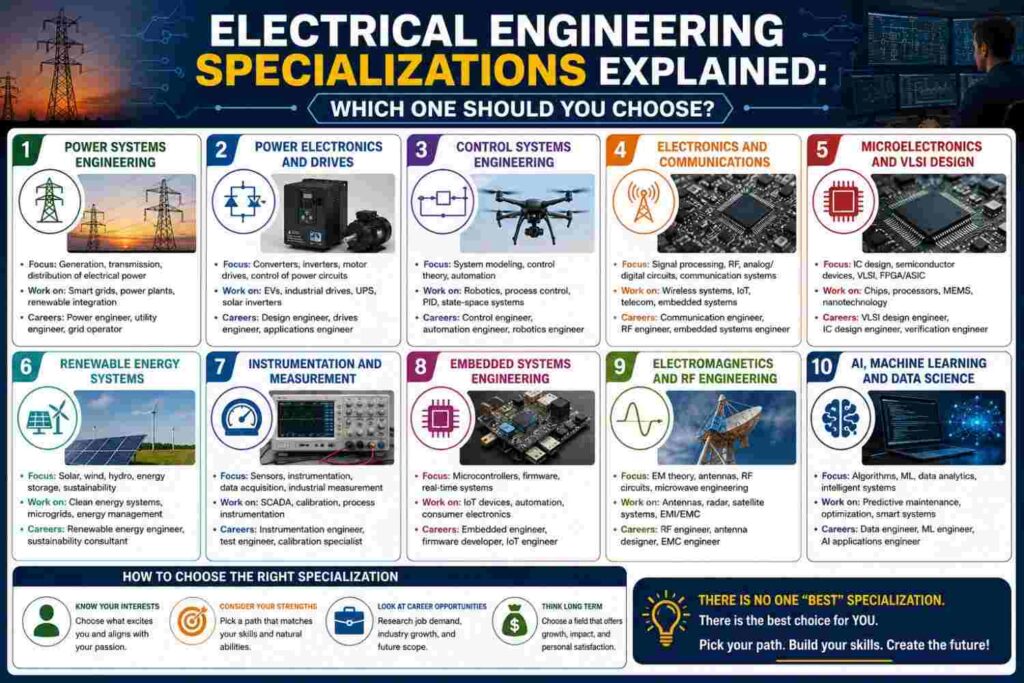
Power Systems Engineering
Power systems engineers work on the generation, transmission, and distribution of electrical power, covering everything from power plant design to grid stability, protection systems, and renewable energy integration, a specialization discussed in depth in our dedicated power systems career article, particularly relevant given Nigeria’s ongoing power sector development and infrastructure needs.
Control Systems Engineering
Control systems engineers design systems that automatically regulate and manage the behavior of other systems, from industrial process control to robotics to automotive systems, a specialization covered in depth in our dedicated control systems article, involving significant mathematical modeling alongside practical implementation skills.
Electronics and Circuit Design
This specialization focuses on designing and analyzing electronic circuits and systems, from basic analog and digital circuits through more specialized areas like RF (radio frequency) design, involving genuinely hands-on circuit design and PCB layout skills discussed in our dedicated software article.
Telecommunications Engineering
Telecommunications specialists work on communication systems and networks, from mobile networks to satellite communications to fiber optic systems, involving significant signal processing knowledge and increasingly overlapping with computer networking and data communications concepts.
Instrumentation and Control
Closely related to control systems but with particular focus on measurement and sensing technology, instrumentation engineers work extensively with sensors, measurement systems, and the interface between physical processes and control systems, genuinely important across industrial, oil and gas, and process industries.
Renewable Energy Engineering
An increasingly prominent specialization focused specifically on solar, wind, and other renewable generation technologies, alongside energy storage and grid integration challenges, a genuinely growing field given global and Nigeria-specific renewable energy development, discussed throughout this site’s solar energy articles.
A Comparison Table
| Specialization | Core Focus | Genuinely Relevant Skills |
|---|---|---|
| Power Systems | Generation, transmission, distribution | Power system analysis software, protection systems |
| Control Systems | Automated regulation of systems | MATLAB/Simulink, mathematical modeling |
| Electronics/Circuit Design | Circuit and hardware design | Circuit simulation, PCB design |
| Telecommunications | Communication systems and networks | Signal processing, networking concepts |
| Instrumentation/Control | Measurement and process control | Sensor technology, PLC programming |
| Renewable Energy | Solar, wind, energy storage | Power systems knowledge, sustainability concepts |
Why Specializations Overlap More Than They Might First Appear
These categories aren’t rigidly separate in practice; a power systems engineer working on renewable integration draws on renewable energy concepts, a control systems engineer in industrial automation draws on instrumentation knowledge, meaning genuine cross-specialization understanding, rather than viewing your chosen specialization as an isolated silo, generally serves engineers well throughout a real career that often involves work spanning multiple traditional specialization boundaries.
How to Actually Decide: Practical Steps Beyond Guessing
- Seek out internship or SIWES placements, discussed in our dedicated articles on both, across different specialization areas if possible, to gain genuine, practical exposure before fully committing.
- Talk to practicing engineers in specializations you’re considering about their actual day-to-day work, which often differs from textbook descriptions.
- Consider genuine career demand and opportunities in your specific region or intended job market, alongside personal interest.
- Take elective coursework in multiple specialization areas before fully committing, if your program’s structure allows this flexibility.
Emerging and Interdisciplinary Areas Worth Watching
Beyond the traditional specializations discussed above, emerging areas like smart grid technology, electric vehicle systems, and the growing intersection of electrical engineering with data science and machine learning represent genuinely developing fields that don’t always fit neatly into traditional specialization categories, worth keeping on your radar even if your primary focus lies within one of the more established specializations, since these interdisciplinary skills increasingly complement traditional expertise across the field.
How to Explore a Specialization Before Fully Committing to It
Rather than relying purely on course descriptions or secondhand impressions, genuinely exploring a specialization before committing deeply, working through a small self-directed project in that area, attending a relevant student chapter talk or webinar, or specifically requesting exposure to that area during an internship or SIWES placement, discussed in our dedicated articles on both, gives you concrete, firsthand experience of whether the specialization’s actual day-to-day work genuinely matches your interests and strengths, considerably reducing the risk of committing based on an inaccurate or incomplete impression.
Common Misconceptions
- “Your chosen specialization permanently locks you into that exact career path forever.” Many engineers transition between related specializations throughout their careers as interests and opportunities evolve.
- “Some specializations are objectively better than others regardless of personal fit.” The right specialization depends genuinely on individual interest, aptitude, and career goals, not a universal ranking.
- “You must fully decide your specialization very early in your studies.” While earlier clarity helps focus your skill-building, many programs allow reasonable flexibility to explore before committing more firmly.
Frequently Asked Questions
Which specialization currently offers the strongest job market in Nigeria specifically?
Power systems and renewable energy have seen particularly strong demand given Nigeria’s ongoing power sector challenges and development, though genuine opportunities exist across all specializations depending on specific industry sectors and individual skill development.
Can I meaningfully change specialization focus after graduation?
Yes, particularly between related specializations; additional coursework, certifications, or on-the-job learning can support a genuine transition, though some specializations require more substantial additional preparation than others depending on how different the underlying skill sets are.
Is it better to specialize narrowly or maintain broad, general electrical engineering knowledge?
A reasonable balance, genuine depth in your chosen specialization alongside maintained broad foundational knowledge, generally serves engineers better than either extreme narrow specialization or purely general knowledge without genuine depth anywhere.
Final Thoughts
Choosing an electrical engineering specialization benefits from genuine understanding of what each area actually involves day-to-day, gained through internships, conversations with practicing engineers, and hands-on exploration, rather than choosing based on assumption or limited textbook descriptions alone. Whatever specialization you choose, maintaining awareness of how it connects to and overlaps with related areas serves you well throughout a genuinely dynamic, evolving engineering career.