Given Nigeria’s persistent grid reliability challenges, many homeowners genuinely wonder whether solar power could completely replace grid electricity rather than merely supplementing it.
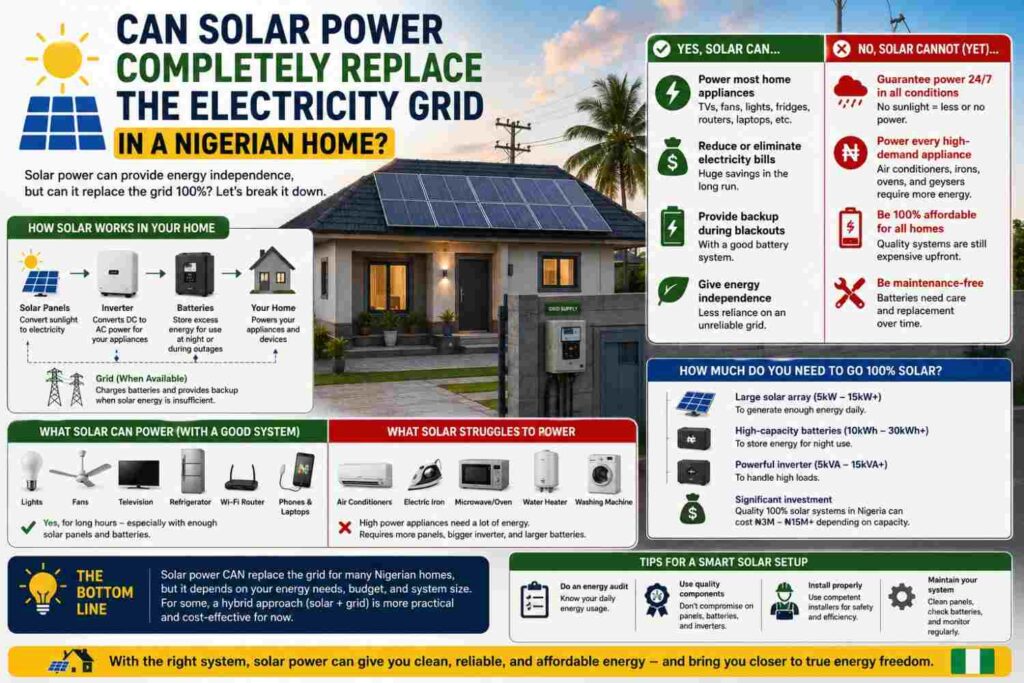
This article examines what would actually be required and whether it’s genuinely practical for a typical Nigerian home.
What “Completely Replacing the Grid” Actually Requires
Fully replacing grid electricity means your solar and battery system must reliably supply 100% of your household’s energy needs year-round, including during Nigeria’s rainy season with reduced sunlight, discussed in our dedicated rainy weather solar article, and during periods of unusually high demand, without any grid fallback available.
Sizing Requirements for Complete Grid Independence
Achieving genuine complete independence requires substantially oversizing both your solar panel array and battery storage capacity beyond what a grid-supplemented system needs, specifically to reliably cover worst-case low-generation periods and peak demand days without any grid backup to fall back on, discussed further in our dedicated panel-count sizing article.
The Genuine Cost Implications
| System Type | Relative Cost | Reliability Approach |
|---|---|---|
| Grid-supplemented solar | Lower | Solar/battery covers most needs, grid fills gaps |
| Fully independent solar | Substantially higher | Solar/battery must cover all needs unassisted |
The substantial additional oversizing required for complete independence, larger panel arrays, significantly larger battery banks, sometimes backup generator capacity for true worst-case scenarios, represents genuinely significant additional cost compared to a well-designed grid-supplemented system.
Seasonal Variation: A Genuine Practical Challenge
Nigeria’s distinct wet and dry seasons create genuine variation in solar generation potential, discussed in our rainy weather article, meaning a system sized adequately for dry season generation may struggle during extended cloudy periods without either substantial battery reserve or backup generation capacity, a genuinely important sizing consideration for anyone pursuing complete grid independence.
Where Complete Solar Independence Genuinely Makes Sense
Complete grid independence is most genuinely practical and cost-justified for locations with no reasonable grid access at all (genuinely off-grid rural locations), or for consumers with sufficient budget who specifically value complete independence from grid reliability issues and billing regardless of the additional cost involved.
Why Most Nigerian Homes Genuinely Benefit More From a Hybrid Approach
For most homes with existing grid access, even unreliable access, a hybrid approach, solar and battery covering a substantial portion of typical usage while retaining grid connection (and often generator backup) for worst-case periods, discussed throughout our solar and inverter articles, generally provides better genuine value than the substantial additional investment required for complete, unassisted independence.
A Practical Middle-Ground Worth Considering First
Before committing to either extreme, purely grid-dependent or fully independent, many homeowners genuinely benefit from starting with a moderately sized hybrid solar and battery system covering essential loads, refrigeration, lighting, key electronics, discussed throughout our appliance articles, then evaluating actual real-world performance and remaining grid dependence before deciding whether further expansion toward greater independence is genuinely worth the additional investment for their specific situation.
Common Misconceptions
- “Any reasonably sized solar system can achieve complete grid independence.” Complete independence requires substantially larger, more expensive systems than typical grid-supplemented installations.
- “Grid unreliability alone justifies pursuing complete solar independence regardless of cost.” A well-designed hybrid system often addresses grid unreliability concerns more cost-effectively than complete independence.
- “Seasonal variation doesn’t meaningfully affect solar system sizing decisions.” Nigeria’s genuine seasonal generation variation is an important, sometimes underestimated sizing consideration.
Frequently Asked Questions
How much more expensive is a complete-independence system compared to a hybrid grid-supplemented one?
This varies considerably by household consumption and specific system design, but complete independence typically requires meaningfully larger investment, often multiples of a well-sized hybrid system’s cost, given the oversizing required for worst-case reliability.
Is battery technology advancing enough to make complete solar independence more affordable soon?
Battery costs, particularly lithium technology discussed in our dedicated battery comparison article, have been genuinely declining over time, gradually improving the economics of larger battery systems, though complete independence remains a substantially larger investment than hybrid approaches currently.
Should I consider complete solar independence if I experience very frequent, extended grid outages?
Very frequent, extended outages genuinely shift the cost-benefit calculation somewhat toward larger independent systems, though carefully evaluating actual costs against a well-designed hybrid alternative remains worthwhile before committing to full independence.
Final Thoughts
While solar power can technically replace grid electricity completely, doing so reliably requires substantially larger, more expensive systems than typical grid-supplemented installations, particularly given Nigeria’s seasonal generation variation. For most Nigerian homes with existing grid access, a well-designed hybrid approach generally provides better practical value than pursuing complete, unassisted solar independence.