
Soft starters and Variable Frequency Drives both address the high inrush current problem that occurs when starting large electric motors directly, leading many students and technicians to confuse the two or assume they’re interchangeable. This article explains the genuine differences and how to decide which one a given application actually needs.
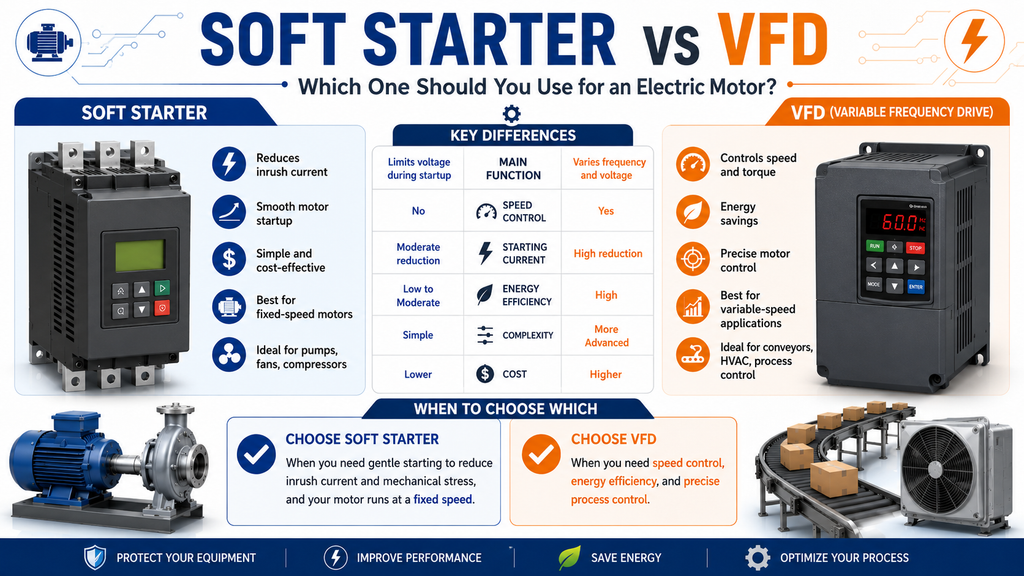
The Shared Problem Both Devices Address
When an induction motor starts directly across the line, it draws significantly higher inrush current, often several times its normal running current, discussed further in our motor overheating article, creating mechanical stress, voltage dips affecting other equipment, and reduced equipment lifespan; both soft starters and VFDs address this problem, but through genuinely different technical approaches.
How a Soft Starter Actually Works
A soft starter uses electronic components (typically thyristors) to gradually ramp up the voltage supplied to the motor during starting, providing controlled, gradual acceleration to full speed, after which the soft starter typically bypasses itself and the motor runs directly on full line voltage at fixed speed for the remainder of operation.
How a VFD Differs in Its Approach
As discussed in our dedicated VFD article, a VFD converts incoming power to DC and back to AC at a controllable frequency, providing not just smooth starting but genuine continuous variable speed control throughout the entire operating period, not just during the starting sequence.
A Direct Comparison Table
| Factor | Soft Starter | VFD |
|---|---|---|
| Addresses starting inrush | Yes | Yes |
| Continuous variable speed control | No (fixed speed after starting) | Yes, throughout operation |
| Relative cost | Generally lower | Generally higher |
| Energy savings potential | Limited (fixed speed operation) | Significant for variable-load applications |
| Complexity | Simpler | More complex |
When a Soft Starter Is the More Appropriate Choice
Applications that genuinely only need smoother starting, without requiring variable speed during normal operation, conveyor systems running at a fixed operational speed, certain pump applications with relatively constant demand, or situations where budget constraints favor the generally lower cost of soft starters, are typically well served by soft starters rather than the added complexity and cost of a full VFD.
When a VFD Is the More Appropriate Choice
Applications genuinely requiring variable speed operation matched to changing process demand, pumps and fans with variable flow requirements, discussed in our VFD article, processes requiring precise speed control for quality reasons, or situations where the potential energy savings from variable speed operation justify the additional VFD investment, are better served by VFDs despite their higher relative cost and complexity.
A Practical Decision Framework
- Does the application need variable speed during normal operation, or just smooth starting? Variable speed needs point toward VFD; starting-only needs may suit a soft starter.
- Would energy savings from variable speed operation justify additional cost? Significant variable-load applications often favor VFD investment.
- What does budget and project complexity tolerance allow? Soft starters offer a simpler, lower-cost solution when variable speed isn’t genuinely required.
Installation and Space Considerations Worth Factoring In
Beyond the functional differences discussed above, soft starters generally require less panel space and simpler installation than VFDs, which typically need additional cooling considerations, more careful cable routing to manage electrical noise, and generally more complex commissioning; for facilities with limited panel space or installation budget, these practical considerations can meaningfully factor into the final decision alongside the core functional requirements.
Common Misconceptions
- “A VFD is always the objectively better choice regardless of application.” For applications not genuinely requiring variable speed operation, a soft starter’s lower cost and simplicity often makes it the more sensible practical choice.
- “Soft starters provide meaningful energy savings similar to VFDs.” Since soft starters run motors at fixed speed after starting, they don’t provide the ongoing energy savings VFDs can achieve in variable-load applications.
- “These two devices can be used interchangeably without consideration of application needs.” The genuine functional difference, fixed-speed versus continuous variable-speed operation, makes application requirements the key deciding factor.
Frequently Asked Questions
Can a soft starter be upgraded to a VFD later if requirements change?
Generally this requires replacing the device rather than upgrading, since they use genuinely different internal technology, though the motor itself typically doesn’t need replacement.
Is a soft starter simply a cheaper, lower-quality version of a VFD?
No, they serve genuinely different functional purposes; a soft starter isn’t a lesser VFD but a distinct device optimized specifically for starting control rather than continuous speed variation.
Which device is more commonly used in typical industrial settings?
Both remain widely used; the appropriate choice depends entirely on whether the specific application genuinely requires continuous variable speed control or only smoother starting characteristics.
Final Thoughts
Soft starters and VFDs both address motor starting inrush current but through genuinely different approaches, with VFDs additionally providing continuous variable speed control that soft starters don’t offer. Choosing correctly between them depends on genuinely evaluating whether a specific application needs variable speed during normal operation or only smoother, controlled starting, balanced against relative cost and complexity considerations.