
Graduating with a solid grasp of electrical engineering theory is essential, but the gap between academic coursework and what employers actually expect on day one can feel surprisingly wide without deliberate preparation. This article covers the practical skills genuinely worth building before you graduate, beyond what your curriculum alone typically covers.
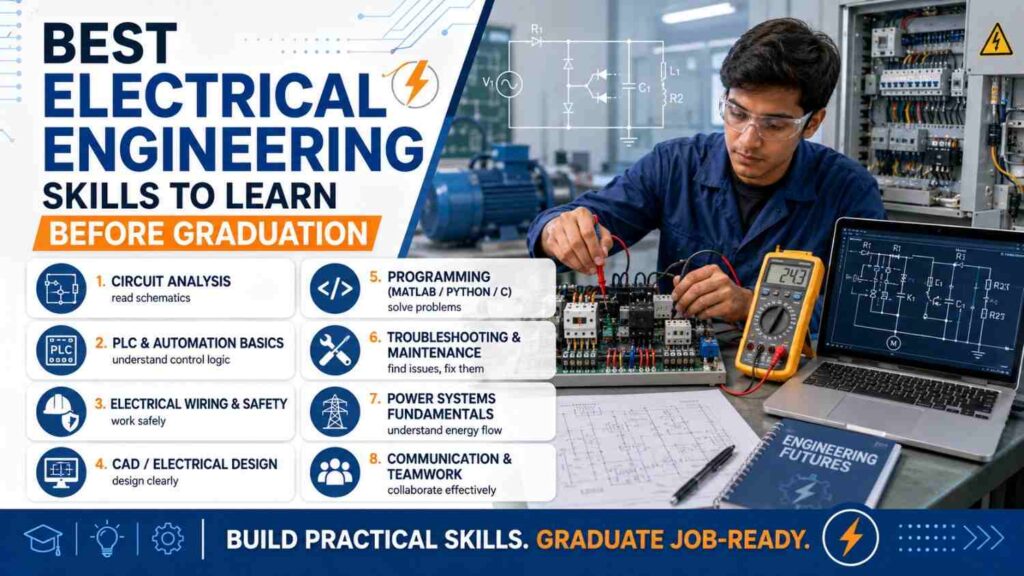
1. Genuine Proficiency in At Least One Simulation Tool
While most programs introduce simulation software, discussed further in our dedicated software and MATLAB articles, genuine hands-on proficiency, actually building and troubleshooting circuits or systems in tools like MATLAB, Simulink, or Proteus, rather than passive familiarity from occasional coursework use, meaningfully distinguishes candidates during internship and job applications.
2. Basic PLC Programming Exposure
Programmable Logic Controllers remain central to industrial automation across manufacturing, oil and gas, and process industries, discussed in depth in our dedicated PLC beginner’s article; even basic, self-taught exposure before graduation gives you a meaningful head start over peers whose only exposure comes from a single course module, if their curriculum covers it at all.
3. Reading and Interpreting Circuit and Wiring Diagrams Fluently
Beyond theoretical circuit analysis, genuine fluency in reading real-world electrical schematics, single-line diagrams, and wiring diagrams as they actually appear in industry documentation is a practical skill worth deliberately developing, since this differs meaningfully from the simplified diagrams typical in academic textbooks.
4. Basic Programming Beyond Engineering-Specific Tools
General programming competency, particularly Python given its growing role in data analysis, automation scripting, and increasingly in engineering applications, is genuinely valuable even for students not pursuing software-focused specializations, since modern electrical engineering practice increasingly intersects with programming and data analysis skills.
5. Practical Understanding of Safety Standards and Practices
Theoretical safety knowledge from coursework often differs from practical, on-the-job safety culture and standards compliance expected in real workplace settings; seeking out opportunities to understand actual industry safety practices, whether through internships, site visits, or professional body resources, gives genuine practical grounding beyond textbook safety theory.
6. Report Writing and Technical Communication
Engineers spend genuinely significant time writing reports, documentation, and technical communications, a skill often underemphasized relative to technical coursework despite its real, ongoing importance throughout an engineering career; deliberately practicing clear, structured technical writing during your studies pays dividends well beyond graduation.
A Quick Self-Assessment Table
| Skill Area | Why It Matters |
|---|---|
| Simulation software proficiency | Directly applicable to design and analysis roles |
| Basic PLC programming | Central to industrial automation careers |
| Real-world schematic reading | Essential for practical, on-site engineering work |
| General programming (Python) | Increasingly relevant across nearly all engineering specializations |
| Practical safety knowledge | Directly relevant to workplace readiness |
| Technical writing | Genuinely used throughout an entire engineering career |
Why Internships and SIWES Placements Are Where This Comes Together
As discussed in our dedicated internship preparation and SIWES articles, structured industrial placements are specifically where these practical skills, PLC exposure, real-world diagram reading, workplace safety culture, and professional communication, genuinely develop and consolidate, making proactive preparation before your placement genuinely valuable for getting the most out of that limited time.
Building a Portfolio of Practical Projects
Beyond formal coursework, undertaking self-directed or small group projects, a basic automation project, a simulation exercise, or a practical circuit build, creates a genuine, demonstrable portfolio you can discuss concretely in interviews, distinguishing you from candidates who can only describe coursework in general, less specific terms.
Networking and Professional Community Engagement
Beyond purely technical skills, building genuine connections with practicing engineers, whether through professional body student chapters, engineering societies, or informal mentorship relationships, provides real value throughout your career, from internship leads to job referrals to ongoing technical guidance, making this relational skill genuinely worth developing alongside the technical competencies discussed above rather than treating career preparation as a purely technical exercise.
Balancing Skill-Building With Academic Coursework Demands
A genuine, practical concern for many students is finding time for this additional skill-building alongside already-demanding coursework, exams, and assignments; rather than treating these as competing priorities requiring an impossible choice, deliberately integrating practical skill-building into existing coursework wherever possible, applying MATLAB skills to assignments that technically only require basic calculations, or writing lab reports with genuine professional formatting rather than minimum-effort submissions, lets you build these practical skills incrementally without requiring large blocks of separate dedicated time, making steady progress genuinely achievable even within a demanding academic schedule.
Common Misconceptions
- “Strong grades alone are sufficient preparation for the job market.” Practical, demonstrable skills genuinely matter alongside academic performance for most employers.
- “Programming skills are only relevant for software-focused specializations.” Basic programming and data analysis skills increasingly apply across virtually all electrical engineering specializations.
- “These skills can all be learned on the job after graduation.” While some learning genuinely happens on the job, arriving with foundational practical skills already in place makes you a considerably stronger, more competitive candidate.
Frequently Asked Questions
How can I build these skills without access to expensive lab equipment?
Simulation software, many with free or student-licensed versions, discussed in our dedicated software article, allows substantial practical skill-building without requiring physical lab access, alongside free online resources and tutorials for programming and PLC basics.
Should I focus on breadth across all these areas or depth in one specific area?
A reasonable baseline across all these areas, combined with deeper focus in whichever specialization genuinely interests you, discussed in our dedicated specializations article, generally serves students better than extreme depth in just one area while neglecting the others entirely.
Is it worth pursuing certifications in these areas before graduation?
Relevant certifications, particularly in widely recognized tools or standards, can meaningfully strengthen your resume, though genuine practical competency demonstrated through real projects generally matters more to employers than certification alone.
Final Thoughts
The gap between academic electrical engineering coursework and workplace readiness is genuinely bridgeable through deliberate, proactive skill-building in simulation tools, PLC basics, practical diagram reading, general programming, workplace safety understanding, and technical communication. Investing time in these areas before graduation, rather than assuming they’ll develop automatically on the job, gives you a genuinely stronger foundation for whatever specialization and career path you pursue.