
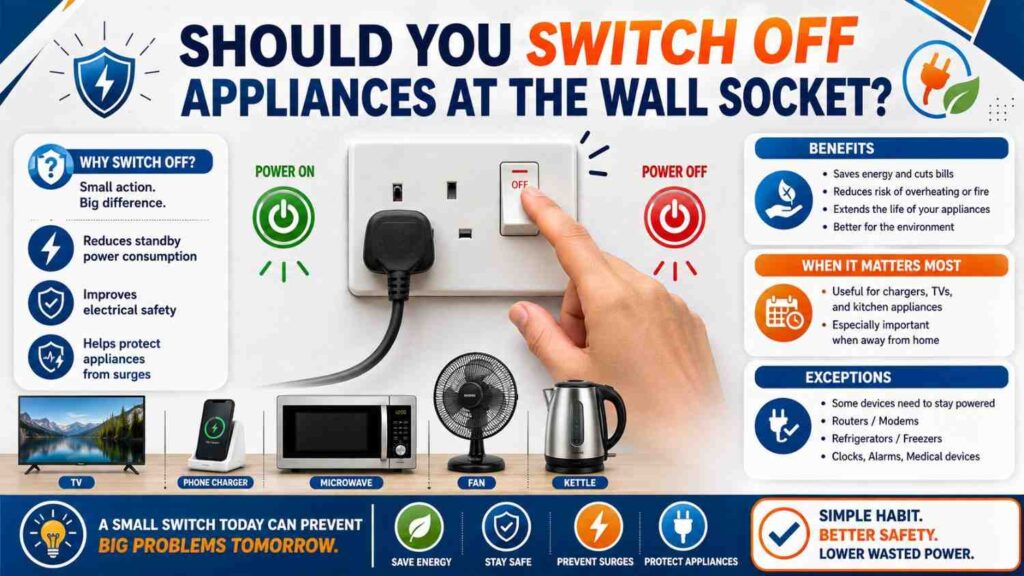
The habit of switching off appliances at the wall socket, rather than simply leaving them plugged in and switched on standby or leaving the appliance’s own power button off, is common in many Nigerian households, and understanding whether this genuinely matters, for both electricity savings and safety, deserves a proper, balanced look. This article examines both angles.
The Electricity Savings Angle
As discussed in our dedicated phantom load article regarding chargers, many appliances draw a small amount of standby power even when switched off at their own power button but still connected to a live wall socket, meaning switching off at the wall socket itself, cutting this connection entirely, does capture this small standby draw that would otherwise continue, though as established in that article, the actual electricity savings involved are typically quite modest for most modern appliances.
Which Appliances Have Meaningful Standby Draw Worth Addressing
Some appliances draw more meaningful standby power than others: older televisions and set-top boxes, particularly those with “instant on” features or clock displays, microwave ovens with digital clock displays, and older electronics generally tend toward higher standby draw than modern, well-designed equivalents, making wall-socket switching genuinely more worthwhile for these specific categories compared to simpler appliances with minimal standby circuitry.
A Reference Table for Standby Draw by Appliance Type
| Appliance | Typical Standby Draw | Worth Switching Off at Socket? |
|---|---|---|
| Phone/laptop chargers (unused) | Very low (~0.1-0.3W) | Minor benefit, mainly for safety/longevity |
| Older TV/set-top box | Moderate (5-15W) | Genuinely worthwhile |
| Microwave with clock display | Low-moderate (2-5W) | Modest benefit |
| Modern LED TV (standby mode) | Low (1-3W) | Modest benefit |
| Desktop computer/monitor (standby) | Low-moderate (varies) | Modest benefit |
The Safety and Equipment Longevity Angle
Beyond pure electricity savings, switching off at the wall socket provides genuine additional benefits: protection from voltage spikes or surges, discussed in our dedicated surge protector article, reaching the appliance while unattended, reduced fire risk from any developing internal fault in the appliance or its cord while unsupervised, and generally extended equipment lifespan from reduced continuous electrical stress, benefits that apply regardless of an appliance’s specific standby power draw and that many households find genuinely worthwhile independent of the modest electricity savings involved.
Why This Habit Matters More During Nigeria’s Voltage Instability
Given Nigeria’s genuine grid voltage fluctuation issues, discussed throughout this site’s wiring and troubleshooting articles, switching off sensitive electronics at the wall socket, particularly during periods of known instability or when leaving the house for extended periods, provides a meaningful protective benefit beyond typical developed-grid contexts where this habit might matter comparatively less.
A Balanced, Practical Approach
Rather than treating wall-socket switching as either essential for every single appliance or entirely pointless, a balanced approach prioritizes it for appliances with genuinely meaningful standby draw, sensitive or expensive electronics benefiting from surge protection, and situations involving extended absence or known voltage instability, while not feeling obligated to unplug every single low-draw device like phone chargers purely for electricity savings, where the benefit is genuinely minimal.
Building a Simple Household Routine Around This Habit
Rather than deciding case-by-case each time, establishing a simple, consistent routine, for example switching off entertainment electronics and non-essential appliances at the socket specifically when leaving home for extended periods or overnight, while leaving continuously operating essentials like refrigerators untouched, makes this a sustainable, low-effort habit rather than a source of daily deliberation or forgotten inconsistency.
Common Misconceptions
- “Switching off at the wall socket saves substantial electricity for every appliance.” The actual savings vary considerably by appliance type, and are genuinely modest for many modern, low-standby-draw devices.
- “This habit is purely about electricity savings.” Genuine safety and equipment protection benefits exist independent of the electricity cost angle, particularly relevant given Nigeria’s voltage instability.
- “If an appliance’s power button is off, there’s no meaningful reason to also switch off the socket.” For voltage spike protection and fire safety specifically, the socket-level disconnection provides genuine additional benefit beyond simply powering off the device itself.
Frequently Asked Questions
Does repeatedly switching wall sockets on and off cause any wear or safety concern itself?
Quality switches are designed for extensive on-off cycling without meaningful wear; this isn’t a genuine concern for normal household use, even with frequent switching.
Is it worth switching off my refrigerator at the wall socket when leaving for a short trip?
Generally not recommended for short trips, since refrigerators need continuous operation to maintain food safety; this habit applies more sensibly to non-essential electronics and appliances rather than continuously operating appliances like refrigerators.
Are surge protector power strips a good alternative to individually switching appliances at the wall?
Yes, a quality surge protector strip, discussed in our dedicated surge protector article, provides meaningful voltage spike protection for multiple devices simultaneously, offering similar protective benefit with somewhat more convenience than individually managing each wall socket.
Final Thoughts
Switching off appliances at the wall socket offers genuine, if often modest, electricity savings for appliances with meaningful standby draw, alongside real safety and equipment protection benefits that matter independently of the electricity angle, particularly relevant given Nigeria’s voltage instability. A balanced, appliance-specific approach, rather than either universal habit or complete disregard, makes the most practical sense for most households.