
A conveyor running backward, a pump that spins but delivers almost no flow, or a fan pushing air the wrong way through a duct are all classic symptoms of a three-phase motor turning in the wrong direction.
The fix is often remarkably simple once you understand the principle behind it, but doing it safely and correctly, especially on a running installation, still requires knowing exactly what you are changing and what to check afterward.
The Principle Behind Direction Reversal
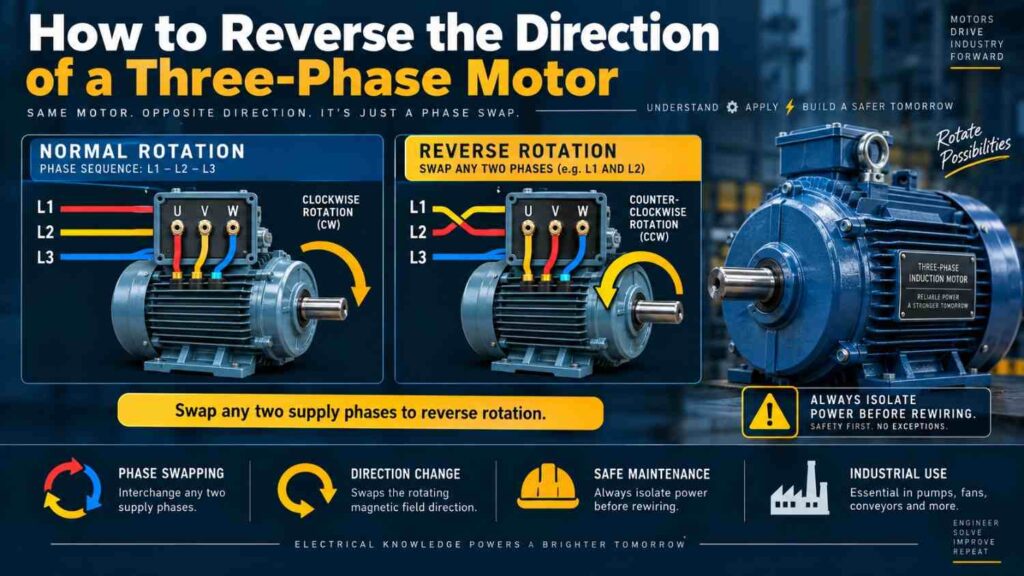
A three-phase motor’s direction of rotation is determined entirely by the sequence in which the three phases reach their peak voltage, known as the phase sequence or phase rotation. The stator windings are arranged so that the rotating magnetic field sweeps around the motor in one direction for a given phase sequence, say L1-L2-L3, and in the opposite direction if that sequence is reversed.
Swapping the connection order of any two of the three supply phases at the motor terminals reverses the phase sequence the motor sees, which reverses the direction of the rotating field, and the rotor simply follows.
The Practical Method: Swap Any Two Phases
In practice, reversing a three-phase motor means physically swapping the connections of any two of the three phase conductors at the motor terminal box, while leaving the third phase connected exactly where it was. It genuinely does not matter which two of the three you choose to swap, the result is the same reversal of rotation either way.
What matters is doing this at a point where you can positively identify and control all three conductors, typically the motor terminal box itself or a dedicated reversing contactor arrangement, rather than guessing at connections inside a junction box shared with other circuits.
- Isolate and lock out the motor’s power supply completely before touching any terminals, confirming zero voltage with a tested meter.
- Identify the three phase conductors at the motor terminal box clearly, using existing labeling or continuity tracing back to the supply if labels are missing or unclear.
- Choose any two of the three conductors and swap their terminal connections, leaving the third phase conductor exactly as it was.
- Double-check the connections are tight and correctly matched to the terminal markings before restoring power.
- Restore power and briefly bump-start the motor, or run it under load if safe to do so, to confirm the new direction is correct.
Using a Reversing Contactor Arrangement Instead
Where a motor genuinely needs to run in both directions as part of normal operation, rather than a one-time correction, the practical solution is a reversing starter built from two contactors wired so that one produces the forward phase sequence and the other produces the reversed sequence, with mechanical and electrical interlocking to guarantee both can never close at the same time.
This interlocking is not optional, since if both contactors closed simultaneously, two phases would be shorted together through the contactor contacts, which produces a severe short circuit. Reversing duty like this is commonly built using the same contactor and relay principles discussed in our dedicated contactors and relays article, and is frequently automated through a PLC or dedicated control circuit in industrial installations.
Why VFD-Controlled Motors Reverse Differently
If a motor is driven through a variable frequency drive, physically swapping wires at the motor is rarely the right approach, since the VFD sits between the supply and the motor and generates its own output phase sequence electronically.
Reversing direction on a VFD-controlled motor is normally done through the drive’s own reverse command, either a parameter setting, a dedicated digital input, or a control system command, all discussed more broadly in our dedicated VFD article, and this method is both safer and far more convenient for applications needing frequent direction changes.
| Method | How Direction Is Reversed | Best Suited For |
|---|---|---|
| Manual terminal swap | Physically swap any two phase conductors | One-time correction, fixed direction |
| Reversing contactor pair | Interlocked contactors switch phase sequence | Frequent forward/reverse operation |
| VFD reverse command | Drive electronically reorders output phases | Motors already run through a VFD |
Checks to Make Before and After Reversing
Before reversing anything, confirm that the driven equipment can actually tolerate running in the opposite direction, since some pumps, fans, and gearboxes are specifically designed for one rotational direction only, and running them backward can damage seals, bearings, or the driven mechanism even if the motor itself handles it fine.
After reversing, it is worth briefly checking motor current and listening for unusual noise, since a mechanical coupling, belt, or fan cover that was set up expecting the original direction can sometimes cause issues once the motor spins the other way. On new or unfamiliar equipment, checking the equipment’s own documentation for any allowed rotation direction is a small step that avoids a potentially costly mistake.
Common Misconceptions
- “You need to swap all three phases to reverse a motor.” Swapping all three phases keeps the sequence identical and changes nothing about direction; only swapping exactly two conductors reverses rotation.
- “Reversing direction is done by changing something inside the motor windings.” Direction is a function of supply phase sequence, not internal winding connections, which is why the fix happens at the terminal connections, not inside the motor.
- “Any motor can be safely run in either direction without consequence.” Some pumps, fans, and gearboxes are built for one direction only, and running them reversed can cause mechanical damage even though the motor itself runs fine.
Frequently Asked Questions
How can I tell which two phases were originally swapped if labeling is missing?
It does not matter which specific two you swap back or forward, since swapping any two of the three always produces the same reversal, so you can simply pick any two conductors to swap without needing to trace the original wiring history.
Is it safe to reverse a motor while it is still running?
No, always bring the motor to a complete stop and isolate power before making any terminal changes; reversing connections on an energized or spinning motor is both an electrical and mechanical safety hazard.
Will reversing a motor’s direction affect its starting current or protection settings?
No, reversing direction does not change the motor’s electrical characteristics, so existing overload and protection settings remain valid after the change.
Final Thoughts
Reversing a three-phase motor comes down to one simple principle, swap any two of the three supply phases and the direction flips, but applying that principle safely means isolating power properly, using interlocked reversing contactors or a drive command where direction needs to change routinely, and confirming the driven equipment can actually tolerate the new direction.
Getting this right the first time avoids both electrical hazards and unnecessary mechanical damage to pumps, fans, and other equipment that were never designed to run backward.