
A motor nameplate packs a surprising amount of useful information into a small metal or plastic plate, but to anyone unfamiliar with the codes and abbreviations, it can look like a wall of cryptic numbers.
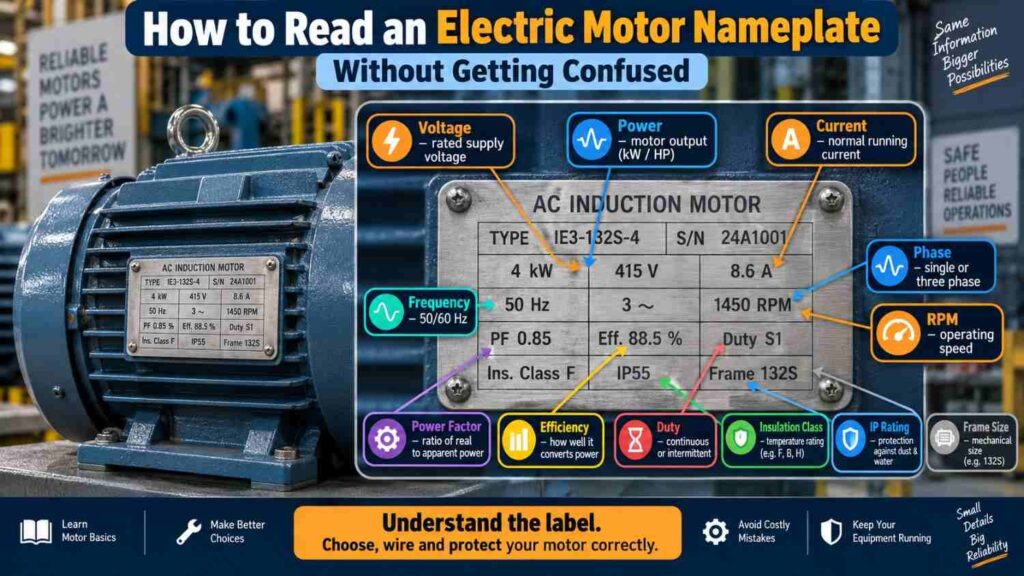
Learning to read it properly means you can correctly size protection, confirm compatibility with your supply, and diagnose problems, without guessing or relying on someone else’s word for what the motor can actually handle.
Why the Nameplate Matters More Than People Assume
The nameplate is the manufacturer’s official statement of exactly what conditions the motor is designed and rated to operate under, and every protection setting, from overload relay current to voltage compatibility checks, should trace back to these figures rather than assumptions or a similar-looking motor’s typical values. Getting even one nameplate figure wrong, most commonly the rated full-load current used to set an overload relay, is a common and entirely avoidable cause of either premature nuisance tripping or, worse, inadequate protection that lets a genuine overload condition run unchecked.
The Core Electrical Ratings
Voltage on the nameplate specifies the supply voltage, or range, the motor is designed for, and often lists two figures separated by a slash for motors that can be connected in either star or delta configuration at different voltages. Current, usually labeled as full-load current or FLA, is the amount of current the motor draws at its rated voltage, frequency, and full mechanical load, and this is the single most important figure for setting overload protection correctly, a topic covered in more depth in our dedicated motor starters article. Frequency, almost universally 50Hz across Nigeria, must match the actual supply frequency, since running a motor designed for one frequency on a meaningfully different one changes both its speed and its magnetizing behavior.
Power, Speed, and Poles
Power rating, usually given in kilowatts or horsepower, states the mechanical power the motor delivers at its shaft under rated conditions, not the electrical power it draws, which is always somewhat higher due to the motor’s own internal losses. Rated speed, given in RPM, is the actual full-load running speed, and comparing this figure against the theoretical synchronous speed for the motor’s pole count reveals the motor’s rated slip, a useful diagnostic figure discussed fully in our dedicated motor slip article. The number of poles is not always printed directly but can be worked out from the rated speed, since a speed near 1500 RPM on 50Hz supply indicates a four-pole motor, near 3000 RPM a two-pole motor, and near 1000 RPM a six-pole motor.
| Nameplate Item | What It Tells You | Why It Matters |
|---|---|---|
| Voltage | Supply voltage the motor is designed for | Confirms compatibility with available supply |
| Full-load current (FLA) | Current drawn at rated full load | Sets correct overload relay pickup |
| Frequency | Design supply frequency | Confirms correct speed and magnetizing behavior |
| Power rating (kW/HP) | Mechanical output at the shaft | Confirms the motor suits the driven load |
| Rated speed (RPM) | Actual full-load running speed | Reveals slip and confirms pole count |
| Insulation class | Maximum temperature the winding insulation tolerates | Guides thermal protection and environment suitability |
| IP rating | Protection level against dust and moisture | Confirms suitability for the installation environment |
Star and Delta Connection Markings
Many three-phase motors are built so their windings can be connected in either star or delta configuration, and the nameplate typically shows this as a voltage pair such as 380/220V, or as a connection diagram showing star and delta terminal arrangements. This matters directly for star-delta starting, discussed in our dedicated star-delta starting article, since the starter must switch the windings between these two configurations correctly and the nameplate is exactly where you confirm the motor is actually built to support that arrangement rather than assuming it does.
Insulation Class and Duty Rating
The insulation class, shown as a single letter such as B, F, or H, indicates the maximum temperature the winding insulation is designed to tolerate continuously, with F being a common standard for industrial motors and higher letters generally indicating greater heat tolerance. The duty rating, often marked S1 for continuous duty, tells you whether the motor is designed to run continuously at rated load or only intermittently, which matters for applications with frequent starts and stops or cyclic loading rather than steady continuous running.
A Simple Step-by-Step Way to Read Any Nameplate
- Confirm voltage and frequency match your actual supply before doing anything else.
- Note the full-load current figure and use it directly to set overload protection.
- Check power rating against what the driven load actually needs, avoiding significant oversizing or undersizing.
- Compare rated speed to the theoretical synchronous speed for the pole count to understand the motor’s slip.
- Check insulation class and IP rating against the installation environment, particularly for dusty, humid, or outdoor locations.
- Note the star/delta voltage pairing if present, confirming compatibility with any star-delta starter fitted.
Common Misconceptions
- “The horsepower or kW figure is the electrical power the motor draws.” That figure is the mechanical output at the shaft, and actual electrical input power is always somewhat higher due to internal motor losses.
- “Any motor with roughly the right horsepower will work for a given job.” Voltage, current, speed, insulation class, and duty rating all need to match the application, not just the headline power figure.
- “Nameplate figures are rough estimates, not exact requirements.” These are the manufacturer’s tested design ratings, and protection settings and supply compatibility should be based directly on them, not treated as approximate guidance.
Frequently Asked Questions
What should I do if a nameplate is worn or unreadable?
Where possible, look up the motor’s specifications using its model and serial number through the manufacturer, or have a qualified technician measure and test the motor directly rather than guessing at ratings.
Why does my nameplate show two different current figures?
This usually corresponds to the two current values for star and delta connection, or occasionally to two different rated voltages the motor supports, and the correct figure to use depends on which configuration and voltage the motor is actually connected to.
Does the nameplate tell me if a motor is suitable for VFD use?
Some nameplates explicitly note VFD or inverter-duty suitability along with any speed range limits, but where this is not stated, it is worth checking with the manufacturer before running an older motor from a VFD, since not all standard motors are built for the electrical stresses that involves.
Final Thoughts
Once you know what each section of a motor nameplate actually represents, it stops being a confusing block of numbers and becomes the single most reliable reference for correctly protecting, connecting, and applying that motor. Taking a few minutes to read it properly before commissioning, setting protection, or diagnosing a fault consistently prevents the kind of avoidable mistakes, wrong overload settings, voltage mismatches, unsuitable environments, that shorten motor life far more often than genuine manufacturing defects do.