
RCD, RCBO and MCB are three acronyms that appear on distribution boards everywhere, often confusing homeowners who just want to know which switch controls what, and why some trip more easily than others.
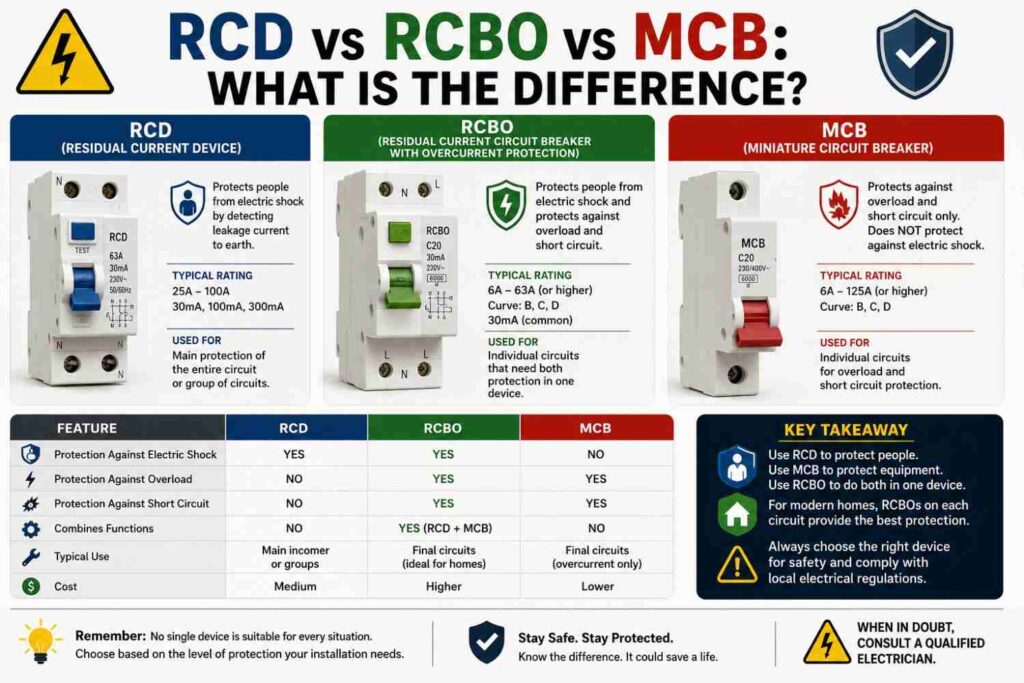
This guide explains each device clearly, what specific hazard each one protects against, and how they work together in a well-designed modern electrical installation.
What Is an MCB (Miniature Circuit Breaker)?
An MCB is the standard circuit breaker most people are familiar with: a switch-like device that automatically trips to disconnect a circuit when it detects excess current, protecting against both overload (gradual excess current) and short circuit (sudden extreme current), as covered in our dedicated circuit overload article. MCBs are rated by current (commonly 6A, 10A, 16A, 20A, 32A and similar values) matched to the cable and load they protect, and they can also be manually switched off for maintenance purposes.
What Is an RCD (Residual Current Device)?
An RCD works on a fundamentally different principle from an MCB: rather than measuring total current against a fixed threshold, it continuously compares the current flowing out through the live conductor against the current returning through the neutral conductor. Under normal, healthy conditions, these two currents should be equal. If current is leaking away through an unintended path, such as through a person accidentally contacting a live part, or through damaged insulation to earth, the RCD detects this imbalance and trips almost instantly, typically within milliseconds, specifically to protect against electric shock rather than against overload or short circuit current.
What Is an RCBO?
An RCBO (Residual Current Circuit Breaker with Overcurrent protection) combines the functions of both an MCB and an RCD into a single device, providing overload and short-circuit protection alongside earth leakage (shock) protection, all on one dedicated circuit. This allows each individual circuit to have its own combined protection, rather than sharing a single RCD across multiple circuits, which has a significant practical advantage explained further below.
Side-by-Side Comparison
| Device | Protects Against | Typical Trip Speed |
|---|---|---|
| MCB | Overload and short circuit | Time-delayed for overload; near-instant for short circuit |
| RCD | Earth leakage (shock hazard) | Near-instant (milliseconds) |
| RCBO | Both of the above, combined | Combines both response characteristics |
Why You Need Both Types of Protection
MCBs and RCDs protect against genuinely different hazards, and neither is a substitute for the other. An MCB will not necessarily trip in response to a person receiving an electric shock, since the current involved in a shock is often far below the MCB’s overload threshold, yet still dangerous or fatal to a human body. Conversely, an RCD does not protect against overload or short-circuit conditions on its own, since it is only monitoring the balance between live and neutral current, not the absolute magnitude of current flowing to a connected appliance. A properly protected modern installation therefore needs both types of protection, either as separate MCBs and RCDs, or combined as RCBOs.
Shared RCD vs Individual RCBOs: A Key Practical Difference
In many older or budget installations, a single RCD protects several circuits together, meaning an earth leakage fault on any one of those circuits trips the shared RCD, cutting power to every circuit it protects, not just the faulty one. This can mean, for example, an outdoor circuit fault unexpectedly cutting power to indoor lighting sharing the same RCD. Using individual RCBOs on each circuit instead means a fault on one circuit only affects that specific circuit, leaving all others unaffected, a meaningfully more convenient and increasingly recommended approach in modern consumer unit design, despite the somewhat higher upfront cost of RCBOs compared to a single shared RCD.
Where RCD/RCBO Protection Matters Most
- Bathrooms and areas with water exposure, where shock risk is elevated due to water’s conductivity
- Kitchens, similarly due to water exposure and frequent appliance use
- Outdoor sockets and circuits, exposed to weather and often used with garden equipment
- Circuits feeding portable equipment used outdoors or in damp conditions
- Any socket circuit, increasingly considered standard best practice regardless of specific room
Why RCDs Sometimes Trip “For No Reason”
An RCD tripping without an obvious cause is often not actually a false alarm; small, genuine leakage currents can accumulate from multiple appliances (particularly some electronics with filtering capacitors, or appliances with developing minor insulation issues) to a level that crosses the RCD’s trip threshold, even without any single appliance having an obvious, severe fault. Persistent unexplained tripping warrants investigation by a qualified electrician, since it may indicate a genuine, if minor, developing fault somewhere on the protected circuits rather than a nuisance to simply be worked around by resetting repeatedly.
Understanding RCD Sensitivity Ratings
RCDs are rated by their trip sensitivity, commonly expressed in milliamps (mA), with 30mA being the standard sensitivity for protecting people against electric shock in most residential applications. Higher sensitivity ratings (lower mA values) trip at smaller leakage currents, providing more sensitive protection but potentially increasing nuisance tripping from minor, cumulative leakage across many appliances. Less sensitive RCDs, sometimes used for specific industrial or specialized applications rather than general personal protection, trip only at higher leakage currents, appropriate for different protective goals such as fire protection rather than shock protection specifically. For standard household socket and lighting circuits, 30mA RCD or RCBO protection is the widely recognized standard for effective shock protection.
How These Devices Fit Into a Complete Distribution Board
A well-designed modern consumer unit or distribution board typically combines a main isolating switch, individual MCBs or RCBOs for each circuit, and in some designs, a main incoming RCD as an additional layer of protection alongside individual circuit devices. This layered structure means a fault on one circuit can be isolated and cleared without necessarily affecting unrelated circuits, while still maintaining a comprehensive safety net across the entire installation. Understanding this layout, even at a basic level, helps homeowners have more informed conversations with electricians about upgrades, troubleshooting, and the specific protective devices installed in their own homes, rather than treating the distribution board as an incomprehensible black box.
Common Misconceptions
- “An MCB provides adequate shock protection on its own.” MCBs protect wiring and equipment from overcurrent damage, not people from the much smaller currents involved in electric shock.
- “RCDs and RCBOs are interchangeable terms for the same thing.” RCBOs combine RCD shock protection with MCB overcurrent protection in one device; a standalone RCD does not provide overcurrent protection by itself.
- “If an RCD keeps tripping, it’s probably just faulty and should be bypassed.” Repeated tripping usually indicates a genuine underlying issue worth investigating, and bypassing safety protection devices is a dangerous practice that should never be done.
Recognizing These Devices on Your Distribution Board
For homeowners unfamiliar with electrical terminology, distinguishing an MCB from an RCD or RCBO at a glance can be genuinely useful practical knowledge. MCBs are typically the simplest looking devices, usually a single switch lever with a current rating printed on the front (such as “16A” or “32A”). RCDs are usually somewhat wider, often featuring a distinctive “T” or “Test” button used for the periodic testing described earlier, along with a milliamp sensitivity rating (commonly “30mA”) printed on the device. RCBOs generally resemble a slightly wider MCB, combining both a current rating and a milliamp sensitivity rating on the same device, along with their own test button. Learning to identify which type of device protects which circuit in your own home is a small but genuinely empowering piece of practical knowledge, useful both for everyday troubleshooting and for informed conversations with an electrician about any future upgrades.
Frequently Asked Questions
Do I need an electrician to add RCD protection to my home?
Yes, installing or upgrading RCD, RCBO or MCB protection involves working on the main distribution board and should always be done by a qualified electrician.
Can I test my RCD myself?
Most RCDs include a built-in test button that should be pressed periodically (commonly recommended monthly) to verify it trips correctly; this is a simple, safe check homeowners can perform themselves.
Why did my RCD trip when I plugged in a specific appliance?
This can indicate a genuine developing fault in that specific appliance’s insulation or internal wiring, and the appliance should be inspected or repaired before continued use.
Is upgrading from a shared RCD to individual RCBOs worth the cost?
For many households, particularly those who have experienced inconvenient nuisance tripping affecting unrelated circuits, the improved convenience and fault isolation of individual RCBOs is considered a worthwhile upgrade, though the shared RCD approach still provides genuine safety protection.
RCD and RCBO Protection for Generator and Inverter Circuits
Backup power systems deserve the same level of protection as grid-supplied circuits, yet earth leakage protection is sometimes overlooked in informal generator and inverter installations, particularly where a generator is connected through improvised wiring rather than a properly designed changeover panel with its own appropriate protective devices. A generator or inverter supply feeding household circuits should ideally pass through protection equivalent to what those circuits would have on grid supply, including appropriate RCD or RCBO protection, since the shock hazards from a fault do not disappear simply because the power source has changed from grid to backup. This is a detail worth specifically discussing with an installer when setting up or upgrading a home backup power system, rather than assuming existing grid-side protection automatically extends to cover generator or inverter-fed circuits.
Final Thoughts
MCBs, RCDs and RCBOs each play a distinct, complementary role in a well-protected electrical installation: MCBs guard your wiring against overload and short-circuit damage, RCDs guard people against dangerous shock from earth leakage faults, and RCBOs combine both protections efficiently on individual circuits. Understanding what each device actually does transforms your distribution board from a confusing wall of switches into a clear, logical safety system you can genuinely understand.