
If you have ever had an electrician mention “ring main” or “radial circuit” while discussing your home’s wiring, you have brushed up against one of the more practically important design decisions in residential electrical installation. These two wiring topologies represent genuinely different approaches to distributing power to sockets throughout a building, each with real advantages, trade-offs and appropriate use cases.
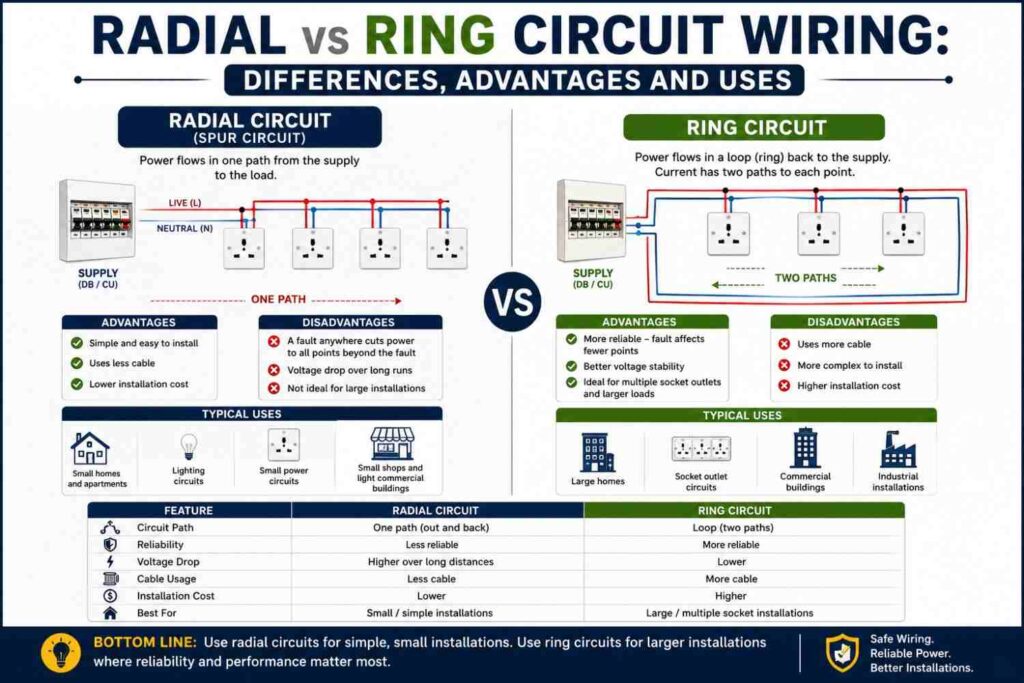
This article explains both in detail, compares them directly, and explains which is more commonly used in Nigerian residential and commercial wiring.
What Is a Radial Circuit?
A radial circuit is the simpler and more intuitive of the two topologies: a single cable runs from the distribution board to the first socket or outlet, then continues on to the next, and the next, forming a single, unbranching chain that ends at the final socket on that circuit. Current flowing to any socket on a radial circuit must pass through the cable segments feeding every socket before it on the chain, meaning the cable closest to the distribution board carries the combined current for every downstream socket, while cable further along the chain carries progressively less current.
What Is a Ring Circuit?
A ring circuit, more common in some regions (notably the United Kingdom and countries influenced by British wiring standards), takes a cable from the distribution board, connects it to every socket on the circuit in sequence, and then loops the cable back to the same distribution board terminal, forming a complete loop or “ring” rather than an open-ended chain. This means every socket on a ring circuit has two possible current paths back to the distribution board, one in each direction around the ring, which allows the cable to be sized somewhat smaller than an equivalent radial circuit for the same total connected load, since current effectively splits across the two paths.
Key Differences at a Glance
| Feature | Radial Circuit | Ring Circuit |
|---|---|---|
| Cable path | Single chain, open-ended | Loop, both ends return to board |
| Current path to any socket | One path only | Two paths (splits current) |
| Effect of a single break in the cable | Everything downstream loses power | Sockets still powered via the other direction |
| Typical cable sizing | Sized for full circuit current | Can be smaller due to current splitting |
| Common region | Most of the world, including Nigeria | UK and British-influenced markets |
Advantages of Radial Circuits
- Simplicity: Easier to design, install, understand and troubleshoot, since there is only one path for current to follow.
- Easier fault diagnosis: A break or fault at any point clearly affects only the sockets downstream of that point, making the location of a problem easier to narrow down.
- Widely standard: Most electricians and standards worldwide, including in Nigeria, are more familiar and experienced with radial circuit design, installation and maintenance.
Advantages of Ring Circuits
- Potentially smaller cable for the same load: Since current splits across two paths, ring circuits can in principle use somewhat lighter cable than an equivalent radial circuit serving the same total load, though this must be balanced against proper design and protection.
- Redundancy against a single break: If the ring is broken at one point, sockets can often still receive power via the other direction, at least temporarily, though a broken ring should always be repaired promptly rather than relied upon in this degraded state.
- Efficient for covering larger areas with multiple sockets from a single circuit, historically popular in the UK partly for material efficiency reasons during a period of copper scarcity after World War II.
Why Nigeria Predominantly Uses Radial Circuits
Nigerian electrical wiring practice, influenced by a mix of standards but generally aligned more closely with simpler radial circuit design for residential socket circuits, favors radial circuits for several practical reasons: they are simpler to design and install correctly, easier for electricians to diagnose and repair, and do not carry the specific design and protection requirements (such as particular fusing arrangements) that ring circuits require to be installed safely and correctly. While ring circuits are not unheard of in some installations, particularly those influenced by British design conventions, the large majority of Nigerian residential and commercial socket wiring uses radial circuit topology.
Common Design Considerations for Radial Circuits
Even though radial circuits are conceptually simpler, proper design still requires careful attention to cable sizing and the number of sockets or fixed loads on a single circuit, discussed further in our dedicated article on how many sockets can safely go on one circuit. A radial circuit’s cable and protective device must be sized for the full current of everything connected to it, since, unlike a ring, there is no second path to share the load. This is why radial circuits feeding higher-power fixed appliances, such as water heaters or air conditioners, are typically wired as dedicated circuits serving that single appliance alone, rather than sharing a radial circuit with multiple general-purpose sockets.
Why Ring Circuits Require Specific Protection
Ring circuits, where used, require particular attention to protective device design, since a break in the ring (an “open ring” fault) can be difficult to detect without proper testing, potentially leaving the circuit operating in a degraded state where cable sized for the shared, split-current condition is now carrying the full current through only one remaining path, risking overheating in that surviving cable segment. This is one of the specific technical reasons ring circuit design and installation is typically only entrusted to electricians specifically trained and experienced in that particular wiring convention, and why periodic testing for ring continuity is a standard part of maintenance in jurisdictions where ring circuits are common.
How to Identify Which Type Your Home Has
For most homeowners, identifying whether a specific circuit is wired as radial or ring is not something to determine by visual inspection alone, since both can look similar at the distribution board and at individual sockets. A qualified electrician can trace the circuit or use proper testing equipment to confirm the topology, which is particularly useful information before undertaking any renovation, extension, or addition of new sockets to an existing circuit, since correctly extending a radial circuit versus correctly extending a ring circuit involves different considerations to maintain safe, code-compliant wiring.
How Circuit Topology Affects Future Renovations
Understanding whether an existing circuit is radial or ring becomes particularly relevant when planning a renovation, extension, or the addition of new sockets to a room. Extending a radial circuit generally means simply continuing the chain to a new socket, provided the additional load remains within the circuit’s safe capacity, discussed in our dedicated article on socket limits per circuit. Extending a ring circuit correctly requires maintaining the loop’s integrity, either by properly reconnecting into the ring at an appropriate point (sometimes called a “spur” when a single branch extends off the ring) or by creating a new independent circuit entirely, since incorrectly breaking or improperly extending a ring can leave it in an unsafe, degraded configuration without this being immediately obvious. This is one of several reasons that even seemingly simple additions like a new socket should be planned and executed by a qualified electrician who understands the existing circuit’s topology, rather than approached as a simple tap-in job.
A Practical Analogy for Understanding the Difference
Think of a radial circuit like a single road leading to a row of houses, ending in a cul-de-sac: if that road is blocked partway along, every house beyond the blockage becomes unreachable. A ring circuit, by contrast, is like a loop road connecting the same row of houses at both ends back to a main junction: if the loop is blocked at one point, most houses can still be reached by traveling the other way around the loop, at least until the blockage is repaired. This analogy captures the core practical trade-off between the two topologies: simplicity and easy fault-tracing with radial wiring, versus a built-in redundancy (with its own added complexity and specific protection requirements) in ring wiring.
Common Misconceptions
- “Ring circuits are always superior to radial circuits.” Each has appropriate use cases and trade-offs; ring circuits are not universally better, and many countries, including Nigeria, achieve entirely safe, reliable wiring using radial circuits as the standard approach.
- “A break anywhere in a ring circuit is automatically safe since power still flows.” A broken ring operates in a degraded, non-compliant state that should be repaired promptly, not treated as an acceptable permanent condition.
- “You can freely mix radial and ring wiring conventions on the same circuit without consequence.” Circuits should be designed and extended consistently with their original topology and appropriate protective devices; improvised mixing of approaches can create unsafe or unpredictable conditions.
Frequently Asked Questions
Which is cheaper to install, a radial or ring circuit?
Costs depend on specific project details, but radial circuits are often simpler and therefore can be quicker and less labor-intensive to install correctly, while any potential cable savings from a ring circuit’s smaller conductor size can be offset by the somewhat more involved design and testing requirements.
Can I convert a radial circuit to a ring circuit myself?
This is a significant electrical modification requiring proper design calculations, correct cable and protective device selection, and professional testing, and should always be carried out by a qualified electrician rather than attempted as a DIY project.
Does a ring circuit use less total cable than an equivalent radial circuit?
Not necessarily less total length, since a ring circuit’s cable must travel out and back to form the loop, but individual cable diameter can sometimes be smaller for the same total connected load due to current splitting across the two paths.
Is one topology inherently safer than the other?
Both can be entirely safe when properly designed, installed and protected according to the applicable standards for that topology; safety depends much more on correct design, quality installation and appropriate protective devices than on the topology choice itself.
Why does this matter for someone who isn’t an electrician?
Understanding the basic concept helps homeowners ask informed questions when having new circuits installed or existing ones extended, and understand why an electrician might recommend a particular approach for a specific renovation or addition.
Final Thoughts
Radial and ring circuits represent two well-established, legitimate approaches to distributing electrical power to sockets throughout a building, each with genuine advantages depending on regional convention, installation context and design goals. While Nigeria’s wiring practice predominantly favors radial circuits, understanding both topologies, and why one might be chosen over the other, gives homeowners and facility managers a clearer, more informed perspective on how their own electrical system is structured and why proper, professional design matters regardless of which approach is used.