
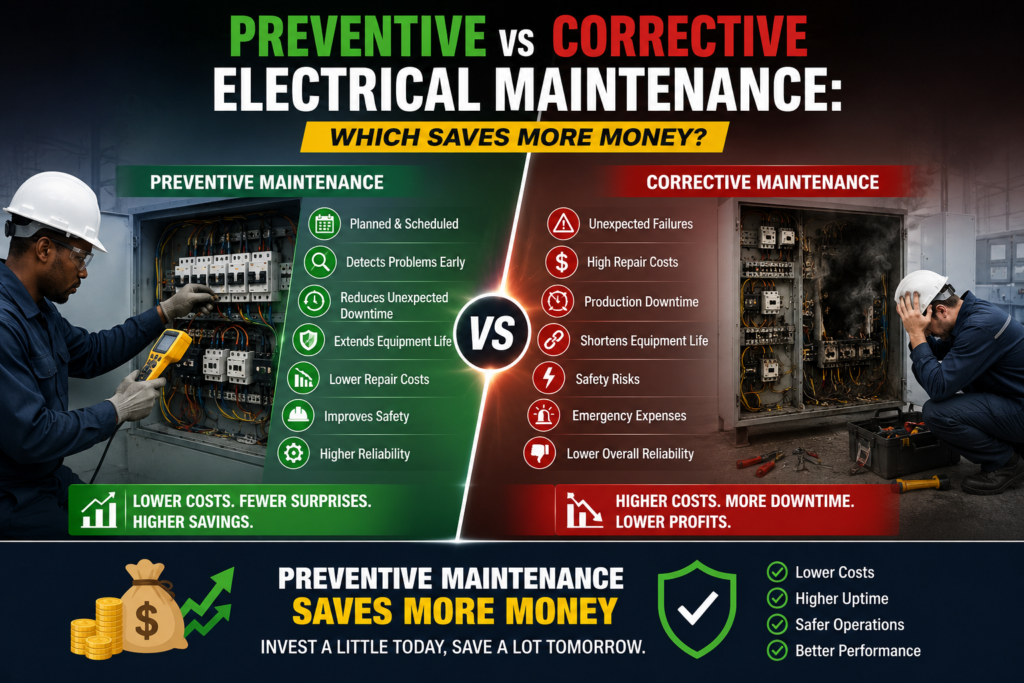
Electrical maintenance strategies generally fall into two broad approaches, preventive and corrective, and the genuine cost and reliability implications of choosing between them, or more realistically, balancing both, represent an important practical consideration for any facility or organization managing electrical systems. This article explains the real difference and which approach genuinely saves more money over time.
What Corrective Maintenance Actually Means
Corrective maintenance, sometimes called reactive or breakdown maintenance, involves repairing or replacing equipment only after it has already failed or shown clear signs of failure, essentially a “fix it when it breaks” approach that requires no proactive scheduling or inspection investment until a problem actually manifests.
What Preventive Maintenance Actually Means
Preventive maintenance involves scheduled, proactive inspection, testing, and servicing of electrical equipment at regular intervals, regardless of whether specific problems have yet appeared, aiming to identify and address developing issues, worn contacts, degrading insulation, loose connections, before they cause equipment failure or safety incidents.
The Direct Cost Comparison: Why Preventive Usually Wins
| Factor | Corrective Maintenance | Preventive Maintenance |
|---|---|---|
| Planned costs | Lower ongoing scheduled cost | Regular scheduled investment |
| Unplanned downtime | Higher, often significant | Substantially reduced |
| Equipment lifespan | Often shortened by unaddressed wear | Generally extended |
| Safety risk | Higher, from undetected developing faults | Lower, from proactive fault detection |
| Total long-term cost | Often higher when downtime/damage included | Generally lower overall |
Why Unplanned Downtime Costs So Much More Than It First Appears
Beyond the direct repair cost itself, unplanned electrical failures typically cause production downtime, potential damage to related equipment, emergency repair premiums (rushed parts and labor cost more than planned procurement), and sometimes safety incidents; these compounding costs, often substantially exceeding the direct repair cost alone, are precisely what preventive maintenance is specifically designed to avoid.
Where Corrective Maintenance Genuinely Remains Appropriate
Purely corrective maintenance isn’t always the wrong choice; for genuinely low-cost, low-consequence equipment where failure causes minimal disruption and replacement is straightforward and inexpensive, the scheduling and inspection investment of preventive maintenance may not be genuinely justified, making a purely reactive approach reasonably sensible for these specific, lower-stakes cases.
Why Most Facilities Genuinely Need a Balanced Approach
In practice, well-managed facilities typically apply preventive maintenance to critical equipment, motors, transformers, protection systems, discussed throughout our motor protection and generator articles, where failure carries significant cost or safety consequences, while accepting a more corrective approach for lower-stakes equipment where the preventive investment genuinely isn’t cost-justified.
Predictive Maintenance: A Related, More Advanced Approach
Beyond basic scheduled preventive maintenance, predictive maintenance uses condition monitoring technology, vibration analysis, thermal imaging, and other diagnostic techniques, to identify developing problems based on actual equipment condition rather than fixed schedules alone, representing a further refinement that some facilities adopt for their most critical equipment.
Building a Basic Preventive Maintenance Schedule
Getting started with preventive maintenance doesn’t require an elaborate program immediately; identifying your most critical equipment, establishing reasonable inspection intervals based on manufacturer recommendations and equipment criticality, and maintaining simple, consistent documentation of what’s been checked and when, provides a genuinely solid foundation that can be refined and expanded over time as the program matures and demonstrates its practical value.
Common Misconceptions
- “Preventive maintenance is always worth the investment regardless of equipment criticality.” For genuinely low-consequence equipment, the added preventive investment may exceed its practical benefit.
- “Corrective maintenance is simply cheaper since you only pay when something actually breaks.” This overlooks the substantial compounding costs of unplanned downtime, emergency repairs, and potential collateral equipment damage.
- “Once a preventive maintenance program is established, it doesn’t need periodic review.” Maintenance schedules and scope should genuinely be reviewed periodically as equipment ages and operational conditions change.
Frequently Asked Questions
How do I determine which specific equipment genuinely warrants preventive maintenance investment?
Considering the cost and safety consequences of unexpected failure, alongside the equipment’s criticality to overall operations, generally identifies which equipment most justifies preventive maintenance investment.
Does preventive maintenance completely eliminate the possibility of unexpected equipment failure?
No, it significantly reduces failure likelihood by catching developing problems early, but doesn’t provide absolute guarantee against all possible failure modes, some genuine unpredictability remains even with diligent preventive practices.
Is preventive maintenance more relevant for large industrial facilities than smaller operations?
While large facilities often have more formalized programs, the underlying cost logic, avoiding compounding unplanned downtime costs, genuinely applies across facility sizes, with smaller operations often benefiting from at least basic preventive practices for their most critical equipment.
Final Thoughts
While corrective maintenance offers lower upfront scheduled investment, preventive maintenance generally saves more money overall by avoiding the substantial compounding costs of unplanned downtime, emergency repairs, and premature equipment failure, particularly for critical electrical equipment where failure consequences are significant. Most well-managed facilities benefit from a genuinely balanced approach, applying preventive practices where they’re truly cost-justified while accepting corrective maintenance for lower-stakes equipment.