
PLC (Programmable Logic Controller) programming represents one of the most practically valuable skills an electrical engineering student can develop given its central role in industrial automation, yet many students feel uncertain about where to actually begin. This article provides a genuine starting roadmap for beginners.
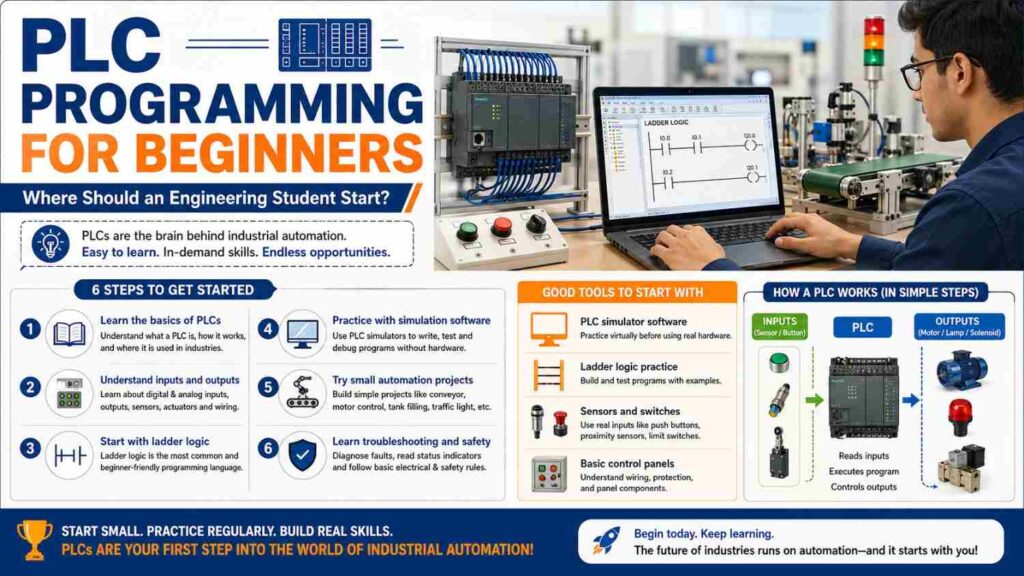
What a PLC Actually Is and Why It Matters
A PLC is a specialized industrial computer designed to control machinery and processes, reading input signals from sensors and switches, executing programmed logic, and controlling output devices like motors, valves, and indicators accordingly; PLCs form the backbone of modern industrial automation across manufacturing, oil and gas, water treatment, and countless other process industries, making genuine PLC competency broadly valuable across control systems and industrial automation career paths, discussed in our dedicated control systems article.
Step 1: Understand Basic Ladder Logic Programming
Ladder logic, the most widely used PLC programming language, uses a visual format resembling electrical relay logic diagrams, genuinely intuitive for students with basic circuit theory background; starting here, rather than more advanced programming languages some PLCs support, provides the most accessible, widely applicable entry point for beginners.
Step 2: Learn Basic Input/Output (I/O) Concepts
Understanding how PLCs interface with real-world sensors and actuators, digital versus analog signals, input and output addressing, and basic wiring concepts, provides essential foundational knowledge before moving into more complex programming logic.
Step 3: Practice With Simulation Software Before Physical Hardware
Many PLC manufacturers and third parties offer simulation software allowing students to write and test PLC programs without requiring physical PLC hardware, a genuinely accessible way to build practical skills, particularly valuable for students without ready access to physical lab equipment.
Step 4: Work Through Progressively Complex Practical Exercises
Starting with simple exercises, basic motor start/stop logic, simple timer applications, and progressively working toward more complex logic involving counters, sequential control, and basic process control concepts, builds genuine competency incrementally rather than attempting to jump directly to advanced applications.
Step 5: Understand Basic Industrial Communication Protocols
As you progress, gaining basic familiarity with how PLCs communicate with other industrial equipment and systems (through protocols like Modbus and others) provides valuable context for understanding how PLCs fit into broader industrial automation systems beyond standalone operation.
A Beginner’s Learning Progression Table
| Stage | Focus |
|---|---|
| 1. Fundamentals | Basic ladder logic, I/O concepts |
| 2. Simulation practice | Simple logic exercises in simulation software |
| 3. Intermediate logic | Timers, counters, sequential control |
| 4. Applied projects | Simple, complete automation projects (simulated or physical) |
| 5. Broader context | Communication protocols, HMI basics, system integration |
Which Manufacturer’s Platform Should Beginners Start With?
Different PLC manufacturers (Siemens, Allen-Bradley/Rockwell, and others) each have their own specific programming environments; rather than worrying excessively about choosing the “right” manufacturer, starting with whichever platform your institution provides access to, or whichever has the most accessible free learning resources and simulation software available to you, is genuinely more important than the specific brand choice, since core ladder logic concepts transfer reasonably well between platforms.
Why Hands-On Practice Matters More Than Passive Study
Genuine PLC competency develops through actually writing and testing programs, encountering and debugging errors, and working through practical logic problems, rather than passively studying PLC concepts without hands-on practice; prioritizing simulation or physical hands-on time over purely theoretical study accelerates genuine skill development considerably.
Connecting PLC Skills to Broader Career Preparation
As discussed in our dedicated skills and internship preparation articles, genuine PLC competency, even at a beginner level, meaningfully strengthens your practical readiness for internship placements, SIWES, discussed in our dedicated SIWES article, and eventual employment in industrial automation and control systems roles.
Understanding Basic HMI Concepts Alongside PLC Logic
As you progress beyond pure PLC logic, gaining basic familiarity with Human-Machine Interface (HMI) concepts, the screens and controls operators actually use to interact with and monitor automated systems, provides valuable additional context for how PLC systems fit into complete, real-world industrial automation setups, rounding out your practical understanding beyond the controller logic alone.
Avoiding Common Beginner Debugging Frustrations
New PLC programmers commonly get stuck on a few genuinely avoidable frustrations, overlooking simple wiring or addressing errors while assuming the logic itself is faulty, failing to methodically test individual rungs of logic in isolation before assembling a complete program, and giving up too quickly when simulation behavior doesn’t match expectations rather than systematically checking inputs, outputs, and logic step by step; developing patience for this systematic debugging approach early, rather than expecting programs to work correctly on the first attempt, considerably smooths the genuine learning curve every beginner experiences.
Common Misconceptions
- “PLC programming requires extensive prior programming experience.” Ladder logic’s visual, relay-logic-based format is genuinely accessible to students with basic circuit theory background, without requiring extensive prior software programming experience.
- “You need expensive physical PLC hardware to genuinely learn this skill.” Simulation software provides genuinely effective learning opportunities without requiring physical hardware investment, particularly valuable for beginners.
- “Learning one specific manufacturer’s PLC platform is sufficient preparation for any industrial automation role.” While core concepts transfer, genuine familiarity with the specific platform an employer uses often requires some additional platform-specific learning.
Frequently Asked Questions
How long does it typically take to build genuine beginner-level PLC competency?
With consistent, deliberate practice, genuine basic competency, comfortable with fundamental ladder logic and simple practical applications, is achievable within a few months of dedicated, regular practice, though genuine mastery continues developing well beyond this initial period.
Are there genuinely free resources for learning PLC programming as a student?
Yes, many manufacturers offer free or trial versions of simulation software, alongside substantial free online tutorials, documentation, and community forums providing genuinely accessible learning resources for motivated beginners.
Is PLC programming knowledge relevant even for students not specifically pursuing industrial automation careers?
Yes, basic PLC understanding provides genuinely valuable broader context for control systems concepts and industrial processes relevant across multiple electrical engineering specializations, even for students whose primary career focus lies elsewhere.
Final Thoughts
PLC programming represents a genuinely accessible, practically valuable skill for electrical engineering students, buildable through a structured progression from basic ladder logic through increasingly complex practical applications, supported by widely available simulation software and free learning resources. Beginning this learning journey deliberately, with consistent hands-on practice rather than passive study alone, provides genuine practical competency valuable across industrial automation and control systems career paths.