
A three-phase motor that vibrates more than usual, sounds louder, or trips its protection repeatedly is often not suffering from a mechanical fault at all, but from phase imbalance in its power supply. Because this problem builds up gradually and rarely announces itself with a single dramatic failure, many motors are damaged slowly over months before anyone identifies the real cause.
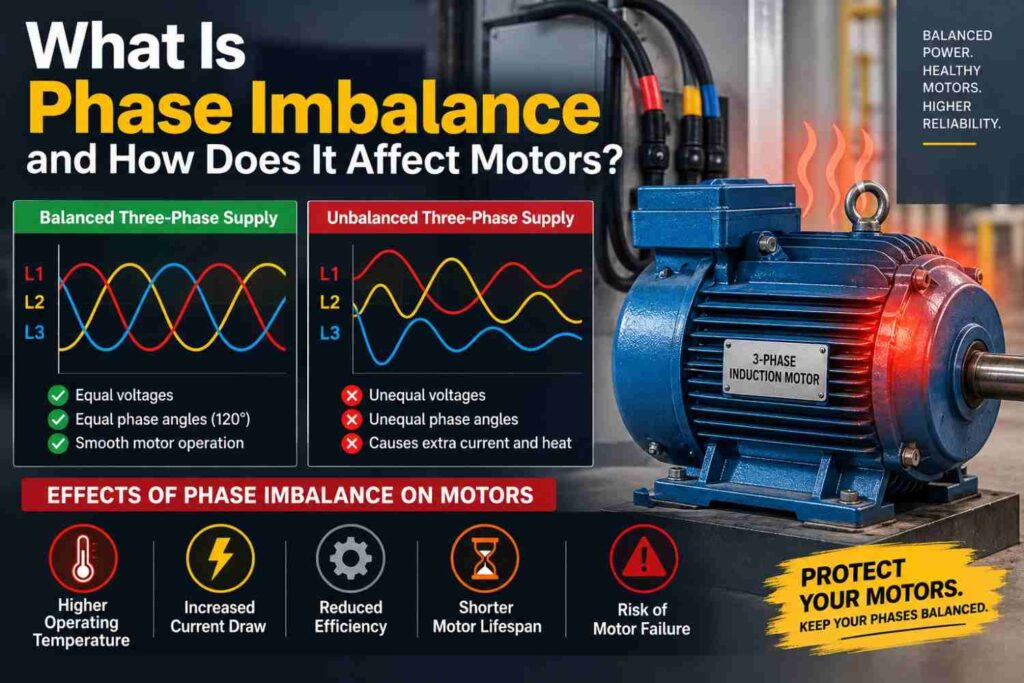
This article focuses specifically on how phase imbalance affects motors, why the effect is worse than most people expect, and how to protect motor-driven equipment from it.
What Phase Imbalance Means for a Motor
As explained in our dedicated voltage imbalance article, phase imbalance occurs when the voltage supplied to the three phases of a system is not equal in magnitude.
For a motor specifically, this matters because a three-phase motor is designed on the assumption that each of its three windings receives the same voltage, producing a smooth, evenly rotating magnetic field.
When one phase supplies noticeably more or less voltage than the others, that smooth balance is disrupted, and the motor’s internal currents and heating patterns become uneven, even though the motor may still run and appear to function normally from the outside.
Why a Small Voltage Imbalance Becomes a Big Current Problem
The most important fact to understand about phase imbalance and motors is that current imbalance grows much faster than voltage imbalance. As a rule of thumb widely used by motor engineers, current imbalance can be roughly six to ten times the corresponding voltage imbalance percentage. This means a voltage imbalance of only 3 percent, which might seem minor, can translate into a current imbalance of 20 percent or more on one winding.
| Voltage Imbalance | Approximate Current Imbalance | Typical Motor Impact |
|---|---|---|
| 1% | 6% to 10% | Minimal, generally safe |
| 2% | 12% to 20% | Noticeable extra heating |
| 3% | 18% to 30% | Significant derating usually required |
| 5% | 30% to 50% | High risk of overheating and failure |
Because the winding carrying the highest current also experiences the most heating, that particular winding degrades faster than the other two, eventually leading to uneven insulation breakdown and, ultimately, motor failure originating from just one phase of the winding.
Symptoms of Phase Imbalance in a Motor
- Unusual vibration or humming noise that was not present when the motor was newly installed.
- One section of the motor housing noticeably warmer to the touch than the rest.
- Reduced output torque or the motor struggling under loads it previously handled easily.
- Frequent tripping of thermal overload protection without an obvious mechanical cause.
- Shorter than expected motor lifespan compared to similar motors on more balanced supply.
Why Motor Derating Is Necessary Under Imbalance
Because motors running on imbalanced voltage generate more heat than their rating accounts for, manufacturers publish derating curves that specify how much a motor’s rated output should be reduced when operating under a given percentage of voltage imbalance. A motor running at even 5 percent voltage imbalance may need to be derated to roughly 75 percent of its nameplate capacity to avoid overheating, meaning the same motor that could safely handle a certain load on balanced supply may need a lighter load, or a larger motor altogether, if imbalance cannot be corrected at the source.
How Phase Imbalance Shows Up in Nigerian Installations
Boreholes, water pumping stations, workshops, and small factories running three-phase motors in Nigeria are frequently exposed to phase imbalance, particularly where supply comes from older or unevenly loaded transformers, or where a generator’s three-phase loads were not carefully balanced during installation. This risk often increases during peak evening hours, when uneven demand across a shared transformer’s phases becomes more pronounced, a pattern discussed further in our article on why appliances perform differently at different times of the day. Motors installed at the tail end of a feeder, further from the transformer, are typically more exposed to both voltage drop and imbalance simultaneously.
Protecting Motors From Phase Imbalance Damage
- Install a phase failure and imbalance protection relay that automatically disconnects the motor when imbalance exceeds a safe threshold.
- Have voltage on all three phases measured periodically, especially for motors running continuously such as borehole pumps.
- Ensure motor loads and any single-phase loads sharing the same supply are distributed evenly across all three phases.
- Apply the manufacturer’s derating guidance if imbalance cannot be fully corrected at the source.
- Consider dedicated motor protection devices covering imbalance, single-phasing, and overload together, a subject covered more broadly in our dedicated motor protection article.
Common Misconceptions
- “A motor will simply stop working if imbalance is a real problem, so if it’s running, it’s fine.” Motors typically continue running under imbalance while suffering gradual internal damage, only failing outright after weeks or months of accumulated heat stress.
- “Phase imbalance only affects very large industrial motors.” Small motors used in domestic boreholes and workshop equipment are equally susceptible, often with less built-in protection than larger industrial units.
- “Overload protection alone is enough to protect a motor from imbalance.” Standard overload protection reacts to overall current, not to imbalance between phases, so a dedicated imbalance protection relay is needed for full coverage.
Frequently Asked Questions
How quickly can phase imbalance damage a motor?
The timeline depends on the severity of the imbalance and the motor’s load, but noticeable insulation degradation can occur within weeks under moderate to severe sustained imbalance, while mild imbalance may take months to cause visible harm.
Can I check for phase imbalance myself without an electrician?
A basic multimeter can measure voltage on each phase to give a rough indication, but accurately diagnosing and correcting the underlying cause generally requires a qualified electrician with proper testing equipment.
Is phase imbalance protection expensive to add to an existing motor?
Dedicated phase imbalance and failure relays are relatively affordable compared to the cost of replacing a burnt motor, making them a cost-effective addition for any continuously running three-phase equipment.
Final Thoughts
Phase imbalance is a quiet but serious threat to three-phase motors precisely because its effects compound rather than strike all at once, and because current imbalance grows far faster than the voltage imbalance that causes it.
Anyone running borehole pumps, workshop machinery, or other continuous three-phase equipment in Nigeria should treat periodic phase voltage checks as routine maintenance rather than an afterthought.
Combined with proper protection relays and sensible load distribution, addressing phase imbalance early is one of the most reliable ways to extend the working life of motor-driven equipment.