
Every year, faulty wiring and overloaded circuits start fires in homes and offices across Nigeria, and in most of those cases, the damage could have been prevented by a properly working overcurrent protection system.
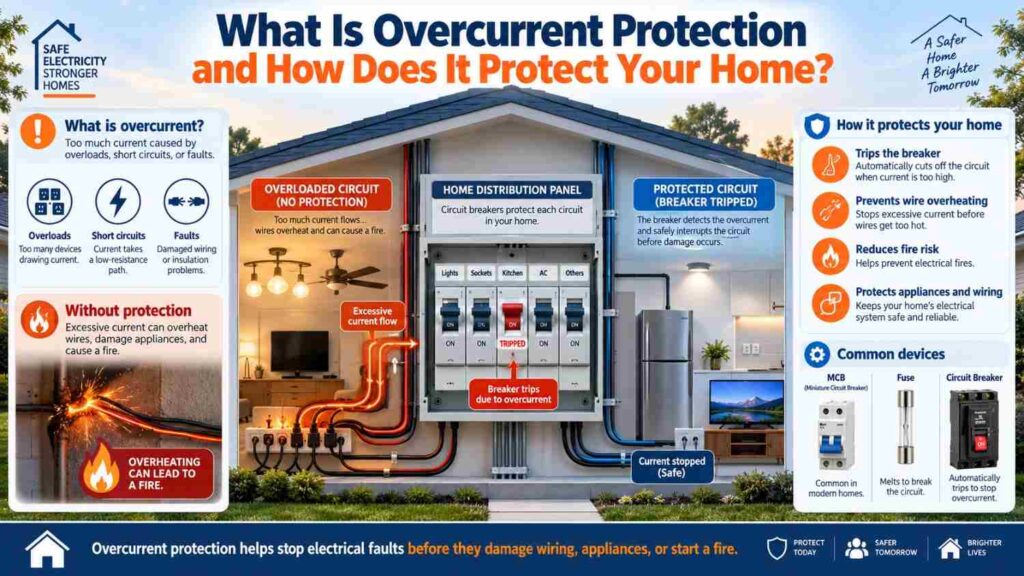
Overcurrent protection is one of those background safety features that homeowners rarely think about until it fails, or until it does its job and prevents something worse.
This article breaks down what overcurrent protection actually means, the devices that provide it, and how it keeps a Nigerian home safe from both slow overheating and sudden electrical faults.
What Overcurrent Means
Overcurrent simply means more current is flowing through a conductor than it is designed to safely carry. Every cable and appliance has a current rating based on its size and construction, and when that rating is exceeded, the conductor heats up faster than it can dissipate that heat into the surrounding air.
Left unchecked, this heat degrades the cable insulation, and eventually can ignite nearby materials such as wood, plastic trunking, or ceiling boards. Overcurrent protection exists specifically to detect this condition and interrupt the circuit before that damage happens.
The Two Main Forms of Overcurrent
Overcurrent protection is generally built to respond to two distinct situations, each requiring a slightly different response time and mechanism.
| Condition | Typical Cause | Response Needed |
|---|---|---|
| Overload | Too many appliances on one circuit, or a struggling motor | Gradual, delayed trip after sustained excess current |
| Short Circuit | Damaged insulation, live and neutral touching directly | Instant trip, within milliseconds |
This distinction is explored more fully in our dedicated overload versus short circuit article, but the important point here is that a good overcurrent device must handle both scenarios correctly, tripping slowly enough to allow normal appliance start-up surges, yet fast enough to prevent damage during an actual fault.
The Devices That Provide Overcurrent Protection
In most Nigerian homes today, overcurrent protection comes from miniature circuit breakers, commonly called MCBs, installed in the distribution board.
Older installations, including many built during the NEPA era, still rely on rewireable fuses or fuse wire in a fuse box, which work on a similar principle but are slower, less precise, and more prone to being tampered with when a fuse blows repeatedly. Circuit breakers, discussed further in our dedicated circuit breakers article, have largely replaced fuses because they are safer, resettable without replacing parts, and available in standardised current ratings.
Larger installations, and the transformers feeding whole estates or streets, use protection at a bigger scale, including fuses and breakers rated for hundreds of amps, but the underlying principle remains the same as the small MCB protecting a bedroom socket circuit.
How Overcurrent Protection Actually Works Inside a Home
A typical Nigerian home distribution board has a main breaker feeding the whole house, and individual branch breakers for lighting circuits, socket circuits, the kitchen, and possibly a dedicated circuit for an air conditioner or water pump.
Each branch breaker is sized to match the cable feeding that circuit, so a lighting circuit wired with smaller cable might use a 6A or 10A breaker, while a socket circuit with heavier cable might use a 20A or 32A breaker. When current on any branch exceeds its rated value for long enough, that specific breaker trips, cutting power only to that section while leaving the rest of the house unaffected.
This selective tripping is one of the biggest advantages of a well-designed board over a single whole-house fuse, because a fault in the kitchen does not plunge the entire building into darkness.
Signs Your Overcurrent Protection Needs Attention
- A breaker that trips repeatedly under normal use, suggesting either a genuine overload or a failing breaker.
- Warm or discoloured switches, sockets, or breaker covers, which indicate excessive current has already caused heating.
- A distribution board still using rewireable fuses with visibly thick or non-standard fuse wire, a common and dangerous shortcut.
- Frequent use of multi-way adapters and extension boards stacked into a single socket, quietly pushing a circuit toward its limit.
- Any burning smell near the meter or distribution board, which should be treated as an emergency and investigated immediately.
Sizing Overcurrent Protection Correctly
Correct sizing is not guesswork. The breaker or fuse rating must be matched to the current-carrying capacity of the cable it protects, which in turn depends on cable cross-sectional area, length, and installation method, all covered in our dedicated wiring and cable sizing article. A breaker rated too high for its cable defeats the entire purpose of overcurrent protection, because the cable can overheat long before the breaker reacts. This mismatch is unfortunately common in Nigeria when property owners upgrade appliances or add extra sockets without upgrading the supporting cable and protection to match.
Common Misconceptions
- “A bigger breaker gives better protection.” A breaker must match the cable it protects, and an oversized breaker can allow a cable to overheat before it ever trips.
- “If the breaker hasn’t tripped, the wiring is fine.” Loose connections, poor earthing, and insulation damage can all cause danger without ever drawing enough current to trip a breaker.
- “Fuses and breakers do exactly the same job, so it doesn’t matter which is used.” Breakers are faster, resettable, and far less likely to be misused with incorrect fuse wire, making them the safer modern choice.
Frequently Asked Questions
Why does my breaker trip when I use a kettle and iron at the same time?
This usually means both appliances together are drawing more current than the circuit is rated for, which is the breaker correctly protecting the wiring from overload.
Is it safe to replace a tripping breaker with a higher-rated one just to stop the tripping?
No, this is dangerous because it removes protection from the cable, which can overheat unnoticed; the real fix is redistributing the load or having an electrician assess the circuit.
How often should overcurrent protection devices be checked?
A qualified electrician should inspect the distribution board and breakers at least every few years, or immediately after any renovation that adds new appliances or circuits.
Final Thoughts
Overcurrent protection is the quiet workhorse of home electrical safety, constantly watching for the two conditions that cause most household fires: gradual overload and sudden short circuits. Whether provided by modern MCBs or older rewireable fuses, its effectiveness depends entirely on correct sizing and regular inspection, something that becomes even more important in homes juggling grid power, generators, and inverters.
Recognising the warning signs of an overloaded system, and resisting the temptation to fit a bigger breaker as a quick fix, keeps this protection doing its job properly. When in doubt about the condition or capacity of a distribution board, a qualified electrician should always be the one to assess it.