
Finding voltage on a neutral wire, which should normally sit close to zero volts relative to earth, is a genuinely confusing and potentially dangerous electrical fault that catches many people off guard, precisely because neutral is widely, if incorrectly, assumed to always be safe.
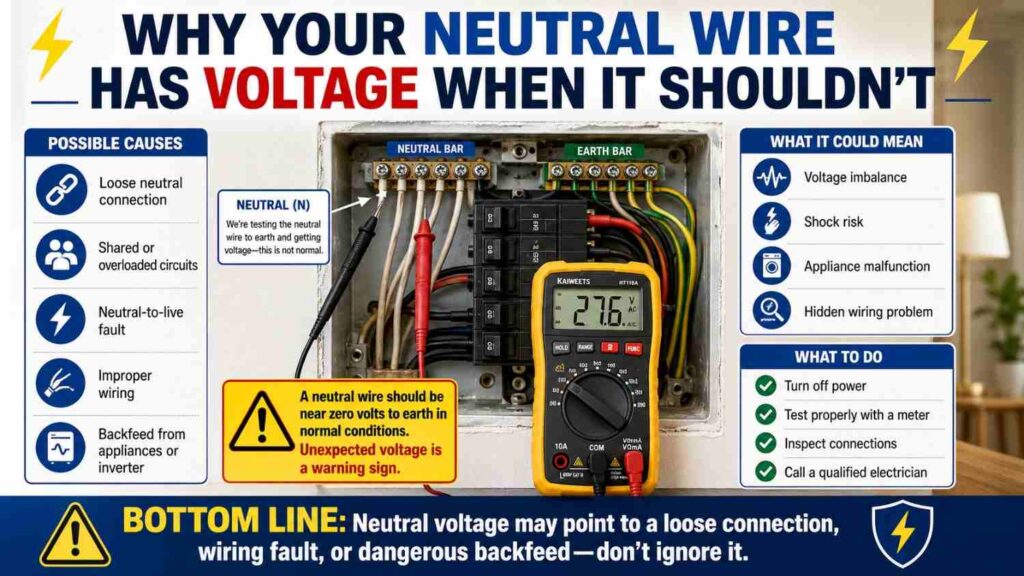
This article explains why and how this happens, and why it deserves serious attention rather than dismissal.
Why Neutral Should Normally Be Close to Zero Volts
As explained in our dedicated live, neutral and earth article, neutral serves as the return path for current after it has passed through a load, and under healthy, properly functioning conditions, it is bonded to earth at a specific point (typically at the main distribution point or transformer), keeping it close to earth potential (near 0V) throughout the system. This is why neutral is generally considered less immediately hazardous to touch than live under normal conditions, though never something that should be treated as inherently safe.
How Neutral Voltage Develops: The Core Mechanism
Voltage appears on a neutral conductor when current flowing through it encounters resistance in a section of the circuit, following the same fundamental V = I × R relationship covered in our voltage, current, resistance and power article. In a healthy system, neutral’s resistance back to its earth bonding point is low enough that any voltage drop along it remains negligible. But if that path develops higher resistance somewhere, due to a loose connection, corrosion, or a broken neutral conductor, current flowing through the remaining, now higher-resistance path creates a voltage drop across it, meaning points along the neutral conductor beyond that resistance can carry meaningful voltage relative to true earth.
Common Causes
- A broken or loose neutral connection somewhere upstream, either within your property’s wiring or, in more serious cases, in the shared neutral serving your street or local distribution transformer
- Corrosion at neutral connection points, particularly relevant in humid environments or aging installations
- Overloaded neutral conductors in three-phase systems with unbalanced loads, where the neutral can carry more current than expected under certain load imbalance conditions
- Incorrect wiring, including live and neutral being accidentally reversed somewhere in the installation
Why a Shared Neutral Fault Can Be Especially Serious
In some distribution configurations, particularly certain shared or communal supply arrangements, multiple properties can share a common neutral conductor back to the transformer. A broken shared neutral in this kind of configuration can cause genuinely dangerous and unpredictable voltage imbalances across multiple properties simultaneously, sometimes causing appliances in some homes to receive higher than normal voltage while others receive lower, alongside neutral-to-earth voltage appearing where it shouldn’t. This is a serious fault requiring the DisCo’s involvement, since the issue originates outside individual property wiring, in the shared distribution infrastructure itself.
Warning Signs That May Indicate a Neutral Problem
| Symptom | Possible Connection to Neutral Issue |
|---|---|
| Lights unusually bright or dim, sometimes simultaneously across different circuits | Possible neutral imbalance |
| Mild shocks from appliance casings connected to neutral-referenced points | Possible neutral voltage issue |
| Flickering that doesn’t correlate with any specific appliance | Possible neutral connection problem |
| Multiple neighboring homes reporting similar unusual symptoms together | Possible shared neutral fault — contact DisCo |
Why This Fault Is Particularly Dangerous
Because neutral is widely, if mistakenly, assumed to be inherently safe, people are often less cautious around neutral conductors and connections than around live ones, precisely the wrong instinct when a neutral fault is present. This mismatch between assumed safety and actual risk is part of why neutral voltage faults are considered particularly hazardous: the people encountering the fault often don’t expect danger from that specific conductor, reducing the caution they would otherwise apply.
What to Do If You Suspect a Neutral Voltage Issue
- Avoid touching neutral conductors, connections, or anything you suspect may be affected, treating them with the same caution as a live conductor until proven otherwise by proper testing.
- Contact a qualified electrician to test and diagnose the issue using proper equipment rather than assumptions.
- If the issue appears to involve your street’s shared supply rather than just your property (especially if neighbors report similar symptoms), contact your DisCo directly, since this may require repair work beyond your property’s own wiring.
- Do not attempt any DIY investigation or repair of neutral wiring, given both the complexity of properly diagnosing the fault and the genuine danger involved.
How This Differs From a Live Wire Fault in Practice
While both live and neutral faults are genuinely dangerous, they tend to be discovered differently, which matters for understanding why neutral faults are sometimes described as more insidious. A live fault, current escaping where it shouldn’t, often trips protective devices relatively quickly and produces more immediately obvious symptoms. A neutral fault, by contrast, can develop and persist for longer before producing symptoms severe or obvious enough to prompt investigation, partly because voltage appearing on neutral doesn’t always trip a standard breaker the way a dead short would, and partly because the symptoms (dimming, brightness changes, occasional mild shocks) can be subtle enough to be dismissed or attributed to other causes for some time before someone connects them to a genuine underlying fault.
Why Testing Requires More Than a Simple Voltage Tester
A basic non-contact voltage tester or simple plug-in socket tester can sometimes indicate that something is wrong, but properly diagnosing a neutral voltage fault, including determining exactly where along the circuit the high-resistance point or break has developed, generally requires a qualified electrician using proper multimeter testing at multiple points, and sometimes more specialized equipment for tracing the fault’s exact location. This is not a case where a homeowner with a basic tester can reliably self-diagnose the specific cause; the tools available to most non-professionals can confirm that a problem exists but rarely pinpoint exactly where it originates.
What Your DisCo Is Responsible for Versus What Falls to You
Understanding the boundary between your property’s internal wiring and the shared distribution infrastructure serving your street helps clarify who should be contacted for what. Generally, wiring and connections within your property boundary, including your service cable’s termination point, distribution board, and everything downstream, are your responsibility to maintain and repair through a private electrician. Issues with the shared neutral, transformer, or distribution infrastructure upstream of your property’s connection point are the DisCo’s responsibility. When you’re not certain which side of that boundary a fault originates on, particularly given how neutral faults can sometimes involve both, starting with an electrician’s assessment is a reasonable first step, since they can often help determine whether DisCo involvement is also needed.
How Three-Phase Homes Differ From Single-Phase Homes Here
Properties with a three-phase supply, more common among larger homes and small commercial or industrial premises, introduce an additional wrinkle to neutral fault behavior: an imbalanced load across the three phases, combined with a compromised neutral connection, can cause voltage on each phase to shift away from its normal value in ways that don’t occur in simpler single-phase installations. This is part of why three-phase neutral faults are generally considered more complex to diagnose and potentially more consequential, since a single fault can produce different, sometimes opposite symptoms (overvoltage on one phase, undervoltage on another) simultaneously across different parts of the same property.
Practical Steps for Prevention Rather Than Just Detection
While neutral faults can’t be entirely prevented, since they often stem from gradual connection degradation that’s difficult to predict, periodic professional inspection of your distribution board and main connections, rather than waiting for symptoms to appear, catches many developing neutral issues while they’re still minor and inexpensive to repair. This is particularly worth prioritizing for older properties or those that have never had a documented electrical inspection, since gradual connection degradation is, by its nature, invisible until it has progressed far enough to produce noticeable symptoms.
Common Misconceptions
- “Neutral is always safe to touch since it’s not live.” Under fault conditions, exactly the scenario discussed in this article, neutral can carry genuinely dangerous voltage.
- “This is always a problem within my own home’s wiring.” The fault can originate upstream in shared distribution infrastructure, requiring DisCo involvement rather than just an electrician working on your property alone.
- “If my appliances still work, there’s no real problem.” Appliances can continue functioning, sometimes with subtly altered performance, even while a genuinely dangerous neutral fault exists elsewhere in the system.
Frequently Asked Questions
How can an electrician test for neutral voltage issues safely?
Using proper testing equipment, including voltage testers and multimeters rated for the task, following established safe testing procedures rather than direct, unprotected contact.
Can this issue resolve itself over time?
No; a broken or high-resistance neutral connection requires an actual physical repair to resolve, and will not improve without intervention, though symptoms may fluctuate depending on load conditions, sometimes creating a false impression of intermittent improvement.
Should I report this to my DisCo even if I’m not certain it’s a shared supply issue?
If you have any reason to suspect the issue extends beyond your own property, including affected neighbors or symptoms that seem to correlate with broader street-level supply conditions, reporting to your DisCo alongside consulting your own electrician is a reasonable, prudent approach.
Final Thoughts
A neutral wire carrying unexpected voltage is a genuine electrical fault, not a minor curiosity, and deserves the same seriousness and caution as any live conductor issue, precisely because the common assumption that neutral is inherently safe makes this specific fault more dangerous in practice than its technical description might suggest. Prompt, professional investigation, rather than continued normal use or DIY troubleshooting, is always the appropriate response.