
Walk into any electronics lab in a Nigerian polytechnic or university and you will hear the two terms used almost interchangeably: microcontroller and microprocessor.
They are not the same thing, and mixing them up is one of the most common mistakes final year students make when writing project reports or explaining their circuit design to a supervisor.
This article breaks down exactly what separates the two, where each one belongs in a real design, and how to decide which one your next project actually needs.
What a Microprocessor Actually Is
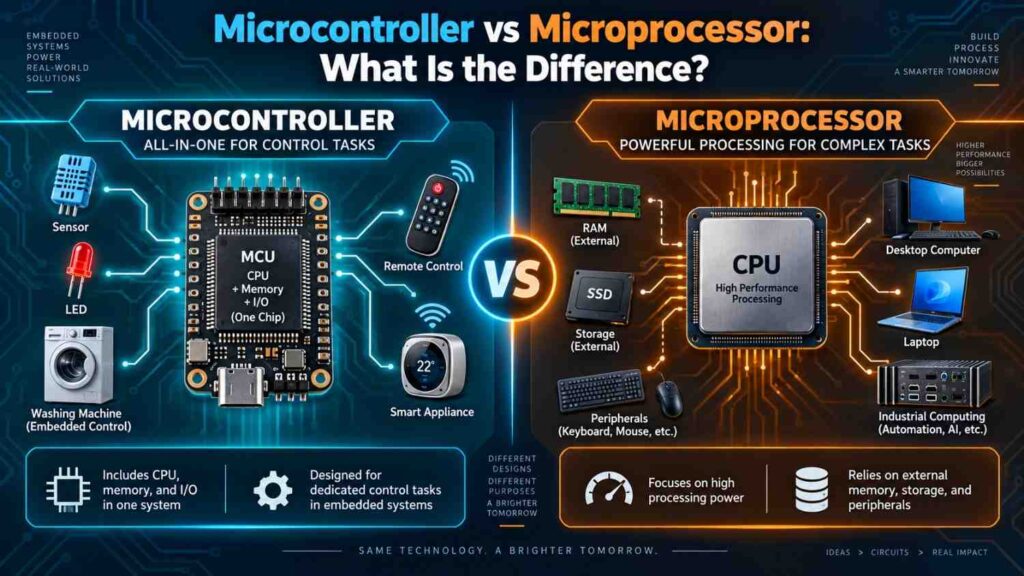
A microprocessor is the central processing unit of a computer system on a single chip. It can fetch, decode, and execute instructions at high speed, but on its own it does almost nothing useful. It has no built-in memory, no input/output ports, and no storage.
To turn a microprocessor into a working computer, you need to add external RAM, ROM, and I/O controller chips on a circuit board. The Intel and AMD chips that power desktop computers and laptops are microprocessors: powerful, fast, and dependent on external support components.
What a Microcontroller Actually Is
A microcontroller, by contrast, is a complete miniature computer on a single chip. It packages a processor core together with RAM, flash memory for program storage, and input/output pins, all in one package.
You can solder a microcontroller onto a small board, write a program to it, and it will run standalone, controlling motors, reading sensors, and driving displays without needing any extra memory chips.
The ATmega328 found in an Arduino Uno and the chips inside a washing machine controller or a generator’s automatic voltage regulator are both microcontrollers.
Core Differences at a Glance
The easiest way to see the distinction is side by side, since students often confuse the two simply because both are small black chips that “do the thinking” in a circuit.
| Feature | Microprocessor | Microcontroller |
|---|---|---|
| Memory (RAM/ROM) | External, added separately | Built into the chip |
| I/O ports | External support chips needed | Built into the chip |
| Processing power | Very high | Moderate, task-specific |
| Power consumption | Higher | Low, often battery-friendly |
| Typical use | General-purpose computing | Dedicated control tasks |
| Cost and board complexity | Higher, more components | Lower, fewer components |
Where Each One Shows Up in Real Projects
Microprocessors run general-purpose systems that need to multitask: your laptop, a desktop PC, a server, or a smartphone’s application processor. They are built to run an operating system and juggle many programs at once.
Microcontrollers are built for one job at a time: reading a temperature sensor and switching on a fan, controlling the timing of an irrigation pump, or managing the charge and discharge cycle in a solar charge controller, a topic covered in more depth in our dedicated solar charge controller article.
Most embedded systems projects you will meet as a Nigerian engineering student, from a SIWES attachment build to a final year automation project, use microcontrollers rather than microprocessors because the task is narrow and power efficiency matters.
Choosing the Right One for a Student Project
If your project needs to control hardware directly, read sensors, and respond in real time on a tight power budget, a microcontroller is almost always the right choice.
Boards like Arduino, and chips such as the PIC and STM32 families, are microcontroller-based and dominate student and hobbyist projects in Nigeria because they are affordable, well documented, and easy to source through local electronics markets and online importers.
Reserve a full microprocessor-based design for situations where you genuinely need to run an operating system, handle a graphical interface, or process large amounts of data, such as a Raspberry Pi based vision system, which is discussed further in our Arduino versus Raspberry Pi comparison article.
How They Work Together in Larger Systems
In many real industrial and commercial systems, both chip types appear side by side rather than as competitors. A factory automation panel might use a microprocessor-based industrial PC to run a supervisory dashboard while a microcontroller inside a PLC or a motor drive handles the fast, deterministic control loop.
This layered approach is common in control systems engineering, a career path explored more fully in our control systems careers article, and understanding the division of labor helps make sense of how larger automation systems are structured.
Practical Steps for Learning the Difference Hands-On
The fastest way to internalize this distinction is to build with both. A short practical sequence that works well for beginners includes the following steps.
- Set up a basic microcontroller board such as an Arduino and blink an LED to see a minimal, standalone control task in action.
- Set up a single-board computer such as a Raspberry Pi, boot an operating system on it, and run a simple Python script to see general-purpose computing in action.
- Compare how much external wiring and support hardware each setup needed before it could do useful work.
- Note the power draw of each: the microcontroller board typically sips far less current than the single-board computer.
- Try connecting a sensor to each platform and observe the difference in how “close to the hardware” each system feels.
This kind of hands-on comparison sticks far better than memorizing a definition for an exam.
Common Misconceptions
- “A microcontroller is just a smaller, weaker microprocessor.” They are different in purpose, not just in scale; a microcontroller is a complete self-contained system built for control tasks, while a microprocessor is only the processing core of a larger computer.
- “Microcontrollers cannot handle complex programs.” Modern microcontrollers can run surprisingly sophisticated code, including real-time operating systems and communication protocols, well beyond simple on-off switching.
- “You always need a microprocessor for a ‘real’ computer system.” Many embedded products people use daily, from remote controls to washing machines to inverter systems, run entirely on microcontrollers with no microprocessor involved.
Frequently Asked Questions
Can a microcontroller run Windows or Linux?
Standard microcontrollers cannot run full desktop operating systems because they lack the memory and processing resources; that job belongs to microprocessor-based systems like a Raspberry Pi or a laptop.
Which is cheaper to use in a student project, a microcontroller or a microprocessor-based board?
A microcontroller board is usually cheaper and simpler to work with for a single-task project because it needs fewer support components and less power.
Is the ATmega328 in Arduino a microprocessor or a microcontroller?
It is a microcontroller, since it includes its own RAM, flash memory, and input/output pins on the same chip, requiring no external memory chips to function.
Final Thoughts
Microprocessors and microcontrollers solve different problems, and knowing which one belongs in your design is a basic engineering judgment call that shows up constantly in coursework, SIWES projects, and professional embedded systems work.
A microprocessor gives you raw computing power for general-purpose tasks, while a microcontroller gives you a compact, low-power, all-in-one solution for dedicated control jobs.
Most beginner and intermediate electronics projects in Nigeria lean on microcontrollers precisely because they are affordable, accessible, and well suited to real-world control tasks. Once this distinction is clear, choosing the right chip for any given project becomes a much faster and more confident decision.