
MATLAB remains one of the most widely used tools across electrical engineering education and industry, yet many students only scratch the surface of its capabilities during coursework. This article walks through the specific MATLAB skills genuinely worth developing to get real, practical value from the tool throughout your studies and early career.
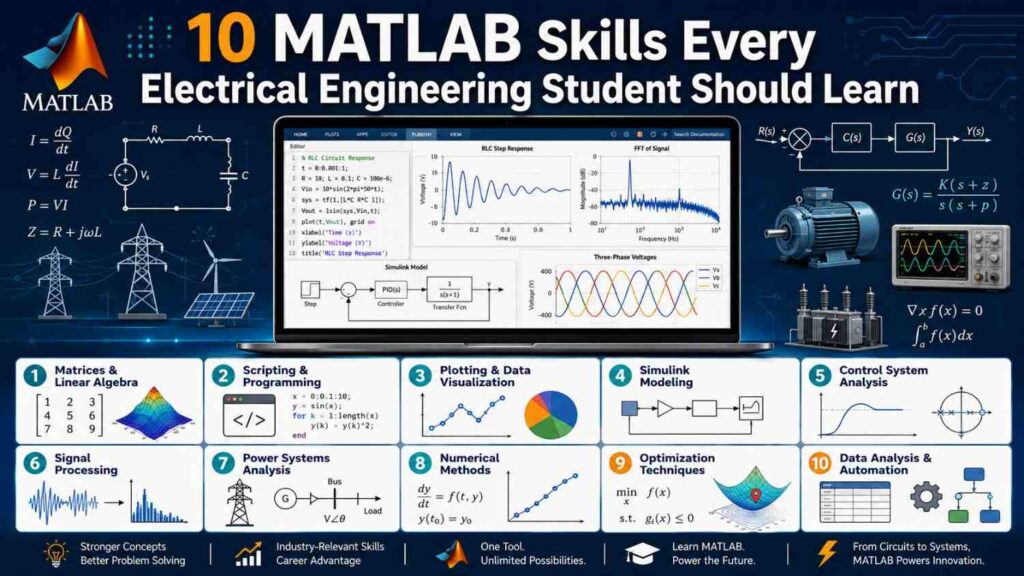
1. Basic Matrix and Vector Operations
MATLAB’s entire design philosophy centers on matrix and vector operations, and genuine fluency here, creating, indexing, and manipulating matrices efficiently, forms the foundation everything else builds on, making this the essential starting point rather than something to treat as a minor preliminary topic.
2. Plotting and Data Visualization
Effectively visualizing data, signals, and simulation results through MATLAB’s plotting functions is a genuinely practical skill used constantly across coursework, projects, and professional work, worth developing well beyond basic default plots to include proper labeling, multiple subplots, and clear, professional-quality figures suitable for reports.
3. Writing and Debugging Custom Functions
Moving beyond simple scripts to writing modular, reusable custom functions is a genuinely important skill transition, both for organizing more complex projects effectively and for developing the kind of structured thinking that transfers directly to general programming skills valuable beyond MATLAB itself.
4. Solving Differential Equations Numerically
Many electrical engineering problems, circuit transient analysis, control system behavior, involve differential equations that MATLAB’s numerical solvers (like ODE45) handle efficiently; genuine comfort with these solvers is directly applicable across circuits, control systems, and signal processing coursework.
5. Signal Processing Toolbox Basics
For students in or considering signal processing, communications, or related specializations, basic fluency with MATLAB’s signal processing functions, filtering, Fourier transforms, and frequency domain analysis, provides genuinely practical, directly applicable skills.
6. Control System Design and Analysis Functions
For students pursuing control systems, discussed in our dedicated control systems article, MATLAB’s control system toolbox functions for transfer function analysis, stability assessment, and controller design represent core, genuinely essential practical skills for this specialization specifically.
7. Simulink Basics for Model-Based Design
As covered in depth in our dedicated MATLAB vs Simulink comparison, Simulink’s graphical, block-based modeling approach complements MATLAB’s script-based approach, and basic Simulink competency is genuinely valuable for students working on system-level modeling and simulation projects.
A Learning Priority Table by Specialization Interest
| Specialization Interest | Priority MATLAB Skills |
|---|---|
| Power systems | Matrix operations, numerical solvers, Simulink |
| Control systems | Control toolbox, transfer functions, Simulink |
| Signal processing/communications | Signal processing toolbox, Fourier analysis |
| General/undecided | Core matrix operations, plotting, custom functions |
Why Working Through Real Problems Beats Passive Tutorial-Watching
Genuine MATLAB proficiency develops through actively working through real problems, coursework assignments, personal projects, or coding challenges, rather than passively watching tutorials without hands-on practice; setting aside deliberate practice time working through problems independently, even beyond assigned coursework, meaningfully accelerates genuine skill development.
Free and Low-Cost Learning Resources Worth Using
MATLAB’s own official documentation and tutorials, alongside student licensing options many universities provide, offer genuinely comprehensive, free learning resources; supplementing these with online course platforms and community forums where you can see how experienced users approach real problems accelerates learning meaningfully beyond documentation alone.
Debugging Skills: An Often-Overlooked but Genuinely Essential Competency
Beyond writing code that works under ideal conditions, genuine proficiency includes systematically debugging code that doesn’t, reading error messages carefully, using breakpoints and step-through execution to trace where logic breaks down, and developing the patience to methodically isolate problems rather than randomly changing code hoping for a fix; this debugging mindset, while sometimes frustrating to develop, is genuinely one of the most transferable skills MATLAB practice builds toward any future programming or technical work.
Common Beginner Mistakes Worth Deliberately Avoiding
Students new to MATLAB commonly fall into a few genuinely avoidable habits: writing everything as one long, unstructured script rather than breaking logic into functions, copying code from examples without genuinely understanding what each line does, and avoiding the debugger in favor of scattering print statements throughout code to guess where problems occur; recognizing these patterns early and deliberately practicing better habits, structured code, genuine understanding over copying, and comfortable debugger use, saves considerable frustration as your projects grow more complex throughout your studies.
Common Misconceptions
- “Basic coursework exposure to MATLAB is sufficient preparation for using it professionally.” Genuine proficiency requires deliberate additional practice beyond typical, limited coursework exposure.
- “MATLAB skills are only relevant for students specifically pursuing computational or theoretical specializations.” MATLAB proficiency is broadly valuable across virtually all electrical engineering specializations, from power systems to controls to signal processing.
- “Learning Simulink is unnecessary if you’re already comfortable with MATLAB scripting.” The two tools serve complementary purposes, and many real-world engineering problems benefit from combining both approaches.
Frequently Asked Questions
Is MATLAB skill still relevant given the growing popularity of Python in engineering?
Yes, MATLAB remains widely used in both academia and industry, particularly for control systems, signal processing, and power systems work, though genuine familiarity with both MATLAB and Python, discussed in our dedicated software article, is increasingly valuable given both tools’ different strengths.
How much MATLAB proficiency should I aim for before graduation?
Genuine comfort with the core skills discussed above, plus deeper proficiency in whichever toolbox areas align with your specific specialization interest, represents a reasonable, achievable target for most students by graduation.
Are there genuinely free ways to access and learn MATLAB as a student?
Most universities provide free or heavily discounted student licensing; checking your institution’s specific arrangement, alongside MATLAB’s own free official tutorials and documentation, provides genuinely accessible learning resources without significant additional cost.
Final Thoughts
Genuine MATLAB proficiency, built through deliberate practice across matrix operations, visualization, custom functions, and specialization-relevant toolboxes, represents one of the most directly transferable, practically valuable skill sets an electrical engineering student can develop. Moving beyond passive coursework exposure to genuine, hands-on competency pays real dividends throughout both your remaining studies and early career.