
Deciding between a manual and automatic changeover switch for your backup power setup involves genuine tradeoffs in cost, convenience, and safety margin, and building on our dedicated automatic transfer switch article, this piece compares the two approaches directly to help you decide which suits your household or business.
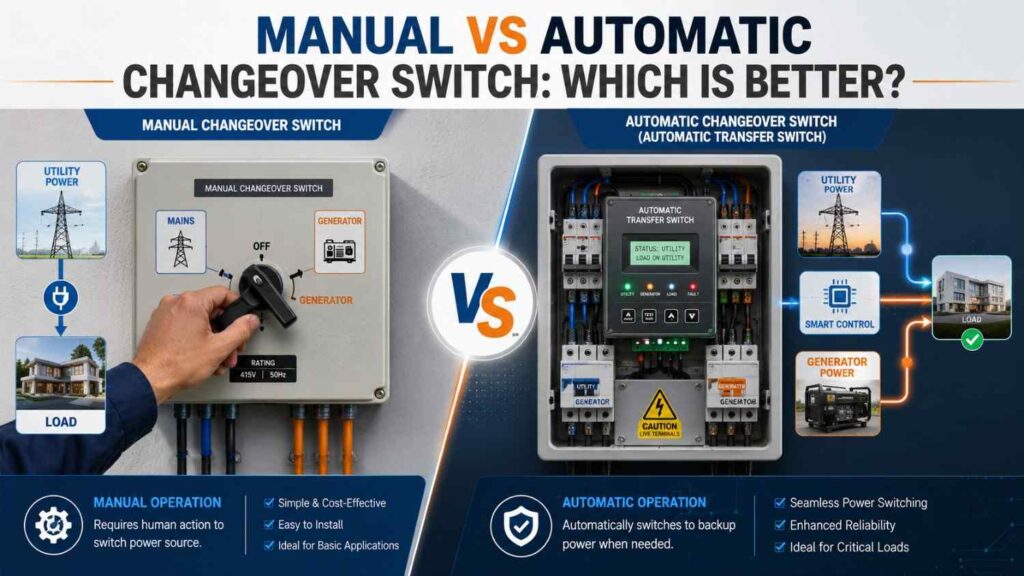
How a Manual Changeover Switch Works
A manual changeover switch requires a person to physically operate the switch, typically a rotary or lever mechanism, to disconnect from one power source and connect to another, meaning someone must be present and aware of a power outage to actually initiate the switching process, and must remember to switch back once primary power is restored.
How This Differs From Automatic Switching
As detailed in our dedicated ATS article, automatic switching detects power loss and performs the entire switching sequence, including disconnection, backup source activation, and reconnection, without requiring any human awareness or action, a fundamentally different experience from the manual process described above.
Cost Comparison
Manual changeover switches are considerably cheaper to purchase and install than automatic transfer switches, making them the more accessible option for budget-conscious households or businesses, particularly those willing to accept the tradeoff of requiring manual operation in exchange for meaningful cost savings.
Convenience and Reliability Tradeoffs
Manual switches require someone present and attentive to operate them promptly; a household away from home during an outage, or an outage occurring overnight while everyone is asleep, means power isn’t restored until someone becomes aware and manually switches, a genuine inconvenience automatic systems eliminate entirely through their hands-free operation.
Safety Considerations for Both Types
Both manual and automatic switches, when properly installed, provide the critical backfeeding prevention function discussed in our ATS article; the safety difference between the two isn’t inherent to the mechanism type but relates to proper installation and, for manual switches, correct operation by whoever is using it, since human error, incompletely switching or forgetting the process, is a genuine risk specific to manual operation that automatic systems remove.
A Direct Comparison Table
| Factor | Manual Changeover | Automatic Transfer Switch |
|---|---|---|
| Cost | Lower | Higher |
| Requires someone present | Yes | No |
| Switching speed | Depends on human response time | Seconds |
| Risk of human error | Present | Minimal |
| Installation complexity | Simpler | More complex |
| Best suited for | Budget-conscious, attended properties | Businesses, frequently unattended properties, critical needs |
Why Businesses Often Lean Toward Automatic Systems
Businesses, particularly those with operations that can’t tolerate extended downtime, refrigeration-dependent businesses, server rooms, medical facilities, or retail operations losing sales during outages, generally find the additional cost of automatic switching justified by the assurance of near-instant, reliable power restoration without depending on staff availability or response time.
Why Many Residential Households Find Manual Switching Perfectly Adequate
For households where someone is typically present and the inconvenience of a brief delay in switching (versus automatic, near-instant switching) is genuinely tolerable, manual switching remains a perfectly reasonable, cost-effective choice, particularly for households already budget-constrained by other aspects of their backup power system investment.
A Middle-Ground Option: Semi-Automatic or Remote-Operated Switches
Some households find value in switches offering remote operation (via a wall-mounted control panel rather than requiring access to the main switch location) without full automatic detection and switching, providing a middle ground between manual and fully automatic systems at an intermediate cost point, worth asking your installer about if pure manual feels too inconvenient but full ATS cost feels unjustified for your situation.
Establishing a Clear Household Routine for Manual Switching
Households choosing manual switching benefit from establishing a clear, simple routine, who is responsible for switching, where the switch is located, and a straightforward reminder system for switching back once primary power returns, reducing the human-error risk discussed above through consistent practice rather than leaving switching responsibility vague or assumed, particularly important in larger households where responsibility might otherwise go unclear.
Common Misconceptions
- “Manual switches are inherently less safe than automatic ones.” Both are safe when properly installed and, for manual switches, correctly operated; the difference is convenience and human-error risk, not inherent safety design.
- “Automatic switches never require any backup manual capability.” Many automatic systems retain manual override capability for situations requiring it, a sensible redundancy worth confirming your specific system includes.
- “The cost difference between manual and automatic isn’t significant enough to matter.” The price gap can be substantial, making this a genuine budget consideration worth weighing against your specific convenience and reliability needs.
Frequently Asked Questions
Can I upgrade from a manual switch to an automatic one later?
Often yes, though this typically requires replacing the switch mechanism itself and possibly some associated wiring, making it a worthwhile consideration to discuss with your installer even if you initially choose manual switching, in case future upgrade is something you might want.
Does switch type affect which generator or inverter brands I can use?
Generally no; both manual and automatic changeover switches are designed to work with standard generator and inverter output, though confirming compatibility with your specific equipment during installation planning is always a reasonable step.
Is professional installation necessary for a manual changeover switch, or can it be simpler?
Professional installation remains important for manual switches too, given the same backfeeding prevention safety concerns discussed throughout this article; the switch mechanism itself is simpler, but proper electrical installation practices still apply.
Final Thoughts
The choice between manual and automatic changeover switches comes down to a genuine tradeoff between cost and convenience/reliability, with both options providing proper safety when correctly installed. Understanding your household or business’s specific tolerance for switching delays and human-dependent operation, weighed against your budget, is the key to choosing the option that genuinely fits your situation.