
Nigeria sits in one of the most lightning-active regions in the world, with some states recording thunderstorm activity on well over a hundred days a year. For any building, especially tall structures, homes with sensitive electronics, or properties near open ground, a lightning arrester is one of the most important yet least understood pieces of protection equipment.
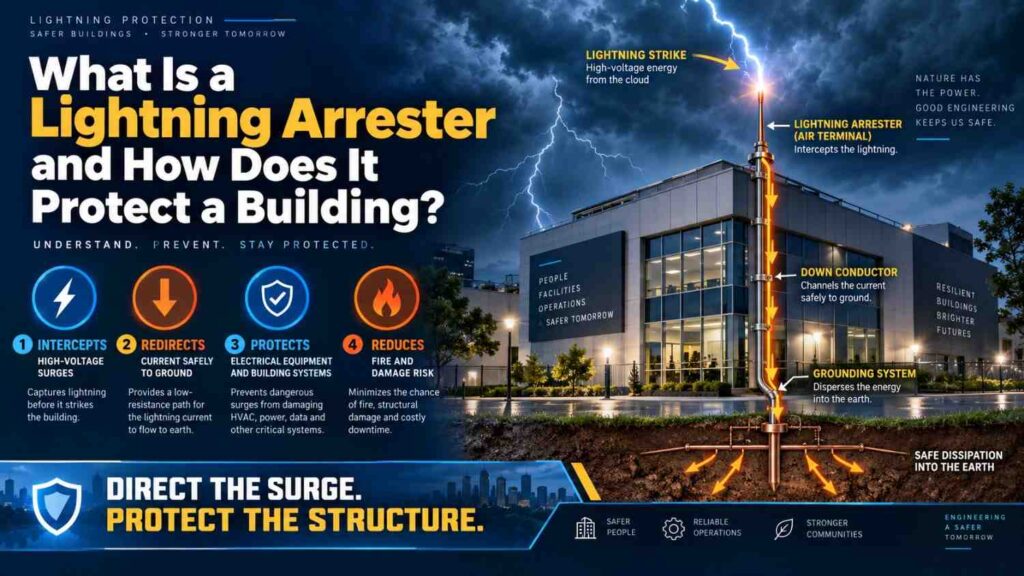
This article explains what a lightning arrester actually does, how it works, and why it deserves a place in serious electrical planning rather than being treated as an afterthought.
What a Lightning Arrester Is
A lightning arrester, sometimes called a surge arrester or lightning protection system depending on context, is a device or system designed to intercept a lightning strike and safely channel its enormous energy into the ground, away from the building’s structure and electrical system.
Rather than trying to prevent lightning from striking a building, which is not fully possible, a lightning arrester works on the principle of controlled interception, giving the massive discharge of current a low-resistance, predictable path to earth instead of letting it find its own unpredictable and destructive route through walls, wiring, or people.
How a Lightning Arrester Works
A typical external lightning protection system has three connected parts working together. An air terminal, often a metal rod mounted at the highest point of the building, is positioned to be the most attractive point for a strike to land. A down conductor, usually a thick copper or aluminium cable, provides a continuous path from the air terminal down the outside of the building.
An earth termination, typically one or more earth rods driven deep into the ground, disperses the current safely once it reaches the base of the building.
When lightning strikes, instead of randomly hitting the roof, a window, or anything sticking up on the property, it is guided to strike the air terminal, travel down the conductor, and dissipate into the earth, largely bypassing the building’s structure and internal wiring. This is a distinctly different function from the surge protection devices fitted inside distribution boards, which handle smaller transient overvoltages rather than a direct strike.
Lightning Arrester vs Surge Protector
| Feature | Lightning Arrester | Surge Protector |
|---|---|---|
| Main Function | Intercepts a direct lightning strike and directs it to earth | Limits smaller voltage spikes reaching appliances |
| Location | External, on the roof and down the building exterior | Usually inside the distribution board or at socket level |
| Handles Direct Strikes? | Yes, this is its primary purpose | No, only indirect surges and induced voltages |
| Protects | The building structure and occupants | Sensitive electronics and appliances |
A complete lightning protection strategy typically uses both together, since a lightning arrester manages the direct strike energy while surge protectors, discussed further in relation to appliance damage in our companion article on lightning and home appliances, guard against the smaller voltage spikes that can still travel through wiring even from a nearby strike.
Why Lightning Arresters Matter So Much in Nigeria
- Nigeria’s tropical climate produces frequent, intense thunderstorms, particularly during the rainy season, making lightning risk significantly higher than in many other regions.
- Many buildings, especially in rapidly developing urban and peri-urban areas, are constructed without any formal lightning protection assessment.
- Tall structures such as water tanks, storage buildings, and multi-storey homes are more exposed and benefit disproportionately from proper protection.
- Poor or absent earthing at many properties, a recurring issue discussed in our dedicated earth leakage article, reduces the effectiveness of any lightning protection that is installed, since the arrester depends entirely on a good earth connection to work.
Signs a Building Needs a Lightning Arrester
Not every building requires the same level of protection, and a proper risk assessment considers the building’s height, location, roof material, and surrounding structures.
A tall building standing alone in an open area, a property near trees or water that has previously been struck, or a structure housing valuable electronics or a business that cannot afford downtime are all strong candidates for a full external lightning protection system.
A qualified electrical engineer can assess a specific property and recommend an appropriately sized system rather than a generic solution.
Installation and Maintenance Basics
A lightning arrester system must be professionally designed and installed, since incorrect positioning of the air terminal, undersized down conductors, or poor earth termination can leave a building less protected than having no system at all, or in worst cases create new hazards.
Regular inspection matters too; connections can corrode, earth rods can lose effective contact with soil during dry seasons, and physical damage to down conductors can go unnoticed for years without a scheduled check. An electrician familiar with lightning protection standards should verify continuity and earth resistance periodically, not just at the time of installation.
Common Misconceptions
- “A lightning arrester means the building will never be struck by lightning.” A lightning arrester does not prevent a strike; it safely controls where the strike lands and how its energy is discharged to earth.
- “Any metal rod on the roof counts as lightning protection.” An effective system needs a properly sized air terminal, continuous down conductor, and low-resistance earth termination working together, not just a rod placed without a complete path to ground.
- “Surge protectors inside the distribution board make an external lightning arrester unnecessary.” Surge protectors handle smaller voltage spikes but cannot safely manage the direct energy of an actual lightning strike hitting the building.
Frequently Asked Questions
Does every home in Nigeria need a lightning arrester?
Not every home, but taller buildings, isolated structures, and properties in high-lightning-activity areas benefit significantly and should have a professional risk assessment.
Can a lightning arrester be installed on an existing building?
Yes, external lightning protection systems can usually be retrofitted to existing structures, though the design should account for the building’s specific layout and existing earthing.
Does a lightning arrester protect appliances inside the home?
Not directly; it protects the building structure from a direct strike, while appliances still benefit from separate surge protection at the distribution board or socket level.
Final Thoughts
A lightning arrester is a specialised but genuinely valuable form of protection in a country as lightning-prone as Nigeria, giving a dangerous, uncontrollable event a safe, predictable path to the ground instead of letting it strike unpredictably.
It works alongside, not instead of, good earthing and internal surge protection, and its effectiveness depends heavily on correct design and ongoing maintenance rather than just having a rod on the roof.
Property owners in high-risk locations, particularly taller or isolated buildings, should have a qualified electrical engineer assess their lightning protection needs. Getting this right before the next storm season is far better than dealing with the aftermath of a preventable strike.