
Few electrical terms cause as much everyday confusion as “kW” and “kWh.” They look almost identical, they both show up on datasheets, inverter displays and electricity bills, and yet they measure two fundamentally different things. Get them mixed up and you might buy an inverter that is far too small for your home, or completely misjudge how much a generator will cost you to run overnight.
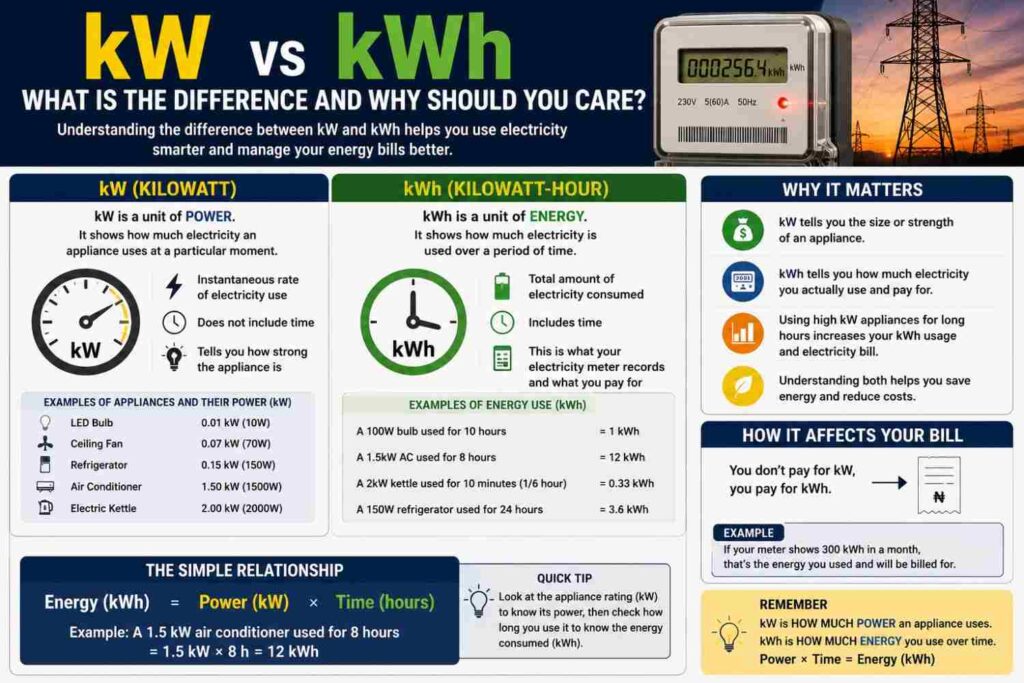
In this article, we will break down exactly what kW and kWh mean, how they relate to each other, and why the distinction matters so much in real life.
What Is a Kilowatt (kW)?
A kilowatt (kW) is a unit of power. Power measures the rate at which energy is being used or produced at any given moment — essentially, “how fast” energy is flowing. One kilowatt equals 1,000 watts. If an appliance is rated at 1.5 kW, it means that, at any instant it is switched on and running, it is consuming energy at a rate of 1,500 watts.
Think of power like the speed of a car. Speed (km/h) tells you how fast the car is moving right now, at this instant, regardless of how long the journey will last.
What Is a Kilowatt-Hour (kWh)?
A kilowatt-hour (kWh) is a unit of energy. Energy measures the total amount of “work” done over a period of time. One kWh is the amount of energy consumed when a 1 kW load runs continuously for one hour. This is the unit your prepaid or postpaid electricity meter actually measures and bills you for; not kW, but kWh.
Continuing the car analogy, energy is like distance traveled. If speed tells you how fast you are going, distance tells you the total ground you have covered by the end of the trip, which depends on both your speed and how long you drove.
The Formula That Ties Them Together
The relationship between power and energy is simple and worth memorizing:
Energy (kWh) = Power (kW) × Time (hours)
This single formula explains almost everything you need to know about how appliances consume electricity and how your electricity bill is calculated.
A Practical Example
Let’s say you run a 2 kW air conditioner for 5 hours in one evening. Using the formula:
Energy = 2 kW × 5 hours = 10 kWh
If your DisCo charges, for example, ₦225 per kWh (tariffs vary by band and change over time, so always check your current rate), that evening of cooling would cost approximately ₦2,250. Compare that to a 60W fan run for the same 5 hours: 0.06 kW × 5 hours = 0.3 kWh, costing roughly ₦67.50. This is why air conditioners and other high-power appliances dominate electricity bills even if they are used for fewer hours than smaller devices.
Why the Difference Matters for Backup Power
Understanding kW versus kWh is essential when sizing an inverter, solar system or generator:
- Inverter/generator sizing (kW or kVA): You need to know the combined kW (or kVA) of everything you plan to run at the same time. This tells you the power rating your equipment must be able to deliver instantaneously without tripping or overheating.
- Battery/fuel sizing (kWh): You need to know the total kWh you plan to consume over a given period (say, an 8-hour outage) to determine how large a battery bank you need, or how much fuel a generator will burn.
Getting this backwards is a common and costly mistake. Someone might buy an inverter with plenty of battery capacity (kWh) but too small a power rating (kW), and then find it trips every time they turn on a kettle or air conditioner, because the instantaneous power demand exceeds what the inverter can deliver — even though there is technically “enough energy” stored in the battery.
Common Appliance Power Ratings (Typical kW Values)
| Appliance | Typical Power |
|---|---|
| LED bulb | 0.007–0.015 kW |
| Ceiling fan | 0.05–0.08 kW |
| Laptop charger | 0.045–0.09 kW |
| Television (LED, 40″–55″) | 0.08–0.15 kW |
| Refrigerator (running) | 0.1–0.2 kW |
| Electric kettle | 1.5–2.2 kW |
| 1HP split-unit air conditioner | 0.75–1.0 kW |
| 1.5HP split-unit air conditioner | 1.1–1.5 kW |
| Electric iron | 1.0–2.0 kW |
These are typical values; always check the nameplate rating on your specific appliance, since actual figures vary by brand, model and age.
How to Calculate Your Own Appliance’s Energy Use
- Find the power rating on the appliance’s nameplate or manual, usually in watts (W) or kilowatts (kW). If only amps and voltage are given, multiply them together (Watts = Volts × Amps) to estimate power.
- Estimate how many hours per day you actually use it.
- Multiply power (in kW) by hours to get daily energy use in kWh.
- Multiply by your tariff rate (₦ per kWh) to estimate daily cost, and multiply again by 30 for a rough monthly estimate.
Why This Confusion Is So Common
Part of the confusion comes from how casually the terms get used in everyday conversation. People say “my inverter is 3.5kVA” (a power rating) in the same breath as “my battery gives me 5kWh of backup” (an energy rating), and because both numbers describe “electricity,” it is easy to assume they measure the same thing. Manufacturers and retailers do not always help matters either, sometimes advertising products loosely. Understanding that power (kW) is about rate and energy (kWh) is about total amount over time resolves almost all of this confusion once it clicks.
kW, kVA and kWh: Where Does kVA Fit In?
You will often see backup power equipment rated in kVA rather than kW. kVA is apparent power (as explained in our article on power factor), and for many practical purposes with a reasonably good power factor, kVA and kW are close in value, though not identical. As a rough rule of thumb, many inverters and generators are rated with a power factor around 0.8, meaning a 5kVA unit delivers roughly 4kW of real, usable power. Always check your equipment’s actual power factor rating rather than assuming kVA and kW are interchangeable.
Worked Example: Estimating a Household’s Daily Energy Use
To see how the kW-to-kWh calculation scales up to a real household, consider a simple example covering a handful of common appliances used over the course of a typical day:
| Appliance | Power (kW) | Hours Used | Energy (kWh) |
|---|---|---|---|
| Refrigerator (cycling on/off) | 0.15 | 24 (intermittent) | 1.8 |
| 6 × LED bulbs | 0.06 total | 6 | 0.36 |
| Television | 0.12 | 4 | 0.48 |
| 1.5HP air conditioner | 1.3 | 6 | 7.8 |
| Electric kettle | 2.0 | 0.5 | 1.0 |
| Laptop & phone charging | 0.08 total | 5 | 0.4 |
Adding these together gives a daily total of roughly 11.8 kWh. Over a 30-day month, that comes to approximately 354 kWh. At a hypothetical tariff of ₦225 per kWh, this household’s monthly electricity cost would be in the region of ₦79,650, though actual figures will vary significantly based on your DisCo, tariff band, appliance efficiency, and how closely your real usage patterns match these estimates. The exercise is most useful as a way to see, in concrete terms, which appliances dominate a typical bill; in this example, the air conditioner alone accounts for nearly two-thirds of total daily energy use, far more than lighting or electronics.
Why Utilities Bill in kWh Instead of kW
It might seem simpler for a utility to just charge based on the power rating of your equipment, but that would be deeply unfair: a 2kW appliance run for ten minutes uses far less energy than the same appliance run for ten hours, even though its power rating never changes. Billing by kWh ensures customers pay for the energy they actually consume, not merely for the equipment they own. This is also why two households with identical appliances can have very different bills purely because of how many hours each appliance is actually switched on and drawing power, which is exactly what the kW × time = kWh formula captures.
Common Mistakes People Make With kW and kWh
- Assuming a bigger kW inverter automatically means longer backup time. A higher kW rating means the inverter can handle a heavier instantaneous load, not that it will run longer. Backup duration depends on battery capacity in kWh (or amp-hours multiplied by voltage) relative to how much power you are actually drawing.
- Confusing appliance wattage with hourly cost directly. A 2000W appliance does not cost “2000 naira-equivalent” per hour; its cost depends on the tariff rate multiplied by 2 kWh (2kW × 1 hour), not on the wattage number alone.
- Ignoring standby and cycling loads. Refrigerators, air conditioners and water dispensers do not run continuously at full power; they cycle on and off to maintain temperature, which is why real-world kWh figures are usually lower than a naive “power rating × 24 hours” calculation would suggest.
- Mixing up kVA and kW when sizing equipment. As covered above, kVA and kW are related but not identical, and using them interchangeably can lead to undersized backup power systems.
Frequently Asked Questions
Which unit does my prepaid meter actually measure?
Your prepaid meter measures energy in kWh, which is why the “units” you buy are quoted and consumed in kWh, not kW.
If my inverter is rated 1.5kW, does that mean it uses 1.5 kWh every hour?
Not necessarily. 1.5kW is the maximum power the inverter can deliver. The actual energy it delivers depends on how much of that capacity your connected appliances are actually drawing at any given time, multiplied by the hours they run.
Why do my appliances list both watts and amps?
Watts and amps are related through voltage (Watts = Volts × Amps). Some manufacturers list amps because that is what a circuit breaker or fuse rating is based on, while others list watts because that directly relates to energy consumption.
Is a higher kW appliance always more expensive to run?
Higher kW means higher energy use per hour of operation, but total cost also depends on how many hours the appliance runs. A high-kW appliance used briefly can cost less than a low-kW appliance left running for many hours.
How do I convert kWh back into naira cost?
Multiply the number of kWh consumed by your current tariff rate per kWh, which varies depending on your DisCo and billing band, and can change over time, so it is worth checking your latest bill or DisCo tariff schedule.
Why does my prepaid meter sometimes show “units” instead of naira directly?
The “units” displayed on a prepaid meter are kWh. When you buy credit, the amount in naira is converted into a corresponding number of kWh units at your applicable tariff rate, and the meter then counts down those units as your appliances consume energy.
Does switching off an appliance at the plug versus standby actually save meaningful kWh?
For most modern appliances, standby power draw is small (often just a few watts), so the kWh saved by switching off at the wall is modest for any single device. However, across many devices left on standby continuously in a household over a full month, the combined kWh can add up to a noticeable, if usually not dominant, portion of a bill.
kW vs kWh When Designing a Solar Power System
Solar system design is one of the clearest places where the kW/kWh distinction becomes financially important, because a solar installation actually involves three separate ratings that are easy to conflate:
- Solar panel array size (kW): The combined power rating of your solar panels under standard test conditions, which determines how fast the array can generate energy at peak sunlight.
- Daily energy yield (kWh/day): How much total energy the array actually produces over a full day, which depends on panel kW rating, sunlight hours, shading, orientation and weather — not just the panel’s peak rating.
- Battery storage capacity (kWh): How much energy can be stored for use at night or during cloudy periods, independent of how fast that energy can be drawn out (which again depends on the inverter’s kW/kVA rating).
A solar installer who only talks about “kW of panels” without discussing expected daily kWh yield and battery kWh storage is leaving out two-thirds of the information a homeowner actually needs to judge whether a system will meet their needs. This is a very common source of disappointment when solar systems are sized based on panel wattage alone without matching it to realistic daily energy consumption.
Comparing Generator and Inverter Running Costs Using kWh
The kW/kWh distinction also explains why comparing a generator to an inverter/battery system purely by “how many kW” they provide can be misleading. A generator’s ongoing cost is driven by fuel consumed per kWh generated, which depends on the generator’s efficiency and how heavily loaded it is relative to its rated capacity (generators are typically least fuel-efficient when very lightly loaded). An inverter’s ongoing cost is driven by the wear on its battery bank per kWh cycled through it, plus the cost of the grid or solar energy used to recharge it. Expressing both options in cost-per-kWh terms, rather than simply comparing kW ratings, is the only fair way to judge which is cheaper for a given household’s actual daily energy needs — a comparison explored in more depth in our dedicated article on generators versus solar inverters.
Is it possible for a low-kW appliance to end up costing more than a high-kW appliance over a month?
Yes, easily. A 100W fan left running for 20 hours a day uses 2 kWh daily, while a 2000W iron used for just 15 minutes a day uses only 0.5 kWh daily. Total running hours matter just as much as the power rating itself, which is exactly why the full formula — power multiplied by time — is more useful than looking at either number alone.
Using a Plug-In Energy Meter to See the Difference Yourself
If the kW/kWh distinction still feels abstract, a simple and inexpensive way to make it concrete is to use a plug-in energy monitor (sometimes called a watt meter or power meter). These small devices sit between an appliance and the wall socket and display, in real time, both the instantaneous power draw in watts (or kW) and the accumulated energy in kWh since you last reset the counter.
Plugging in something like an electric kettle and watching the power reading jump to well over 1,500W the moment it starts heating, while the kWh counter climbs slowly and steadily, is often the moment the difference between the two units finally clicks intuitively. Many people find this kind of hands-on demonstration far more memorable than any formula, and it can also help identify which appliances in a household are quietly running up the electricity bill.
Final Thoughts
The difference between kW and kWh comes down to the difference between rate and total amount; power versus energy. Once this distinction is clear, sizing an inverter, choosing a generator, estimating a fuel budget, or simply understanding your electricity bill all become far more intuitive.
Whether you are shopping for solar equipment or just trying to make sense of your monthly power costs, keeping “kW tells you how fast, kWh tells you how much” in mind will save you from some very common and costly mistakes.