
It’s a particularly confusing scenario: your inverter’s display or battery indicator shows a healthy charge level, yet the system suddenly shuts off anyway, seemingly contradicting the very information it’s displaying.
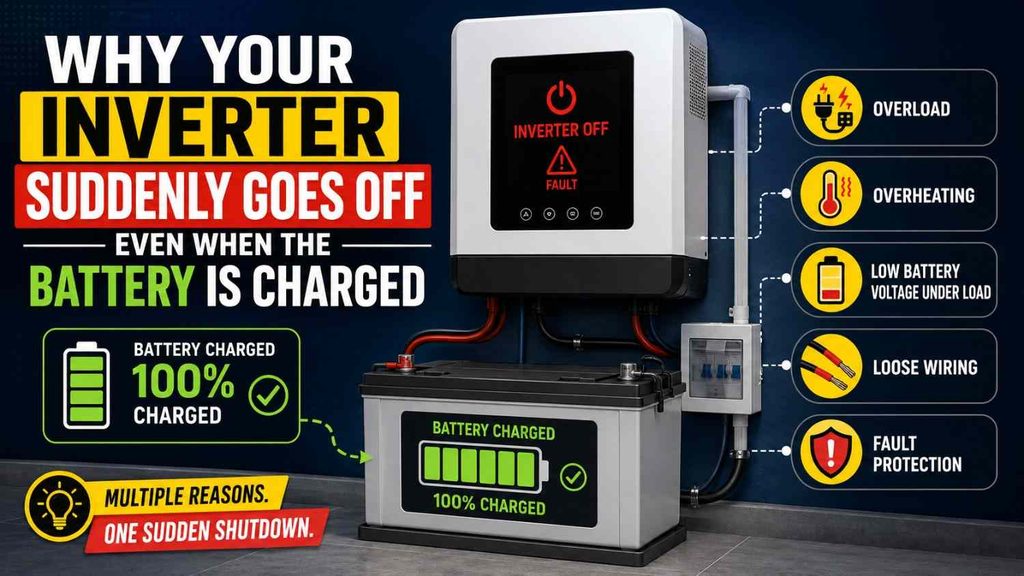
This article explains the genuine reasons this happens, since the battery indicator, it turns out, doesn’t always tell the whole story.
Why Battery Indicators Aren’t Always as Reliable as They Seem
Many inverter and battery indicators, particularly on simpler or older systems, estimate charge level based primarily on voltage readings, which can be a genuinely imprecise proxy for actual remaining capacity, especially under load, since a battery’s voltage can sag temporarily under heavy draw even when its underlying charge level is still reasonable, creating a misleading momentary low reading, or conversely can show an artificially healthy voltage shortly after charging stops even though usable capacity is actually more depleted than the reading suggests.
1. Sudden Overload Triggering Protective Shutdown
The most common explanation: your connected load briefly or suddenly exceeded your inverter’s rated capacity, perhaps from an appliance’s startup surge (motors and compressors often draw significantly more current at startup than during steady operation), triggering an automatic protective shutdown regardless of your battery’s actual charge level, a safety mechanism protecting the inverter itself rather than a battery-related issue at all.
2. Voltage Sag Under Load Triggering a False Low-Battery Shutdown
As mentioned above, a battery under heavy load can experience temporary voltage sag, and if your inverter’s low-voltage cutoff threshold is triggered by this momentary dip, even though the battery’s actual state of charge is reasonable, the system may shut down as if the battery were critically low, an especially common issue with aging batteries that have developed higher internal resistance, discussed further in our replacement-timing article.
3. A Failing or Degrading Battery Cell
A battery bank with one significantly weaker or failing cell, particularly relevant for older tubular or lead-acid batteries, can show a reasonable overall voltage reading while actually being unable to sustain load properly due to that one weak point, causing unexpected shutdown despite an apparently healthy indicator reading that doesn’t account for this kind of internal imbalance.
4. Loose or Corroded Battery Connections
A loose or corroded connection at the battery terminals can cause intermittent voltage drops under load severe enough to trigger a protective shutdown, even though the battery itself, if properly connected, would show adequate charge and be fully capable of sustaining the load in question.
5. Inverter Internal Fault or Overheating
Occasionally, the inverter itself, rather than the battery, is the source of the problem: an internal fault, an overheating component, or an inverter reaching the end of its own service life can cause unexpected shutdowns unrelated to battery charge status, particularly worth suspecting if the pattern doesn’t correlate clearly with load or battery age.
A Diagnostic Table
| Symptom Pattern | Likely Cause |
|---|---|
| Shutdown coincides with a specific appliance starting | Overload from startup surge |
| Shutdown under heavy load, battery seemed fine before | Voltage sag, possibly aging battery |
| Shutdown happens randomly, battery is older | Failing battery cell |
| Shutdown accompanied by warm terminals or visible corrosion | Loose or corroded connections |
| Shutdown unrelated to load pattern, inverter is older | Possible inverter internal fault |
How to Start Diagnosing This Yourself
- Note exactly what was happening when the shutdown occurred, particularly which appliances were running or had just started, since this pattern is often the most useful diagnostic clue.
- Check battery terminal connections for looseness, corrosion, or visible damage, and clean or tighten if needed (with power safely disconnected first).
- Reduce connected load and observe whether shutdowns stop occurring, a reasonably direct test of whether overload is the primary cause.
- Have your battery’s actual condition tested by a qualified technician if the battery is more than a couple of years old and the pattern doesn’t clearly point to overload or connections, since voltage readings alone don’t reliably reveal internal cell health.
Why This Pattern Often Signals a Battery Nearing End of Life
Unexpected shutdown despite an apparently adequate charge reading is one of the more common and telling early symptoms of a battery approaching the end of its useful service life, since aging batteries increasingly struggle to sustain their rated voltage under real load even while showing a reasonable resting voltage when unloaded, precisely the discrepancy this article has been explaining throughout.
Why Professional Load Testing Gives a More Definitive Answer
While the diagnostic steps above are a reasonable starting point, a qualified technician’s load test, applying a known, controlled load while measuring the battery’s voltage response directly, gives a considerably more definitive answer than symptom-watching alone, particularly valuable for distinguishing a battery genuinely nearing end of life from a connection or charging system issue that might otherwise be mistaken for battery failure.
Common Misconceptions
- “The battery indicator always accurately reflects true remaining capacity.” Voltage-based indicators can be misleading, particularly under load or with an aging or unbalanced battery bank.
- “Unexpected shutdown always means the inverter itself is faulty.” Battery condition, connections, and overload are all more common causes than a genuine inverter fault.
- “If the battery recovers and shows a good reading afterward, there’s no underlying issue.” A pattern of repeated unexpected shutdowns, even with apparent recovery afterward, usually indicates a genuine underlying issue worth investigating rather than a one-off fluke.
Frequently Asked Questions
Should I be concerned if this only happened once?
A single isolated incident, particularly if it coincided with a large appliance starting up, is less concerning than a repeated pattern; monitoring for recurrence is a reasonable approach before assuming a serious underlying issue.
Can adjusting my inverter’s low-voltage cutoff settings help?
In some cases, if your cutoff threshold is set overly conservatively for your battery type, adjustment may help, though this should be done carefully and ideally with technical guidance, since setting it too low risks actual battery damage from over-discharge.
Does this issue relate to the 12V vs 24V vs 48V system choice discussed elsewhere on this site?
Higher voltage systems generally experience proportionally less severe voltage sag under a given load compared to lower voltage systems delivering the same power, since current is lower at higher voltage for the same power level, making this a relevant consideration in system design decisions.
Final Thoughts
An inverter shutting off despite showing a seemingly healthy battery charge is a genuine, diagnosable symptom with several specific possible causes, ranging from simple overload to a battery nearing end of life, rather than a mysterious malfunction. Working through the pattern methodically, as outlined above, usually reveals which specific cause applies to your situation, pointing toward the right fix rather than continued confusion and frustration.