
A standard multimeter cannot tell you whether the insulation wrapped around a cable is quietly breaking down until it eventually causes a shock hazard or a fire. That is the specific job of insulation resistance testing, performed with an instrument commonly called a megger.
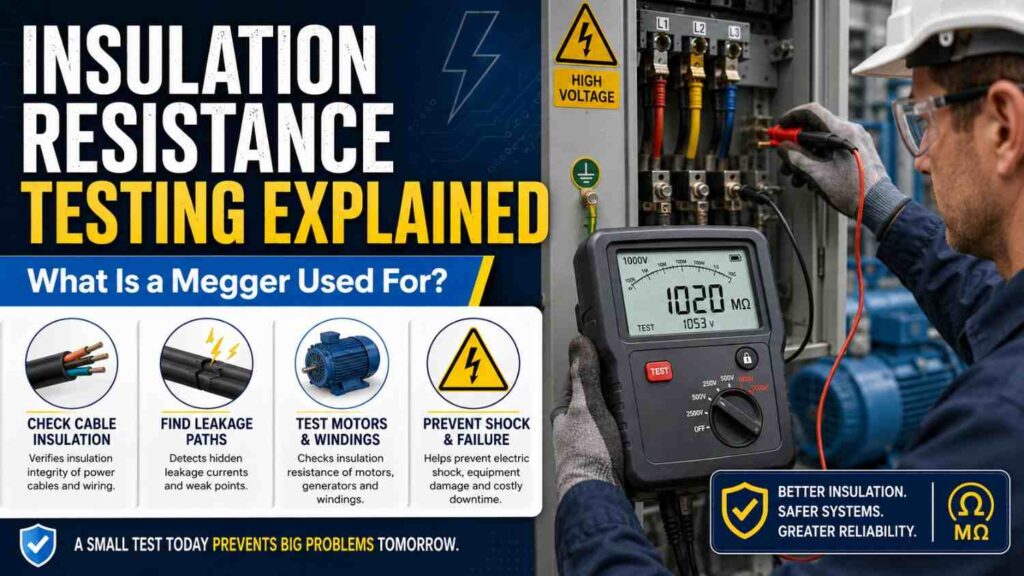
This article explains what a megger actually measures, why insulation resistance testing matters, and how the test is typically carried out.
What Insulation Resistance Testing Actually Measures
Every electrical cable relies on its insulation, the plastic or rubber sheathing around the conductor, to keep current safely contained within the wire rather than leaking out to the earth, a metal conduit, or an adjacent conductor. Insulation resistance testing measures how effectively that insulation is still blocking current flow, expressed in megohms (millions of ohms). A very high resistance reading means the insulation is in good condition; a low reading means current is leaking through weakened, damaged, or moisture-compromised insulation, even if the cable still appears to work normally day to day.
Why “Megger” Is the Common Name for This Test
The name megger comes from a historic brand name, Megger, that became so associated with insulation resistance testers that it is now used generically, much like “Hoover” is used for vacuum cleaners, regardless of actual manufacturer. A megger works by applying a high test voltage, typically 250V, 500V, or 1000V DC depending on the equipment being tested, far higher than a standard multimeter applies, and measuring the tiny leakage current that results to calculate resistance in megohms.
Why This Test Cannot Be Done With a Regular Multimeter
A standard multimeter’s resistance function uses a very small test voltage from its internal battery, sufficient for testing components and continuity but far too low to reveal how insulation actually behaves under real operating stress. Insulation breakdown is a voltage-dependent phenomenon; weakened insulation might show as effectively fine resistance under a multimeter’s tiny test voltage while still failing dangerously under full mains voltage. A megger’s higher test voltage replicates that stress far more realistically, which is exactly why dedicated equipment is necessary for this specific test.
When Insulation Resistance Testing Is Needed
- Before energizing a newly wired building or extension, to confirm the installation is safe before first use.
- Periodically on existing installations, especially older wiring, to catch gradual insulation degradation before it causes a fault.
- After water damage or flooding has affected wiring, since moisture is one of the most common causes of insulation breakdown.
- On motors, generators, and transformers, where winding insulation health directly affects equipment lifespan and safety.
- As part of routine maintenance for commercial and industrial installations, often a formal compliance requirement.
How the Test Is Typically Performed
The circuit or equipment being tested must be completely isolated and de-energized, with any sensitive electronic equipment disconnected first, since the high test voltage can damage delicate components. The megger’s leads are connected between the conductor being tested and earth (or between two separate conductors), the appropriate test voltage is selected, and the instrument applies that voltage briefly while measuring the resulting leakage current to display a resistance value in megohms. This is specialized work generally performed by trained electricians, since incorrect isolation or handling of the high test voltage carries real risk.
Typical Acceptable Insulation Resistance Values
| Installation Type | Typical Test Voltage | Generally Acceptable Minimum |
|---|---|---|
| Household wiring circuit (230V) | 500V DC | Around 1 megohm or higher (often much higher when new) |
| Motor windings | 500V – 1000V DC | Varies by motor size, typically several megohms |
| Three-phase 400V/415V installation | 1000V DC | Around 1 megohm or higher per circuit |
These figures are general guidance rather than a universal standard, since acceptable values vary by cable type, equipment, and applicable wiring regulations, so always check the specific requirement for your installation type.
How This Fits Into Broader Electrical Safety
Insulation resistance testing complements, rather than replaces, other checks such as earth continuity testing, discussed in our dedicated earth connection article, and RCD/earth leakage testing covered in our dedicated RCD article. A properly earthed system with a working RCD still relies on intact insulation to prevent leakage currents from developing in the first place, so insulation testing is best understood as catching problems earlier, before they ever reach the point of tripping a protective device or causing a shock.
Common Misconceptions
- “A megger and a multimeter test insulation the same way, just with different names.” A megger applies a much higher test voltage specifically to stress-test insulation, which a standard multimeter’s low-voltage resistance function cannot replicate.
- “If wiring is working normally with no tripped breakers, insulation must be fine.” Insulation can degrade gradually and still function acceptably day to day while resistance values fall well below a safe margin, until a fault eventually develops.
- “Insulation testing is only necessary for industrial equipment.” Household wiring, especially older installations or those affected by moisture, benefits significantly from periodic insulation resistance testing too.
Frequently Asked Questions
Can I perform insulation resistance testing myself as a homeowner?
It is strongly recommended to have this done by a trained electrician, since the high test voltage requires careful isolation and handling to avoid damaging equipment or causing injury.
How often should insulation resistance testing be done on a home?
There is no universal fixed interval, but testing before moving into an older property, after flooding, or every few years for older wiring is common practice recommended by many electricians.
What does a very low insulation resistance reading actually mean in practice?
It means current is leaking from the conductor through the insulation faster than it should, indicating damaged, degraded, or moisture-affected insulation that needs to be located and repaired or replaced.
Final Thoughts
Insulation resistance testing with a megger fills a genuine gap that everyday multimeter checks cannot cover, revealing insulation breakdown long before it becomes an obvious, dangerous fault. While the equipment and technique require training and care, understanding what the test measures and why it matters helps homeowners recognize when it is worth requesting from a qualified electrician. Combined with routine earthing and RCD checks, insulation resistance testing forms a genuinely important layer of proactive electrical safety.