
Sending electricity over long distances always loses some energy to heat in the conductors along the way, and without transformers, that loss would be so severe that large-scale power transmission would barely be practical. The reason power networks step voltage up for transmission and back down for distribution comes down almost entirely to reducing this loss.
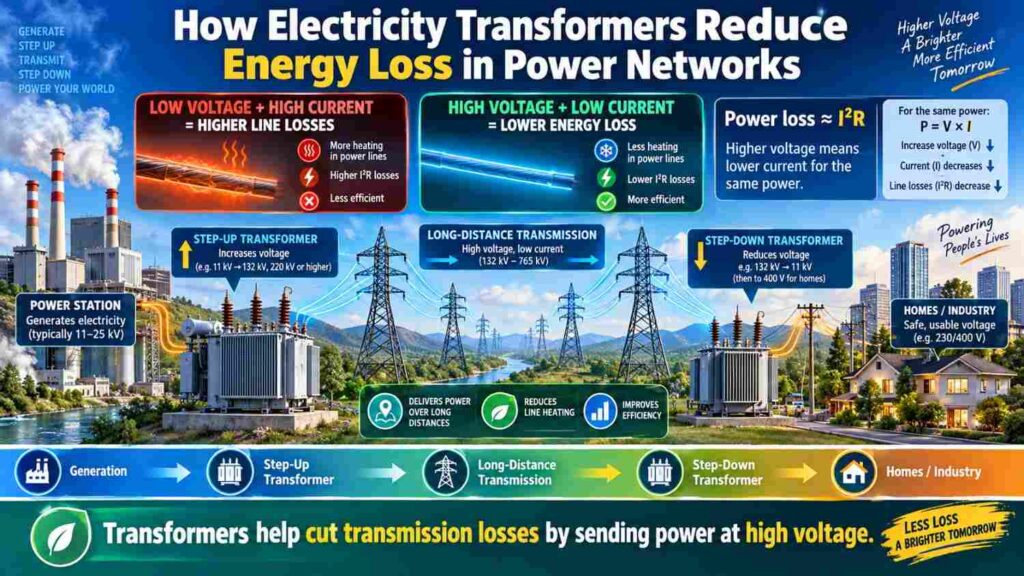
This article explains the physics behind that relationship and how transformers are used throughout a power network to keep losses manageable.
Where Transmission Losses Actually Come From
Every conductor carrying current has resistance, and current flowing through resistance generates heat, a loss described by the formula power loss equals current squared multiplied by resistance.
This relationship is the entire reason voltage level matters so much for long-distance power transmission: for a fixed amount of power being delivered, doubling the transmission voltage halves the current needed to deliver that same power, and since loss depends on current squared, halving the current cuts transmission losses to roughly a quarter of their original value.
This is why transmission lines run at very high voltages, often hundreds of kilovolts, while the electricity actually used in homes and factories runs at a small fraction of that.
How Transformers Make High-Voltage Transmission Possible
Power is generated at a moderate voltage, then transformers at the generating station step it up dramatically for transmission, a process explored more fully in our dedicated article on step-up and step-down transformers.
Without transformers to change voltage levels efficiently along the way, power would have to be generated, transmitted, and used at the same voltage, forcing a trade-off between manageable equipment insulation and unacceptably high transmission losses.
The Full Voltage Journey From Generation to Consumption
A typical path through a national grid like Nigeria’s passes through several distinct voltage stages, each one shaped by transformers matched to that stage’s purpose.
| Stage | Typical Voltage Role | Transformer Function |
|---|---|---|
| Generation | Generator terminal voltage | Step-up transformer raises voltage for transmission |
| Transmission (TCN) | High voltage, long-distance lines | Minimises current and I-squared-R losses over distance |
| Sub-transmission | Intermediate voltage | Step-down transformer reduces voltage for regional distribution |
| Distribution (DisCo) | Medium voltage feeders | Further step-down for local network delivery |
| Final delivery | Low voltage to customers | Distribution transformer steps down to usable utilisation voltage |
Transformer Losses vs Network Losses: Two Different Things
It is worth separating two related but distinct ideas. Transformers themselves have their own internal losses, the copper and core losses discussed in our dedicated article on why transformers need cooling systems, which represent a small but real inefficiency in the transformer itself.
Network losses, on the other hand, refer to the much larger I-squared-R losses in the transmission and distribution conductors that transformers help minimise by enabling higher voltage, lower current transmission.
The genuinely remarkable thing about this system is that the modest losses added by transformers at each voltage stage are vastly outweighed by the far larger conductor losses they prevent by allowing high-voltage transmission in the first place.
Why Loss Reduction Matters So Much for a Network Like Nigeria’s
Nigeria’s grid moves power across long distances between generation clusters and demand centres, and transmission and distribution losses have historically been a significant challenge, compounded by ageing infrastructure, deferred maintenance, and, at the distribution level, illegal connections that are a separate issue from the physical transmission losses discussed here.
Even so, the underlying principle stays the same: every voltage stage that transformers enable is there to keep current, and therefore resistive loss, as low as practical for the distance and load involved. Upgrading ageing transformers, maintaining proper cooling, and avoiding chronic overloading, discussed in our dedicated article on what causes transformer overheating, all support keeping the network’s overall loss level under control.
Practical Factors That Affect Real-World Network Losses
Beyond the basic voltage-current relationship, several practical factors influence how much loss a real network actually experiences.
- Conductor size and material, since thicker or more conductive cables have lower resistance
- Load power factor, since poor power factor increases current for the same real power delivered
- Distance between generation, substations, and end customers
- Transformer efficiency and how well-maintained the cooling systems are, discussed in our dedicated article on why transformers need cooling systems
- Balanced loading across phases, since imbalance creates additional losses beyond the theoretical minimum
- Overall network topology, including how many voltage transformation stages the power passes through
Steps Utilities Take to Minimise Losses
- Operate transmission lines at the highest voltage practical for the distance and equipment insulation available.
- Maintain transformers properly, including cooling systems and oil condition, to keep transformer-level losses near their design values.
- Correct poor power factor at large industrial loads using capacitor banks, reducing unnecessary current.
- Balance loads evenly across the three phases at distribution transformers.
- Right-size distribution transformers to actual neighbourhood demand rather than allowing chronic overloading.
- Reduce technical losses through conductor upgrades on heavily loaded or ageing feeder sections.
Common Misconceptions
- “Transformers waste a lot of energy every time they step voltage up or down.” A well-maintained transformer typically operates at well over 95 percent efficiency, and the losses it does have are far smaller than the transmission losses it prevents by enabling high-voltage transport.
- “Higher voltage transmission is only about safety clearances.” Clearance and insulation requirements matter, but the dominant reason for high transmission voltage is minimising current and therefore resistive loss over long distances.
- “Network losses in Nigeria are purely a transformer problem.” Losses stem from a mix of factors including conductor condition, load imbalance, poor power factor, and non-technical losses like illegal connections, not transformers alone.
Frequently Asked Questions
Why not just use very thick, low-resistance cables instead of high voltage to reduce losses?
Thicker cables help but only to a point, since the cost, weight, and physical practicality of extremely low-resistance conductors over long distances make raising voltage a far more economical solution.
How much energy is typically lost in transmission and distribution?
This varies significantly by network condition and distance, but well-maintained modern grids often keep combined technical losses in the single digits to low double digits as a percentage of energy delivered.
Do distribution transformers contribute much to overall network losses?
Their own internal losses are relatively small individually, but across a large network with many units, cumulative transformer losses and the losses from any overloading do add up to a meaningful share of total technical losses.
Final Thoughts
The relationship between voltage, current, and resistive loss is one of the most consequential pieces of physics in all of power engineering, and transformers are the practical tool that lets a network exploit it at every stage from generation to the final connection at a customer’s meter.
Each step-up and step-down transformer along the way trades a small amount of its own internal loss for a much larger reduction in transmission loss, a trade that makes long-distance power delivery viable at all.
For a network working to modernise ageing infrastructure and reduce losses, keeping this fundamental relationship in mind helps frame why voltage levels, transformer maintenance, and loading practices all matter together rather than in isolation.