
A properly working earth connection is one of the most important, and most overlooked, safety features in any electrical installation, silently protecting you from shock in the event of a fault. Many Nigerian homes have earth pins on their sockets that are never actually connected to a real earth, leaving that protection missing entirely without anyone realizing it.
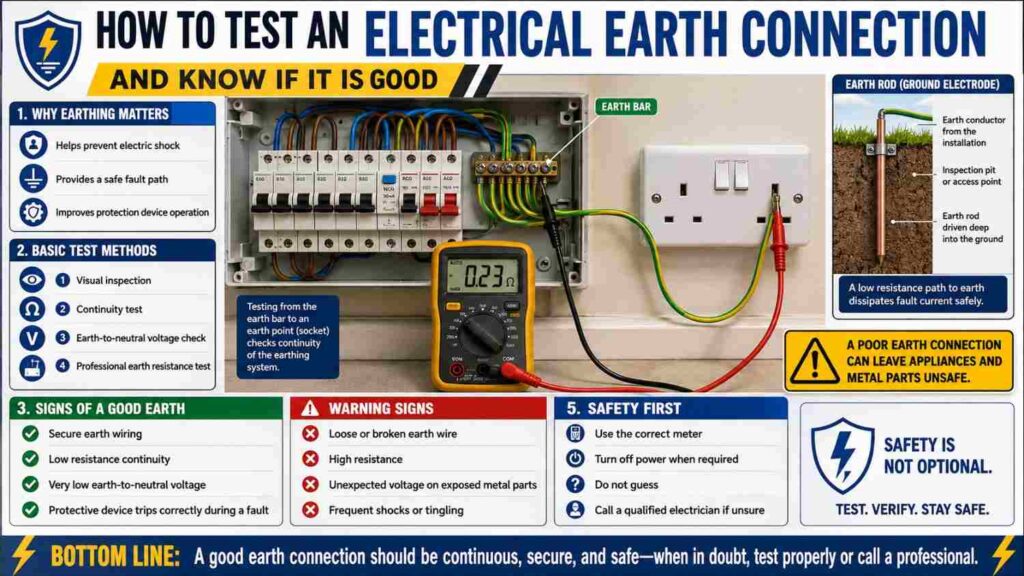
This article explains how earthing works, why it matters, and practical ways to check whether your own earth connection is actually doing its job.
What an Earth Connection Is Actually For
An earth (or ground) connection provides a low-resistance path back to the ground itself, so that if a live conductor accidentally touches the metal casing of an appliance or a socket, fault current flows harmlessly through the earth wire instead of through a person who touches that casing. This dramatically reduces shock risk and, combined with a properly functioning RCD or earth leakage circuit breaker, discussed further in our dedicated RCD article, gives you two layers of protection against a fault becoming a serious injury.
Why a Missing or Poor Earth Is So Common in Nigeria
Older buildings, informal wiring extensions, and properties where the original earthing rod has corroded or lost contact with damp soil over time are all common reasons an earth connection stops working effectively even though the socket still has a visible earth pin. Because a poor earth connection generally doesn’t stop appliances from working normally day to day, it often goes unnoticed for years until a fault occurs and the protection that should have been there simply isn’t, making periodic testing genuinely important rather than optional.
Basic Visual and Voltage Checks
Before more advanced testing, a few basic checks with a multimeter give a useful first indication. Measuring AC voltage between the live slot and the earth pin of a socket, as covered in our dedicated AC voltage measurement article, should give a reading reasonably close to the live-to-neutral voltage; a reading of zero or very low voltage suggests the earth path is broken or disconnected somewhere.
- Set the multimeter to AC voltage mode with an appropriate range.
- Measure between the live slot and neutral slot, noting the reading (typically 220-240V).
- Measure between the live slot and the earth pin, expecting a similar reading if earthing is good.
- A significantly lower or zero reading on the live-to-earth test indicates a poor or missing earth connection requiring further investigation.
Testing Continuity of the Earth Wire
With the circuit fully isolated, continuity testing, explained in detail in our dedicated continuity testing article, can confirm whether the earth wire itself forms an unbroken path from the socket back to the main earthing point or consumer unit. Touching one probe to the socket’s earth pin and the other to a known good earth point, such as the main earthing terminal at the distribution board, should produce a beep and near-zero resistance reading; no continuity indicates a break somewhere along that earth wire run.
When a Professional Earth Loop Impedance Test Is Needed
Basic voltage and continuity checks give a useful first indication, but confirming that an earth connection can actually carry enough fault current fast enough to trip a breaker or RCD within a safe time requires a proper earth loop impedance test, performed with specialized test equipment by a qualified electrician. This test measures the total resistance of the entire fault current path, from the point of a potential fault, through the earth conductor, back through the supply, giving a far more complete picture than a simple continuity check alone.
Quick Reference: Earth Testing Methods
| Test Method | Tool Needed | What It Tells You |
|---|---|---|
| Live-to-earth voltage check | Multimeter | Rough first indication of earth presence |
| Earth wire continuity test | Multimeter (continuity mode) | Confirms unbroken earth wire path |
| Earth loop impedance test | Specialized tester | Confirms fault current can trip protection fast enough |
| Earth rod resistance test | Earth resistance tester/megger | Confirms the actual earth rod is making good soil contact |
Why a Good Earth Matters Even With a Generator or Inverter
When a property switches to generator or inverter backup power, discussed in our dedicated generator and inverter articles, the earthing system needs to remain properly connected and functional for that backup supply too, since a good earth is not automatically carried over just because the power source has changed. Some changeover switch setups or informal wiring modifications inadvertently disconnect the earth path during a switch to generator power, which is worth specifically checking if your earthing was never verified after such a system was installed.
Common Misconceptions
- “A socket with a visible earth pin automatically has a working earth connection.” The physical earth pin can be present while the wire behind it is broken, corroded, or never actually connected to a real earth point.
- “If appliances work fine, the earth connection must also be fine.” Appliances generally function normally regardless of earth condition, since earthing exists specifically for fault protection, not normal operation.
- “An RCD makes a proper earth connection unnecessary.” RCDs and earthing work together as complementary layers of protection, and relying on one without the other leaves a real safety gap.
Frequently Asked Questions
Can I test my home’s earth connection myself with a basic multimeter?
Yes, the basic voltage and continuity checks described above can be done safely with a standard multimeter, though a full earth loop impedance test still requires a qualified electrician and specialized equipment.
What are the warning signs of a poor earth connection?
Mild tingling sensations when touching appliance casings, an RCD that never trips even during genuine faults, or a live-to-earth voltage reading significantly lower than the live-to-neutral reading are all warning signs worth investigating.
How often should earth connections be checked in a Nigerian home?
There’s no strict universal interval, but checking after any rewiring work, after flooding, or every few years for older properties is a reasonable, practical approach.
Final Thoughts
A working earth connection is invisible during normal daily use, which is exactly why it is so easy to neglect until the moment it is actually needed during a fault. Simple voltage and continuity checks with a multimeter give you a genuinely useful first indication of your earthing’s condition, while more thorough testing is best left to a qualified electrician with proper equipment. Given how directly this affects personal safety, verifying your earth connection is one of the most worthwhile electrical checks any homeowner can prioritize.