
A blown fuse is one of the simplest and most common reasons an appliance suddenly stops working, yet many people replace working fuses unnecessarily or overlook a genuinely blown one because they aren’t sure how to test it properly.
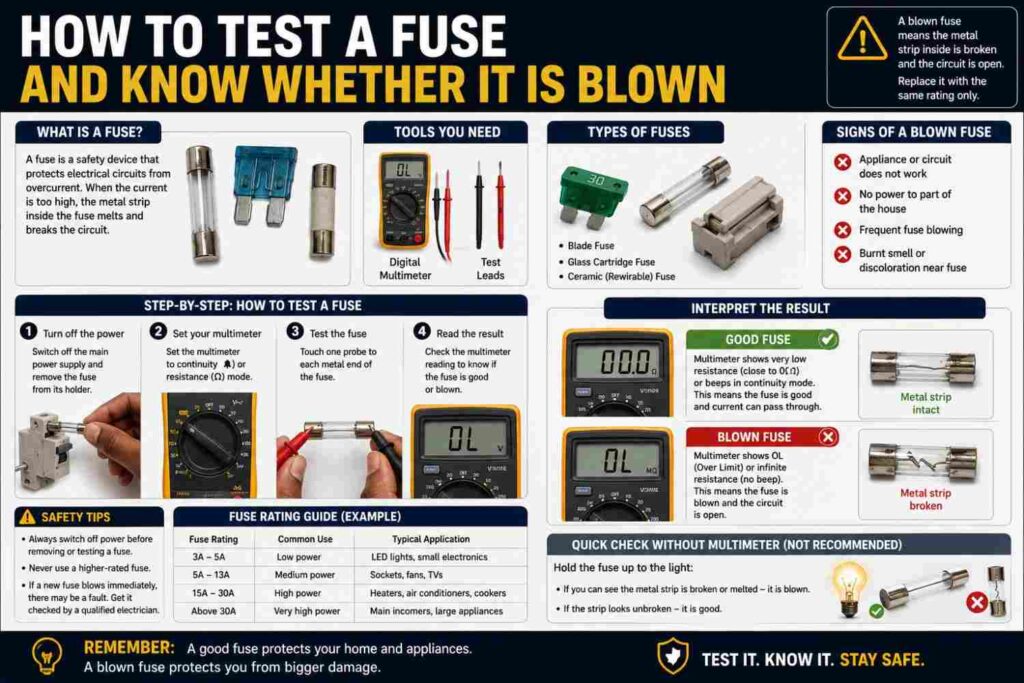
This article explains what a fuse actually does, the different ways to test one with a multimeter, and how to read the results correctly.
What a Fuse Does and Why It Blows
A fuse is a deliberately weak link in a circuit, containing a thin wire or metal strip designed to melt and break the circuit when current exceeds a safe level, protecting the wiring, appliance, or user from damage caused by a short circuit or overload. When a fuse “blows,” that internal strip has physically melted apart, permanently breaking the circuit until the fuse is replaced. Fuses are found in plug tops, appliance internals, and older-style fuse boards still common in many older Nigerian buildings alongside more modern circuit breaker distribution boards.
Visual Inspection: The First Quick Check
Before reaching for a multimeter, many blown fuses can be identified visually. Glass cartridge fuses often show a visibly broken or scorched internal wire, or a blackened, cloudy glass body from an over-current event. However, some fuses blow without any visible sign at all, particularly ceramic types or plug fuses with an opaque body, which is why a multimeter test remains the only truly reliable method to confirm a fuse’s condition.
Testing a Fuse With Continuity Mode
Continuity mode is the fastest and most intuitive way to test a fuse, as covered in more depth in our dedicated continuity testing article.
- Remove the fuse completely from its holder or circuit; never test a fuse while it remains connected to a live circuit.
- Set the multimeter dial to continuity mode (sound wave symbol).
- Touch one probe to each end cap of the fuse.
- A beep and near-zero reading confirms the fuse is good and intact.
- No beep and an “OL” or infinite reading confirms the fuse is blown.
Testing a Fuse With the Resistance (Ohms) Setting
If your meter lacks continuity mode or you want a numeric confirmation, set the dial to the lowest ohms range instead. A good fuse should read a very low resistance, typically close to zero ohms, since it is essentially just a short piece of wire or metal strip. A blown fuse will show “OL” or an infinite/open reading, since the internal element has physically separated and no longer forms a complete path.
Quick Reference: Fuse Test Results
| Test Method | Good Fuse Result | Blown Fuse Result |
|---|---|---|
| Continuity mode | Beep, near-zero reading | No beep, “OL” or infinite |
| Ohms mode | Close to 0 ohms | “OL” or infinite ohms |
| Visual inspection (glass type) | Clear glass, intact wire | Blackened glass or broken wire |
Why a Fuse Keeps Blowing Repeatedly
A single blown fuse is often just wear or a one-off surge, but a fuse that blows again shortly after replacement signals an underlying problem that must be addressed rather than repeatedly replacing fuses of the same rating. Common causes include a genuine short circuit in the appliance or wiring, an overloaded circuit drawing more current than the fuse is rated for, or fitting a fuse with too low an amperage rating for the actual load, a topic connected to correct cable and fuse sizing discussed in our dedicated wiring article. Never fit a higher-rated fuse than specified just to stop it blowing, since this defeats the fuse’s entire safety purpose and can allow dangerous overheating in the wiring it is meant to protect.
Fuses vs Circuit Breakers: A Quick Distinction
Many modern Nigerian homes have moved from fuse boards to circuit breaker distribution panels, discussed in more detail in our dedicated electrical panels article, since breakers can simply be reset rather than replaced after tripping. However, fuses remain common in plug tops (particularly on imported appliances with UK-style plugs) and inside many appliances themselves, such as the internal fuse protecting a microwave or television, so this testing skill remains genuinely relevant even in homes with modern breaker panels.
Replacing a Fuse Correctly
Once you have confirmed a fuse is blown, always replace it with one of the exact same amperage rating and type, checking the appliance manual or the rating printed on the original fuse itself. After replacing, switch the appliance back on cautiously and monitor it briefly; if the new fuse blows again almost immediately, stop and investigate the underlying fault rather than continuing to replace fuses.
Common Misconceptions
- “A fuse that looks physically intact must be working.” Many blown fuses, especially ceramic or ones with opaque bodies, show no visible damage at all despite being completely open internally.
- “Fitting a higher amperage fuse solves a fuse that keeps blowing.” This removes the fuse’s protective function and can allow dangerous overheating in wiring or the appliance before the fuse ever reacts.
- “You can test a fuse safely while it’s still installed in a live circuit.” Testing an installed fuse in a live circuit is unsafe and can give a misleading reading through other parallel paths; always remove it first.
Frequently Asked Questions
Can I test a fuse using the voltage setting instead of continuity or ohms?
Not directly on a removed fuse, since voltage testing requires an active power source; continuity or resistance testing on the isolated fuse is the correct method.
Why does my multimeter show a beep on one end of the fuse but not through the whole length?
This typically confirms the fuse is blown internally partway along its element, and touching both end caps directly should still show no continuity if it has actually failed.
Is it safe to test a fuse that has visibly blackened glass?
Yes, testing a removed, de-energized fuse is always safe; the blackening itself is just confirmation of the over-current event that likely caused it to blow.
Final Thoughts
Testing a fuse takes less than a minute once you know the correct continuity or resistance method, and it removes the guesswork from one of the most common household electrical faults. Always remove the fuse before testing, replace it with the exact correct rating, and investigate further if a replacement fuse blows again quickly. This simple diagnostic habit saves both money and unnecessary appliance replacement whenever the real problem is nothing more than a five-naira piece of melted wire.