
Measuring AC voltage is one of the most common tasks a multimeter is used for, whether you are confirming a wall socket is delivering proper power, checking generator output, or diagnosing why an appliance won’t start. Because AC mains voltage in Nigeria carries real risk of serious injury, doing this correctly and safely matters as much as getting an accurate number.
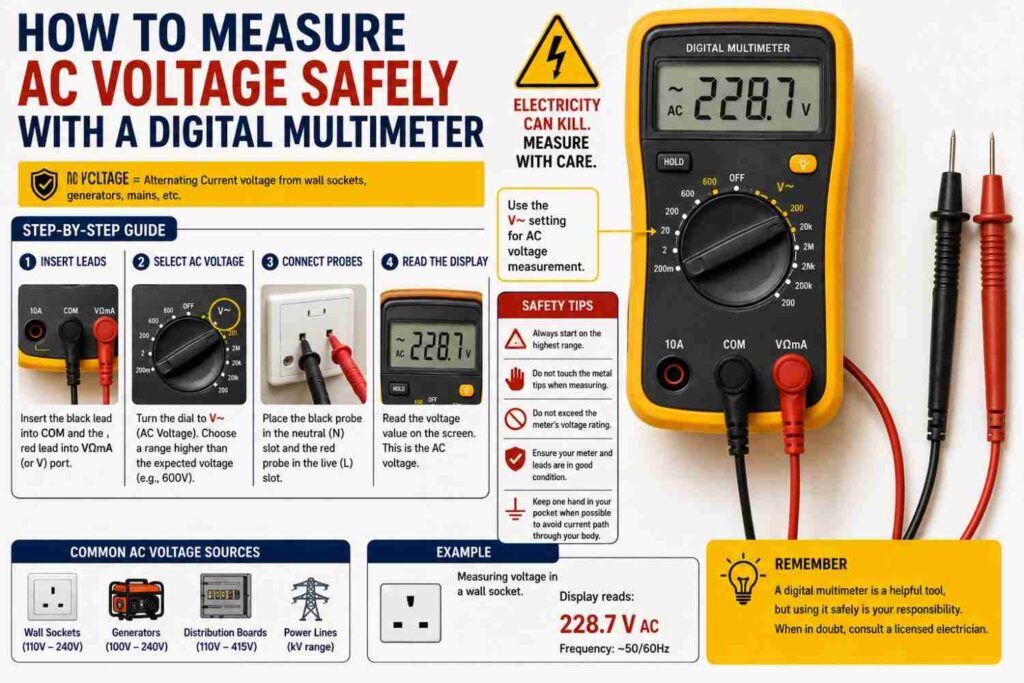
This guide walks through the safe, correct procedure for measuring AC voltage with a digital multimeter.
Understanding AC Voltage in the Nigerian Context
Nigerian household sockets typically supply single-phase AC power at 230V to 240V, 50Hz, while larger installations, workshops, and some commercial premises are fed by three-phase supply at 400V to 415V. Legacy NEPA/PHCN naming aside, this is the same standard supply now delivered through the various DisCos across the country, though voltage can fluctuate meaningfully above or below nominal depending on load, distance from the transformer, and grid conditions. Knowing this expected range helps you sanity-check your reading before assuming your meter or the socket itself is faulty.
Selecting the Correct Setting and Range
Always select the AC voltage setting, marked with a V and a wavy line (sometimes shown as VAC or V~), never the DC voltage setting, when measuring mains power, generator output, or inverter AC output. On a manual-range meter, choose a range above the expected voltage, such as the 750V or 600V range for a 230V measurement; on an auto-ranging meter this step is handled automatically. Using the wrong setting will not give a dangerous shock by itself in most cases, but it will produce a meaningless or zero reading and can occasionally damage the meter.
Step-by-Step: Testing a Wall Socket
- Set the dial to AC voltage (VAC), on an appropriate range covering at least 250V.
- Insert the black probe into COM and the red probe into the VΩ port.
- Insert one probe tip into the live slot and the other into the neutral slot of the socket, holding only the insulated probe handles.
- Read the displayed voltage; a healthy Nigerian socket should read approximately 220V to 240V.
- Optionally test between the live slot and the earth pin to confirm proper earthing, expecting a similar reading close to the live-neutral value.
Physical Safety Precautions While Testing
Never touch the metal tips of the probes while they are in contact with a live socket or wire, and always hold the probes only by their insulated handles. Keep your other hand away from any grounded metal surface or in your pocket, since this reduces the chance of current passing through your chest if something goes wrong. Work in a dry area, avoid testing with wet hands or while standing on a damp floor, and use a meter with an appropriate CAT III rating for household distribution-level testing, a topic covered in more depth in our dedicated multimeter beginner’s guide.
Testing Generator and Inverter AC Output
Given how common generator and inverter backup systems are in Nigerian homes and businesses, checking their AC output voltage is a frequent and genuinely useful task. Measure at the generator’s output socket or the inverter’s AC output terminals the same way you would a wall socket, expecting a reading close to 220-240V under normal load; a reading significantly outside this range can indicate a voltage regulation problem, an overloaded unit, or a fault worth investigating further, as discussed in our dedicated generator and inverter articles.
Typical Voltage Readings to Expect
| Test Point | Expected Reading | What an Abnormal Reading May Suggest |
|---|---|---|
| Standard wall socket (live-neutral) | 220V – 240V | Grid fluctuation, wiring fault, or loose connection |
| Live to earth pin | Close to live-neutral reading | Poor earthing if reading is very low or zero |
| Generator output under load | ~220V – 240V | Voltage regulator issue or overload |
| Three-phase line-to-line | 400V – 415V | Phase imbalance or supply fault |
When a Reading Suggests a Problem
A reading well below the expected range, especially one that sags further as an appliance is switched on, often points to a loose connection, undersized wiring, or a heavily loaded circuit rather than a faulty meter, a topic explored further in our dedicated wiring and cable sizing article. A reading well above the expected range, particularly during grid switching or generator startup, can indicate voltage instability that puts connected appliances at risk and may justify investing in a voltage stabilizer or a properly rated inverter/UPS system.
Common Misconceptions
- “Measuring AC voltage on the DC setting just gives a slightly wrong number.” The DC setting will typically show zero or a meaningless reading on an AC source, since it is designed to read a different type of waveform entirely.
- “If the socket reads close to 230V, the earthing must also be fine.” Live-neutral voltage and proper earthing are separate checks; a socket can show correct voltage while still having a poor or missing earth connection.
- “A higher voltage range setting gives a less accurate reading.” Selecting a higher range than necessary only reduces display resolution slightly; it is far safer than selecting too low a range, which can overload the meter.
Frequently Asked Questions
Is it normal for socket voltage to vary slightly throughout the day?
Yes, minor fluctuations within roughly 220V to 240V are normal in Nigeria due to grid load changes, though large or frequent swings outside this range may indicate a supply problem worth reporting to your DisCo.
Can I measure AC voltage with wet hands or in a wet environment?
No, moisture significantly increases shock risk, and testing should always be done in a dry environment with dry hands and dry probe insulation.
Why does my multimeter show a low, unstable reading near a running generator?
This can indicate the generator is overloaded, has a failing voltage regulator, or is running at incorrect speed, and further investigation is warranted before continuing to use it under that load.
Final Thoughts
Measuring AC voltage safely comes down to using the correct setting, respecting the physical risks of live conductors, and understanding what a normal reading should look like in the Nigerian supply context. Once you are comfortable with the basic socket test, the same technique extends naturally to checking generators, inverters, and other AC sources around your home or workplace. Treat every live measurement with full caution regardless of how routine it feels, since AC mains voltage remains genuinely dangerous no matter how many times you have tested it before.