
Before touching any wire, socket, or exposed conductor, you need a reliable way to confirm it is not carrying power, and doing so without physical contact is both safer and faster than reaching for a multimeter every time.
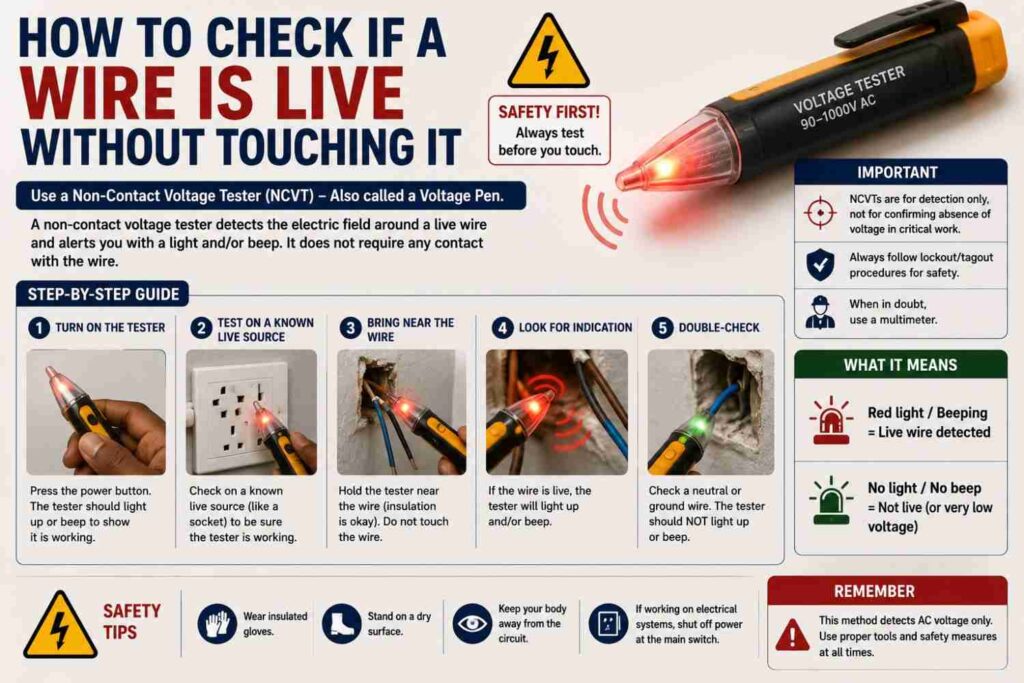
This article explains the tools and techniques for checking whether a wire is live without touching it, when each method is appropriate, and where their limitations lie.
Why Non-Contact Testing Matters
Many electrical faults in Nigerian homes involve wiring hidden behind walls, inside trunking, or bundled in ceiling roses where you cannot easily isolate a single conductor to test it directly. A non-contact voltage tester lets you scan a wire, socket, or cable and get an immediate indication of live voltage without exposing bare skin or probe tips to the conductor. This is especially valuable as a first-pass safety check before you open a junction box, work on wiring, or handle a cable that may or may not still be connected to the supply.
The Non-Contact Voltage Tester (NCVT)
A non-contact voltage tester, often called a voltage pen or voltage sniffer, is a small pen-shaped device that detects the electromagnetic field surrounding a live AC conductor. You simply hold the tip near or against the insulation of a wire, cable, or socket faceplate, and the device lights up and often beeps if voltage is present. These devices typically cost between 1,500 and 6,000 naira in Nigeria and are inexpensive enough that every household toolbox should have one, alongside a proper multimeter for more precise work.
How to Use a Voltage Pen Correctly
- Test the pen first on a known live source, such as a working wall socket, to confirm the battery and detector are functioning.
- Hold the pen near the insulation of the wire or against the socket faceplate, not on bare stripped conductors.
- Watch for the light and listen for the beep, which indicates detected voltage.
- Move it along the length of a cable if checking for a break or confirming which wire in a bundle is actually live.
- Re-test the pen on the known live source again afterward to confirm it did not fail silently during use.
Understanding the Limitations
Non-contact testers are extremely useful but not infallible, and treating a negative reading as absolute proof of safety is a mistake that has caused real injuries. Thick insulation, metal conduit, or certain cable types can shield the electromagnetic field enough that the pen fails to detect a genuinely live wire underneath. Additionally, a wire that is live but carrying very low current, or an isolated neutral wire in some fault conditions, may not always trigger a clear response. For this reason, a non-contact tester should be treated as a quick screening tool, not a final confirmation, especially before any direct contact work.
Combining Non-Contact Testing With a Multimeter
The safest practical approach is to use the non-contact tester as your first check, and then confirm with an actual voltage measurement using a multimeter, as detailed in our dedicated multimeter beginner’s guide, before treating any circuit as fully dead. This two-step approach, sometimes called “test, verify, test again,” is standard practice among professional electricians and dramatically reduces the risk of a false negative leading to accidental contact with a live conductor.
Comparing Non-Contact Detection Methods
| Method | Contact Required | Best Use Case | Reliability |
|---|---|---|---|
| Non-contact voltage pen | No | Quick screening of cables, sockets, switches | Good, but can miss shielded wires |
| Multimeter (AC voltage mode) | Yes, probe contact | Confirming exact voltage present | Very reliable when used correctly |
| Visual/physical inspection alone | No electrical contact, but risky | Never recommended as sole method | Unreliable, cannot detect voltage |
Other Practical Signs Worth Checking
Alongside using a proper tester, some circumstantial clues can support your judgment, though none should replace an actual measurement. If a circuit’s breaker is confirmed off at the panel and locked or tagged, that is a strong indicator, though breakers can occasionally be mislabeled, which is why physically verifying the correct breaker feeds the correct circuit, as covered in our dedicated electrical panels article, matters. Similarly, an RCD or earth leakage breaker that has tripped, discussed further in our dedicated RCD article, does not guarantee the downstream wiring is fully de-energized in every fault scenario.
Common Misconceptions
- “A non-contact tester that shows no light means the wire is definitely dead.” Shielded cables, low current, or a weak battery in the tester can all produce a false negative, so confirmation with a multimeter is still necessary.
- “Non-contact testers can also measure how much voltage is present.” These devices only indicate the presence of voltage, not its actual value, unlike a multimeter which gives a precise reading.
- “If the switch is off, the wire beyond it is automatically safe to touch.” Depending on the wiring, the switch may control only one side of the circuit, leaving the other side still live even with the switch off.
Frequently Asked Questions
Can a voltage pen detect DC voltage from batteries or inverters?
No, most non-contact voltage testers are designed specifically for AC voltage detection and will not reliably detect DC sources like batteries or many inverter output circuits.
Is it safe to rely only on a non-contact tester before working on house wiring?
No, it should only be your first screening step; always confirm with a multimeter measurement before making direct contact with any conductor.
Why did my voltage pen beep near a wire I know is switched off?
Nearby live conductors, induced voltage from adjacent live wires, or a wire still connected on one side even with a switch off can all trigger a reading, so further investigation with a multimeter is warranted.
Final Thoughts
Non-contact voltage testers are an inexpensive, genuinely useful first line of defense for checking whether a wire is live before you go anywhere near it. They are not a substitute for a proper multimeter measurement, and understanding their limitations is just as important as knowing how to use them. Build the habit of testing your tester on a known live source before and after each use, and always follow up a non-contact check with direct verification before touching any conductor.