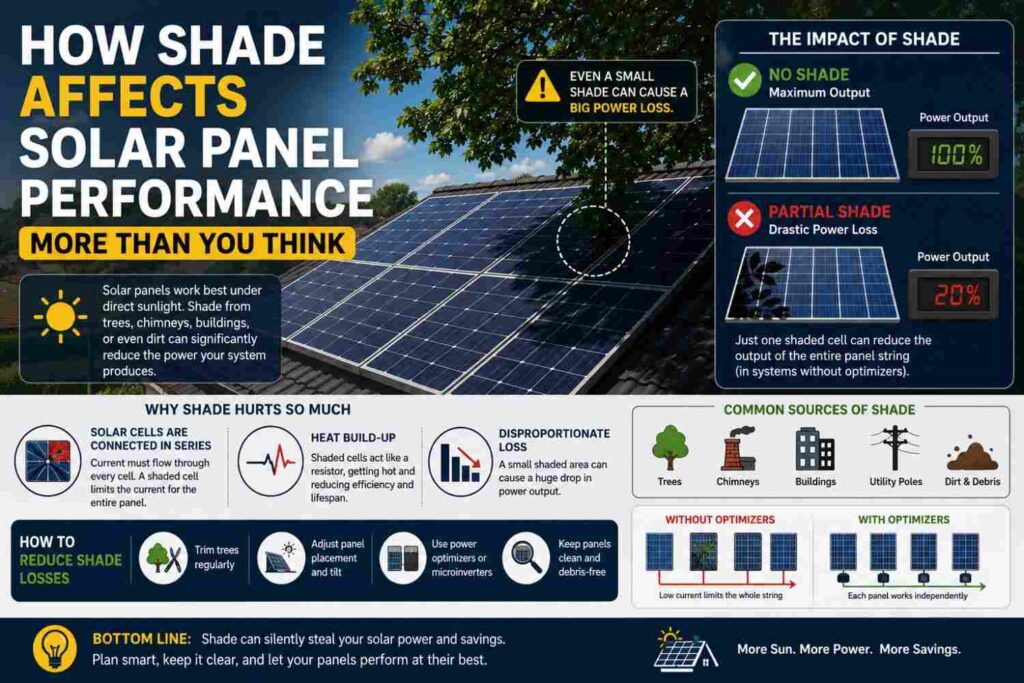
A shadow that covers just a small fraction of your solar array’s total surface area can, counterintuitively, reduce your system’s total output by a percentage far larger than the shaded area itself would suggest.
This article explains the electrical reasons why partial shading has such a disproportionate impact, and what can genuinely be done to minimize it.
Why Shading Isn’t Simply Proportional to Lost Output
Intuitively, you might expect a panel with 10% of its surface shaded to lose roughly 10% of its output, but solar cells and panel wiring don’t work this way in practice. Solar cells within a panel, and panels within a series string, are typically wired in series internally, meaning current flow through the entire chain is limited by whatever single cell or panel is performing worst at that moment, similar to the series wiring principle discussed in our series vs parallel panel wiring article, applied at the cell level within a single panel as well as across an entire string.
How This Plays Out Within a Single Panel
A single panel’s cells are typically wired in series internally; if even one cell is significantly shaded, for example by a fallen leaf or a section of roof structure casting a shadow, it can restrict current for the entire panel’s cell chain, potentially reducing that panel’s output far more than the shaded area’s proportion of total surface would suggest, sometimes by 50% or more from a relatively small shadow covering just a few cells.
How This Compounds Across a Series String
When multiple panels are wired together in series to form a string, the same principle applies at the string level: one significantly shaded panel can restrict current for every panel in that string, meaning the entire string’s output drops toward the shaded panel’s reduced output level, effectively multiplying a single panel’s shading problem across every panel electrically connected to it in series.
Why Bypass Diodes Help but Don’t Fully Solve This
As mentioned in our series vs parallel wiring article, quality panels include bypass diodes that allow current to route around a significantly underperforming section of cells rather than being completely blocked by it, meaningfully reducing, though not entirely eliminating, the disproportionate impact of partial shading. Bypass diodes typically protect sub-sections of a panel (often three sections per panel) rather than every individual cell, meaning shading affecting even part of one of these sections still meaningfully impacts that section’s contribution, even with bypass protection functioning correctly.
Common Sources of Shading Worth Identifying
- Trees and vegetation, including growth that has increased since original installation and wasn’t accounted for at the time
- Nearby buildings or structures, including your own home’s chimney, water tank, or roof features
- Overhead cables or poles, particularly relevant in denser residential areas
- Dust and dirt accumulation creating a milder, more uniform “shading-like” effect across the whole array rather than a sharp, localized shadow
- Bird droppings or debris concentrated on specific cells, creating small but electrically significant localized shading
A Practical Comparison: Shading vs Its Real Impact
| Shading Scenario | Naive Expectation | Realistic Impact |
|---|---|---|
| Small shadow on one cell, no bypass diode active | Tiny reduction | Can significantly reduce that panel’s entire output |
| One fully shaded panel in a series string | Loss of that panel’s share only | Can drag down entire string’s output toward shaded panel’s level |
| Uniform light dust across whole array | Proportional to dust coverage | Roughly proportional, less disproportionate than localized shading |
Practical Steps to Minimize Shading Impact
- Site assessment before installation: A proper installer should map shading patterns throughout the day and across seasons before finalizing panel placement, not just at a single point in time.
- Trim or plan around vegetation growth: Trees that don’t currently shade your array may grow to do so within a few years; accounting for this at installation time avoids a recurring maintenance and performance issue.
- Consider panel-level optimization or microinverters for sites with unavoidable partial shading, technologies that manage each panel’s output more independently than a simple series-string configuration, reducing the disproportionate impact discussed throughout this article, though at additional cost.
- Regular cleaning to address the more uniform, gradual shading-like effect of dust accumulation, covered in our dedicated cleaning article.
Why This Matters More in Nigeria Than You Might Expect
Many Nigerian residential installations are in denser urban or semi-urban settings with nearby buildings, walls, and vegetation, and rooftop space constraints sometimes force panel placement in less-than-ideal locations relative to potential shading sources. Given how disproportionately even minor shading impacts total system output, a proper shading assessment before installation is a genuinely worthwhile investment of time, often more impactful to your system’s real-world performance than a marginal difference in panel brand or type.
Mapping Shadows Across the Full Day, Not Just a Single Snapshot
A proper shading assessment shouldn’t rely on a single observation at one time of day, since shadow patterns from the sun’s changing position shift considerably from morning through evening, meaning a spot that appears fully sun-exposed at midday might experience significant shading during morning or late afternoon hours from the very same nearby obstruction. Professional site assessments often use specialized tools or extended observation across a full day, sometimes across different seasons given the sun’s changing path throughout the year, to build an accurate, complete shading profile before finalizing panel placement, a level of thoroughness worth confirming your installer is actually applying rather than assuming from a brief site visit.
Seasonal Shadow Changes Worth Anticipating
Because the sun’s path across the sky shifts meaningfully between Nigeria’s relatively more equatorial seasons compared to higher-latitude regions, though still enough to matter, shadows from a fixed obstruction like a building or tree can lengthen or shorten and shift direction somewhat across the year, meaning a site that seems shade-free during one season’s assessment might experience more shading during another. This is part of why a conservative shading assessment, accounting for the full range of seasonal variation rather than only the specific conditions present on the day of a single site visit, produces a more reliable long-term performance expectation.
When Relocating Panels Is Worth the Additional Cost
If a post-installation shading assessment reveals significant, unavoidable, and worsening shading affecting a substantial portion of your array’s output, relocating the affected panels to a less obstructed area, even at some additional installation cost, can sometimes deliver better long-term value than continuing to operate a significantly shaded configuration, particularly once you calculate the cumulative energy loss such shading represents over the system’s remaining multi-decade lifespan.
Common Misconceptions
- “A small amount of shading only causes a proportionally small loss.” Due to series wiring within panels and strings, small shading can cause disproportionately large output reductions.
- “Bypass diodes completely eliminate shading’s impact.” They meaningfully reduce but don’t entirely eliminate the disproportionate effect, particularly for shading affecting multiple cell sections.
- “Shading only matters at the moment it’s actually blocking the sun.” Because shading patterns shift throughout the day and across seasons, a site that seems shade-free at one particular time can still experience significant shading losses at other times.
Frequently Asked Questions
Can I fix a shading problem after installation without moving the panels?
Sometimes, through trimming vegetation, removing the specific obstruction if possible, or upgrading to panel-level optimization technology; a full site reassessment by a qualified installer is the best starting point.
Does shading affect monocrystalline and polycrystalline panels differently?
The underlying series-wiring shading mechanism affects both technologies similarly; the panel type discussed in our dedicated comparison article isn’t the primary factor in shading sensitivity.
Is it worth paying extra for microinverters or panel-level optimizers specifically for shading concerns?
For sites with unavoidable, significant partial shading, this additional investment often pays for itself through meaningfully recovered output that a standard series-string configuration would otherwise lose.
Final Thoughts
Shading’s disproportionate impact on solar output is one of the more counterintuitive aspects of how solar systems actually behave, rooted directly in the series wiring used within both individual panels and typical panel strings. Taking shading seriously during site assessment and installation planning, rather than treating it as a minor afterthought, is one of the highest-value steps you can take toward ensuring your system delivers close to its realistic potential output.