
Solar panels represent a genuinely significant upfront investment, making their expected lifespan a critical factor in evaluating whether solar makes financial sense for your household over the long term.
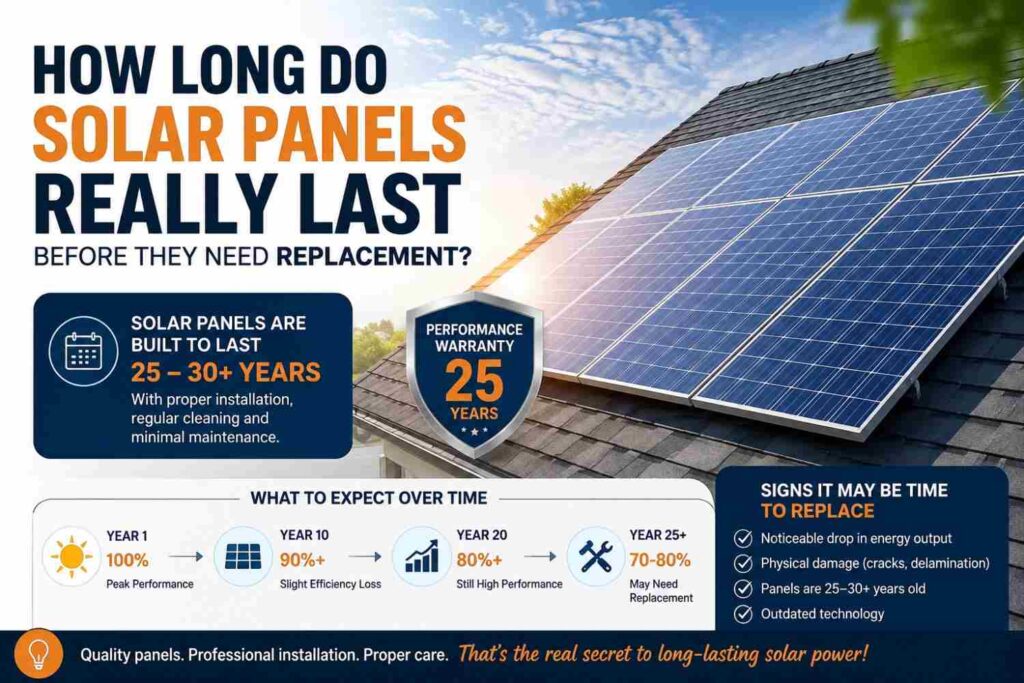
This article explains what “lifespan” actually means for solar panels, how gradual degradation works, and what realistically determines when replacement becomes necessary.
Solar Panels Don’t Simply Stop Working at a Fixed Date
Unlike some electronics that fail relatively abruptly at end of life, solar panels typically degrade gradually and continuously over decades rather than suddenly stopping production at some fixed cutoff point, meaning “lifespan” for solar panels is more accurately understood as the point at which output has declined enough that continued use becomes impractical or uneconomical, rather than a hard failure date.
Understanding Manufacturer Performance Warranties
Most reputable solar panel manufacturers offer performance warranties guaranteeing a panel will still produce at least a specified percentage of its original rated output after a set number of years, commonly structured as roughly 90% output guaranteed after 10 years and 80-85% after 25 years, figures worth checking specifically for any panel you’re considering, since warranty terms vary meaningfully between manufacturers and product lines.
Typical Real-World Degradation Rates
Quality solar panels typically degrade at roughly 0.5-0.8% of their original output per year under normal conditions, meaning a panel producing 400W when new might realistically produce somewhere around 340-360W after 20 years of service, still substantial, usable output despite two decades of continuous outdoor exposure and operation.
Factors That Influence Your Panels’ Actual Lifespan
1. Panel Quality and Manufacturing Standards
Panels from established, reputable manufacturers with rigorous quality control generally experience more predictable, gradual degradation than lower-quality or unbranded alternatives, which can sometimes degrade faster or fail more abruptly due to manufacturing defects or inferior materials not built to withstand decades of outdoor exposure.
2. Installation Quality
Proper mounting, weatherproofing, and electrical connection quality at installation time significantly affects long-term reliability; poor installation can introduce water ingress, connection degradation, or physical stress points that accelerate failure well beyond what the panels themselves would otherwise experience under normal aging.
3. Environmental Exposure
Consistent high temperatures, common throughout much of Nigeria, can modestly accelerate certain degradation mechanisms compared to cooler climates, while coastal areas face additional consideration around humidity and salt air exposure, particularly relevant for mounting hardware and electrical connections rather than the panels’ core cells themselves.
4. Physical Damage Events
Severe weather, falling debris, or accidental impact can cause sudden physical damage unrelated to normal gradual degradation, an important distinction since such damage typically affects specific panels rather than reflecting your entire array’s underlying age-related condition.
A Realistic Degradation Timeline
| Age | Typical Remaining Output (vs. original rating) |
|---|---|
| New | 100% |
| 10 years | ~90-95% |
| 20 years | ~83-88% |
| 25 years | ~80-85% |
| 30+ years | Often still functional, output continuing to gradually decline |
When Does Replacement Actually Become Worthwhile?
Rather than a fixed age, replacement typically becomes worthwhile when degraded output no longer adequately meets your household’s needs, when panels experience specific physical damage or failure beyond simple gradual degradation, or when significantly more efficient newer panel technology becomes available at a cost that justifies replacing still-functional but comparatively lower-output older panels, an economic calculation specific to your situation rather than a fixed universal timeline.
How to Extend Your Panels’ Practical Working Lifespan
Regular cleaning, discussed in our dedicated cleaning article, prompt attention to any physical damage or connection issues, ensuring your mounting hardware remains structurally sound over time, and avoiding unnecessary physical stress or shading changes (like nearby construction or growing vegetation) all help your panels perform closer to their potential throughout their realistic multi-decade lifespan, rather than experiencing accelerated, avoidable degradation.
What Actually Happens Physically as Panels Age
Gradual degradation stems from several slow physical and chemical processes occurring within a panel over years of continuous outdoor exposure: minor discoloration or yellowing of the encapsulant material protecting the cells, microscopic changes within the silicon cells themselves from repeated thermal cycling (heating during the day, cooling at night), and very gradual reduction in the effectiveness of anti-reflective coatings on the glass surface. None of these processes typically cause sudden failure; they simply, gradually reduce the panel’s light-capturing and power-conversion efficiency over time, consistent with the roughly 0.5-0.8% annual figures discussed above.
Comparing Panel Lifespan Expectations Against Other System Components
Understanding panels’ multi-decade lifespan in context matters for realistic total-cost-of-ownership planning: while panels themselves may still be functioning well after 25-30 years, batteries typically need replacement every 5-15 years depending on type and usage patterns, and inverters or charge controllers often have practical lifespans in the 10-15 year range before replacement or significant repair becomes necessary. Budgeting for these shorter-lived components’ eventual replacement, rather than assuming your entire system shares the panels’ impressively long lifespan, is essential for realistic long-term financial planning around your solar investment.
What to Check Before Buying a Secondhand or Used Panel System
If considering secondhand panels, common in some budget-conscious markets, checking the original installation date, requesting any available performance history or degradation data, and if possible arranging a basic output test under known sunlight conditions before purchase all help assess how much realistic remaining useful life a used system actually has left, rather than relying solely on visual condition or the seller’s own claims about remaining lifespan.
Common Misconceptions
- “Solar panels stop working completely after their warranty period ends.” Panels typically continue producing meaningful power well beyond standard 25-year warranty periods, just at a gradually reduced output level.
- “All panels degrade at the same predictable rate regardless of brand.” Quality and manufacturing standards genuinely affect real-world degradation rates and long-term reliability.
- “A panel producing less than its original rating has failed and needs replacing.” Gradual degradation is normal and expected; replacement is a needs-based and economic decision, not an automatic response to any decline from original output.
Frequently Asked Questions
Do batteries and inverters last as long as the panels themselves?
Generally no; batteries, particularly, typically have considerably shorter practical lifespans than panels and will likely need replacement one or more times before the panels themselves reach end of practical life, an important consideration for total system cost planning.
Is it worth buying panels with the longest available warranty even at a higher price?
A longer, more comprehensive warranty from a reputable manufacturer often reflects genuine confidence in build quality and can be a worthwhile factor, though it’s worth weighing against the manufacturer’s actual track record and reputation rather than warranty length alone.
Can degraded older panels still be useful for lower-priority applications even after significant decline?
Yes, panels with reduced but still meaningful output can often be repurposed for lower-demand applications, such as basic lighting or charging, even after they no longer adequately serve their original primary household role.
Final Thoughts
Solar panels are a genuinely long-lived investment, typically remaining functional and producing meaningful power for well over two decades, with gradual, predictable degradation rather than sudden failure being the norm for quality panels properly installed and maintained. Understanding this realistic degradation curve, rather than either overestimating panel lifespan or worrying unnecessarily about normal gradual decline, helps you plan your solar investment’s true long-term value accurately.