
Induction motors power an enormous range of industrial and household equipment, from factory conveyors to ceiling fans, yet many people who encounter or even work with these motors regularly don’t have a clear picture of how they actually generate rotational motion. This article provides a genuinely beginner-friendly explanation of the underlying working principle.
The Basic Concept: Electromagnetic Induction
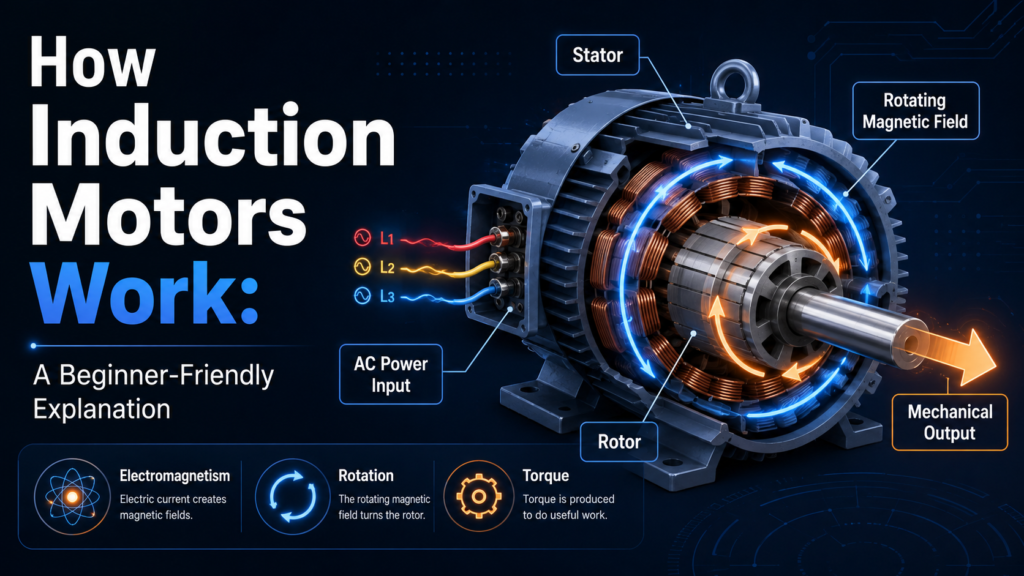
Induction motors work based on electromagnetic induction, the same fundamental physical principle underlying transformers: a changing magnetic field induces electrical current in a nearby conductor, and that induced current, interacting with the original magnetic field, produces mechanical force, which in an induction motor’s specific geometry translates into rotational motion.
The Stator: Creating a Rotating Magnetic Field
The stator, the motor’s stationary outer section, contains windings arranged such that, when supplied with three-phase AC power, discussed in our article on three-phase motors, they collectively generate a magnetic field that continuously rotates around the stator’s circumference at a speed determined by the supply frequency and the motor’s specific winding configuration.
The Rotor: Where Induction Actually Happens
The rotor, the motor’s rotating inner section, typically consists of conductive bars (in the common “squirrel cage” design) arranged in a cylindrical pattern; as the stator’s rotating magnetic field sweeps past these rotor bars, it induces electrical current within them, exactly as a transformer induces current in its secondary winding.
How Induced Current Produces Rotation
The current induced in the rotor bars, flowing through the rotor’s conductors within the stator’s magnetic field, experiences a force (following basic electromagnetic force principles) that causes the rotor to follow the stator’s rotating magnetic field, producing the continuous rotational motion that makes the motor useful for driving mechanical loads.
Why It’s Called “Induction”: The Absence of Direct Electrical Connection
Unlike some other motor types where the rotor receives electrical power through direct physical connections (brushes and slip rings), the induction motor’s rotor receives its current purely through electromagnetic induction from the stator’s rotating field, with no direct electrical connection to the rotor at all, contributing to induction motors’ genuine mechanical simplicity and reliability.
Slip: Why the Rotor Never Quite Catches the Magnetic Field
| Concept | Explanation |
|---|---|
| Synchronous speed | The speed of the stator’s rotating magnetic field |
| Rotor speed | Always slightly slower than synchronous speed |
| Slip | The difference between synchronous and rotor speed |
| Why slip exists | Induction requires relative motion between field and rotor |
If the rotor ever reached exactly the same speed as the rotating magnetic field, there would be no relative motion between them, and therefore no induced current and no torque production; this necessary small speed difference, called “slip,” is a fundamental characteristic of how induction motors work, not a design flaw or inefficiency.
Why This Design Makes Induction Motors So Widely Used
The absence of direct electrical connections to the rotor gives induction motors genuine mechanical simplicity, reliability, and relatively low maintenance requirements compared to motor types requiring brushes or slip rings, contributing significantly to why induction motors dominate industrial and commercial motor applications worldwide, from the small motors in household appliances discussed throughout our appliance articles to large industrial drives.
Single-Phase Versus Three-Phase Induction Motors
While the core induction principle applies to both, single-phase induction motors, common in smaller household appliances discussed throughout our appliance articles, require additional starting mechanisms (like auxiliary windings or capacitors) to create the initial rotating field that three-phase motors generate naturally from their inherently rotating three-phase supply, explaining why three-phase motors are generally preferred for larger industrial applications where three-phase power is available.
Common Misconceptions
- “The rotor and the magnetic field rotate at exactly the same speed.” A small speed difference, slip, is genuinely necessary for the induction process to keep producing torque.
- “Induction motors require some direct electrical connection to the rotor to function.” The rotor receives current purely through electromagnetic induction, with no direct electrical connection at all in standard designs.
- “All AC motors work through essentially the same mechanism.” Different AC motor types (induction, synchronous, and others) use genuinely different working principles despite superficial similarities.
Frequently Asked Questions
Why do induction motors need reduced-current starting methods like star-delta starting?
As discussed in our dedicated star-delta starting article, the high inrush current during starting relates to the induction process itself and the motor’s initial standstill condition, requiring various starting methods to manage this current for larger motors.
Do induction motors work the same way regardless of their physical size?
The fundamental electromagnetic induction principle applies across motor sizes, from small household appliance motors to large industrial drives, though construction details and specific characteristics vary considerably by application and size.
Is “squirrel cage” just a nickname, or does it describe an actual design feature?
It genuinely describes the rotor’s physical appearance, conductive bars arranged in a cylindrical pattern resembling a rotating exercise cage, and remains the standard, most widely used induction motor rotor design.
Final Thoughts
Induction motors generate rotational motion through electromagnetic induction, a rotating magnetic field in the stator inducing current in the rotor, which then produces the force driving rotation, all without any direct electrical connection to the rotor itself. Understanding this genuinely elegant working principle provides essential foundational knowledge for anyone studying or working with the induction motors that power so much of modern industrial and household equipment.