
It’s one of the more confusing electrical scenarios a homeowner can face: the lights work, the TV comes on, the fridge is humming along fine, yet one specific appliance, or a small group of them, simply refuses to power up or behave normally.
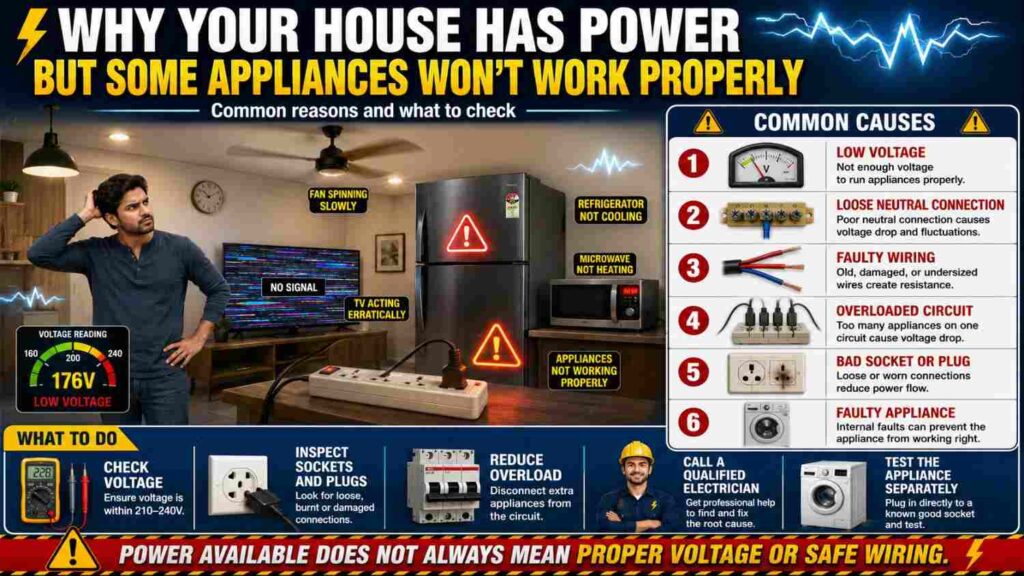
This article walks through why this happens, how to think through the possible causes methodically, and when the issue is safe to investigate yourself versus when it needs a qualified electrician.
Why “Power Is Present” Doesn’t Mean “Every Appliance Gets What It Needs”
Electrical supply to a home isn’t a single uniform thing that either “works” or “doesn’t.” Your property has multiple separate circuits, each potentially protected by its own breaker, and each appliance depends not just on a live conductor being present but on a complete, correctly functioning path: live, neutral, and often earth, all intact, all at the correct voltage, all the way from the distribution board to the appliance itself. A fault anywhere along that specific chain for one appliance can leave every other appliance in the house completely unaffected.
Most Common Explanations, From Simple to Serious
1. The Appliance Is on a Different, Tripped Circuit
The most straightforward explanation: the affected appliance simply sits on a different circuit than the ones still working, and that specific circuit’s breaker has tripped while others remain on. This is worth checking first at your distribution board before assuming anything more complex.
2. The Appliance Itself Has Failed
If an appliance stops working while everything else on the same socket or circuit continues normally, including other things plugged into the very same socket, the fault is very likely internal to the appliance rather than the household wiring. This is common, unglamorous, and usually resolved by repair or replacement rather than electrical investigation.
3. A Socket-Specific Fault
As discussed in our dedicated article on sockets that stop working while others remain fine, a break or fault partway along a radial circuit’s chain, or a fault within one specific socket, can leave that socket (and anything plugged into it) without power while neighboring sockets on nominally the same circuit continue working.
4. Voltage Imbalance Across Circuits or Phases
In homes with a three-phase supply or certain distribution arrangements, an imbalance between phases, sometimes related to a neutral fault discussed in our neutral voltage article, can cause some circuits to receive noticeably different voltage than others, potentially affecting sensitive appliances on one phase while others continue operating normally.
5. An Appliance-Specific Protective Device Has Tripped
Some appliances, particularly larger ones like water heaters or air conditioning units, have their own internal thermal cutouts, fuses, or protective devices, separate from your home’s distribution board, that can trip or blow while leaving the rest of your electrical system completely unaffected.
A Logical Troubleshooting Sequence
- Confirm what’s actually not working. Is it one single appliance, everything on one specific socket, or everything in one room or area? This distinction narrows down the likely cause significantly.
- Test the affected appliance elsewhere if practical (a different, known-working socket), to determine whether the fault travels with the appliance or stays with the location.
- Test a different, known-working appliance in the affected socket or location, to check the reverse: does a working device also fail there?
- Check the distribution board for any tripped breaker or RCD specifically associated with the affected area, even if it isn’t obviously linked to what you assumed the circuit layout would be.
- Call an electrician if the simple checks above don’t resolve or explain the issue, particularly if it involves a socket or wiring rather than a single appliance that’s simply reached the end of its working life.
A Simple Diagnostic Table
| Observation | Likely Cause |
|---|---|
| Only one appliance affected; works fine elsewhere | Appliance-specific fault |
| One appliance affected; still fails in a different socket | Appliance itself has failed |
| Everything at one socket affected; other sockets fine | Socket-specific fault |
| Everything past a certain point in the house affected | Circuit-level break or fault |
| Specific appliances dim, flicker or misbehave inconsistently across the house | Possible voltage imbalance or neutral issue |
Why This Pattern Sometimes Points to Something More Serious
While a single failed appliance is usually a mundane, appliance-level problem, a pattern where several seemingly unrelated appliances misbehave inconsistently, especially alongside symptoms like flickering lights, unusual brightness changes, or appliances in different rooms all acting strangely at once, deserves more serious attention, since it can point toward a neutral fault or voltage imbalance issue affecting your property’s broader supply rather than any single appliance’s internal fault.
How Appliance Age Factors Into the Diagnosis
When troubleshooting why one specific appliance has stopped working while everything else functions normally, its age and history are genuinely useful diagnostic context, not just incidental detail. An appliance well past its typical service life failing in isolation, with no wiring changes, no recent overload events, and no other symptoms elsewhere in the home, is statistically far more likely to simply have reached component end-of-life than to be revealing some new wiring fault that happens to coincide with its failure. Conversely, a relatively new appliance failing shortly after installation, especially if it coincides with any other unusual electrical symptoms elsewhere in the home, deserves a slightly more thorough look at the socket and circuit it’s connected to before assuming the appliance itself is simply defective.
Using a Multimeter or Socket Tester as a First Check
Before concluding an appliance itself has failed, a simple plug-in socket tester or a multimeter check (if you’re comfortable and it’s safe to do so) at the affected socket can quickly confirm whether power is actually present and at a normal voltage. This single check meaningfully narrows the possibilities: confirmed normal power at the socket strongly shifts suspicion toward the appliance itself, while an absent or abnormal reading redirects attention toward the socket or circuit instead, saving considerable time compared to guessing or immediately assuming the more complex explanation.
When It’s Worth Getting a Second Opinion
If an appliance repair technician diagnoses the appliance itself as the fault, but the same socket or circuit has a history of other issues, or a replacement appliance in the same location develops similar problems relatively quickly, it’s reasonable to have an electrician separately assess the socket and circuit rather than assuming the appliance-level diagnosis was necessarily the complete picture. Genuine coincidences do happen, but a repeated pattern at the same physical location is exactly the kind of signal worth taking seriously rather than dismissing as bad luck a second time.
How This Scenario Connects to the Rest of Your Home’s Electrical Health
A single, isolated instance of one appliance failing while everything else works fine is, on its own, rarely a signal of any broader problem worth generalized concern. But viewed alongside the other troubleshooting scenarios covered throughout this series, dead sockets, flickering, neutral voltage issues, extension box overload, this specific symptom is best understood as one node in a broader diagnostic picture. Noticing this pattern is a good prompt to briefly consider whether anything else has seemed slightly off lately, an occasional flicker, a socket that feels warm, a breaker that trips a bit more than it used to, since a cluster of minor, individually dismissible symptoms sometimes adds up to a more coherent, and more worth addressing, underlying picture than any single symptom considered in isolation.
Building a Habit of Noticing Before Symptoms Escalate
Households that develop a general habit of noticing and mentally logging small electrical oddities, rather than only reacting once something fails outright or becomes obviously dangerous, tend to catch developing issues earlier and more cheaply than those who only engage with their home’s electrical system reactively. This doesn’t require technical expertise, simply a baseline awareness of what “normal” looks and feels like in your own home, so that deviations, however minor, register as worth a second look rather than being absorbed as simply how things are.
Common Misconceptions
- “If my lights work, my whole electrical system must be fine.” Lights are typically on their own dedicated circuit, separate from socket circuits serving appliances, so a fault affecting one doesn’t necessarily affect the other.
- “One appliance not working always means an electrician is needed.” Often the appliance itself has simply failed and needs repair or replacement, unrelated to your home’s wiring at all.
- “If a few appliances misbehave, it’s always coincidence that they failed around the same time.” While possible, a cluster of unrelated appliances acting up simultaneously is also a reasonable prompt to check for a shared underlying cause like voltage imbalance.
Frequently Asked Questions
Why does my fridge work but my washing machine won’t turn on, even though both are plugged into sockets in the same kitchen?
This most often points to either the washing machine itself having failed, or the two appliances being on genuinely different circuits or sockets despite being physically close together; testing the washing machine at a different socket is a useful first step.
Can a single failed appliance damage my home’s wiring?
Generally no, properly functioning circuit protection (breakers, RCDs/RCBOs) is specifically designed to isolate a faulty appliance’s problem from affecting the broader wiring, though a serious enough fault could still stress the specific socket or connection it’s plugged into.
Should I be worried if this happens only occasionally and then resolves itself?
Intermittent issues are still worth investigating rather than dismissing, since an occasional symptom can indicate a developing fault, such as a loose connection, that hasn’t yet become a constant, obvious problem.
Is it normal for high-power appliances to sometimes trip only their own circuit while others stay on?
Yes, this is exactly how properly designed circuit protection is meant to work: isolating a fault or overload to the specific circuit involved, rather than affecting your entire home’s supply.
Final Thoughts
“Power is present but some appliances don’t work” is less a single problem than a symptom that can stem from several different, distinct causes, ranging from a simple failed appliance to a more involved circuit or supply-level issue. Working through the pattern methodically, what exactly is and isn’t affected, and testing accordingly, is the key to correctly identifying which category your specific situation falls into, and whether it’s a simple appliance repair or something warranting a proper electrician’s assessment.